

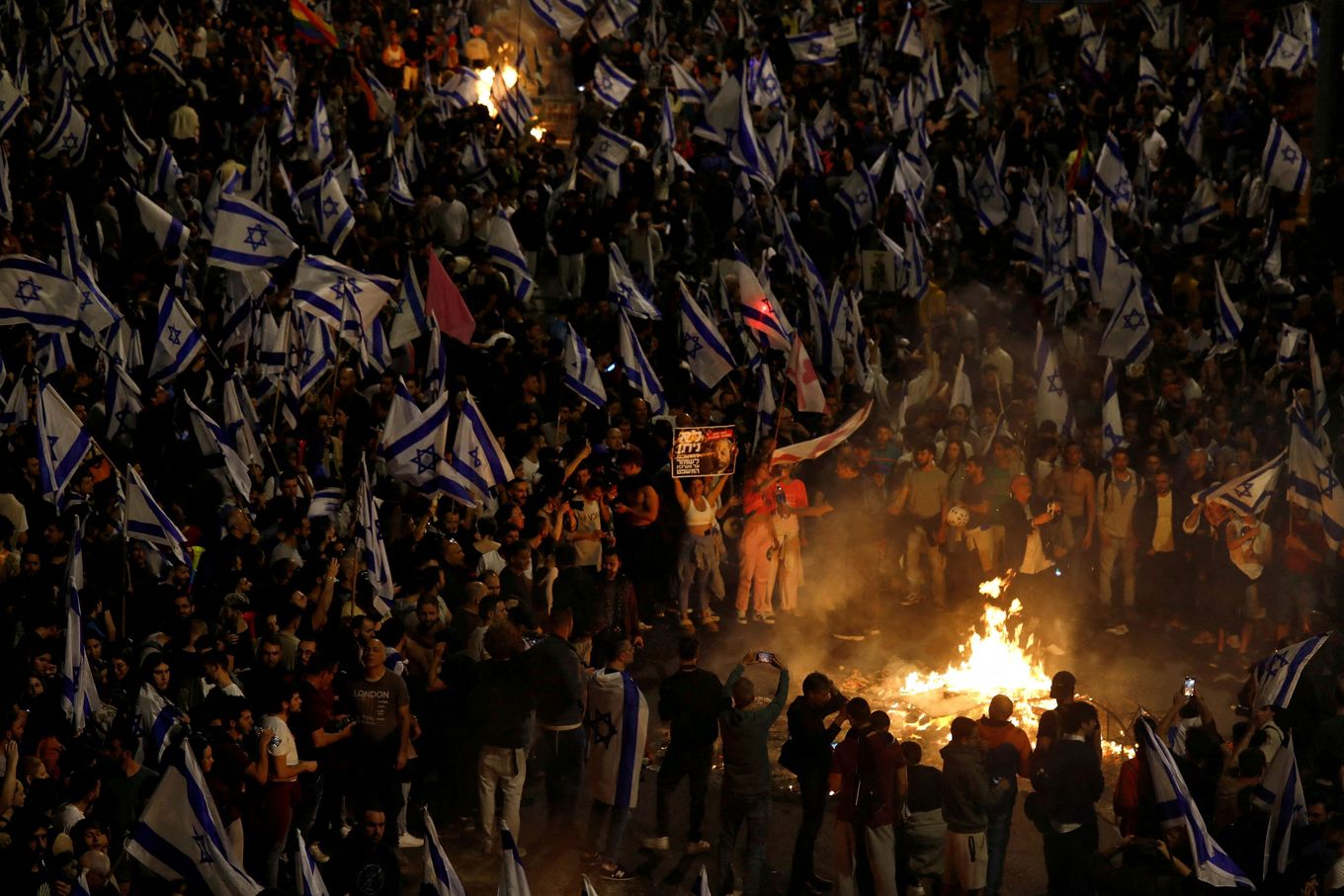
People attend a demonstration in Tel Aviv on Sunday. (Nir Elias/Reuters)
Not long after elections gave him a new mandate for power in November, Israel’s incoming prime minister won eager praise from a foreign counterpart. “What a great victory for Benjamin Netanyahu in Israel!” tweeted Hungarian Prime Minister Viktor Orban. “Hard times require strong leaders. Welcome back!”
Such a reaction was hardly a surprise. The two right-wing nationalists are birds of a feather, illiberal demagogues who have for years weaponized fears over ethnic minorities and conspiracies about liberal plots in their electoral and political battles with perceived enemies to the left. Orban, the black sheep of the European Union, has arguably taken his nation further down the illiberal path than Israel. He has bent the judiciary in his favor, cowed independent media, rejiggered elections with gerrymanders that favor his ruling party and co-opted right-wing extremists to further consolidate his power. Netanyahu looked on, perhaps admiringly; his allies even appeared to recycle the campaign imagery once used by Orban’s Fidesz party in their election race last year.
To be sure, Israel’s de facto military control over millions of Palestinianspresents a unique wrinkle — no human rights organizations have accused Budapest of implementing apartheid. But when it comes to those in Israel afforded full democratic rights, many are concerned over Netanyahu’s penchant to dip into Orban’s playbook. That was most visibly on show during the rolling crisis over the government’s attempts to overhaul the judicial system, which reached a kind of denouement Monday.
After weeks of protests against a proposed bill that would empower the government to handpick judges — protests that intensified over the weekend and led to a wave of strikes, as well as counter-protests by supporters of the government — Netanyahu announced that, “out of national responsibility,” his ruling coalition government would suspend the effort until after the Knesset returns from its Passover recess, a delay that allows for a few months of stalling and potential negotiation.
The move kicks a combustible can down the road, with both the prime minister and his coalition allies still intent on passing the legislation. It appears that in order to get far-right national security minister Itamar Ben Gvir on side with the delay, Netanyahu granted him the authority to create a new “national guard” — a potential paramilitary force under the exclusive control of one of the most extremist and racist politicians in the country.
The protest movement, meanwhile, is not ready to retreat. “The coup d’etat laws must be shelved completely,” read a statement from the Movement for Quality Government in Israel, a nongovernmental organization. “Not paused, not halted. Shelved. The suspension of the legislation looks like a cheap political exercise designed entirely to wait for a good time to bring the blitz of anti-democratic legislation back into our lives.”
Netanyahu’s opponents explicitly fear him achieving what illiberal nationalist governments in Hungary and Poland already have, where entrenched right-wing parties set about restructuring the judiciary much to the ire of colleagues elsewhere in the European Union. Over the weekend, a panel convened in Jerusalem by the Israel Democracy Institute gave the floor to a pair constitutional scholars from both European countries.
Under Orban, Hungary’s parliament enacted constitutional amendments that limited the ability of the country’s constitutional court to strike down laws and lowered the retirement age for judges, which allowed the government to appoint political allies on the bench. According to an account from the Times of Israel, Gabor Halmai, an expert of constitutional law at the European University Institute, said these moves weakened the Hungarian judiciary’s independence, “because the selection process is not only political, it lacks any kind of merit,” and the justices appointed by the Orban government “are not experts in constitutional law.”
As a result, “we have no free and fair elections in Hungary, we have no free media, we have no free civil society organizations,” Halmai said at the event.
“If you really want to capture your democracy, you always start with the most important guardrail, and this is judicial review,” said Tomasz Tadeusz Koncewicz, a law professor at the University of Gdansk in Poland, at the same gathering. “The ruling majority understood that if you have an independent court in place, the constitutional capture will never work because the constitutional court would always stand in the way.”
Tellingly, it emerged that Israeli officials had consulted with Polish counterparts as they plotted their own judicial reforms. “Of course, we are talking with Israel, and to some extent we shared our experiences in this regard,” Polish Deputy Foreign Minister Pawel Jablonski told a local radio station on Monday. “I’m telling the honest truth. Israel was interested in what was happening in Poland. We were interested in what was happening in Israel.”
In recent years, Netanyahu and his allies have found increasingly common cause with a constellation of right-wing nationalist movements elsewhere.These connections have been forged in part with the aid and support of U.S.-based right-wing Jewish organizations, including the Tikvah Fund, which is closely linked to the Kohelet Policy Forum, a secretive Israeli think tank funded by a U.S. libertarian billionaire that is seen as the guiding hand behind the judicial overhaul legislation.
Earlier this year, Amiad Cohen, head of the Tikvah Fund’s Israel chapter, called on Orban in Budapest. “The Left is crying that we are turning into Hungary,” Cohen tweeted. “Public discussion should be deep and serious, so I went over there to see what is happening and learn.”
The sense of solidarity between these conservative camps is, on one level, quite curious, given Israel’s historical animosity to the agendas of European ultranationalists. But it has also become par for the course in Netanyahu’s Israel, where a steady lurch to the right has seen the mainstreaming of the extremist settler movement and the codification of certain Jewish supremacist positions in a controversial “nation-state” law. Israel’s privileging of its Jewish identity over all others is now seen by some in the European far right as a model to be emulated, a muscular rejection of universalist doctrines and the high-minded liberalism that they despise.
While Netanyahu’s coalition was thwarted in its attempts to follow Hungary and Poland’s lead, it has time to return to the fray, inflamed in part by a growing, angry counterprotest movement. Those arrayed against them won’t back down either. “Israel isn’t Poland” was one of the protesters’ cries.
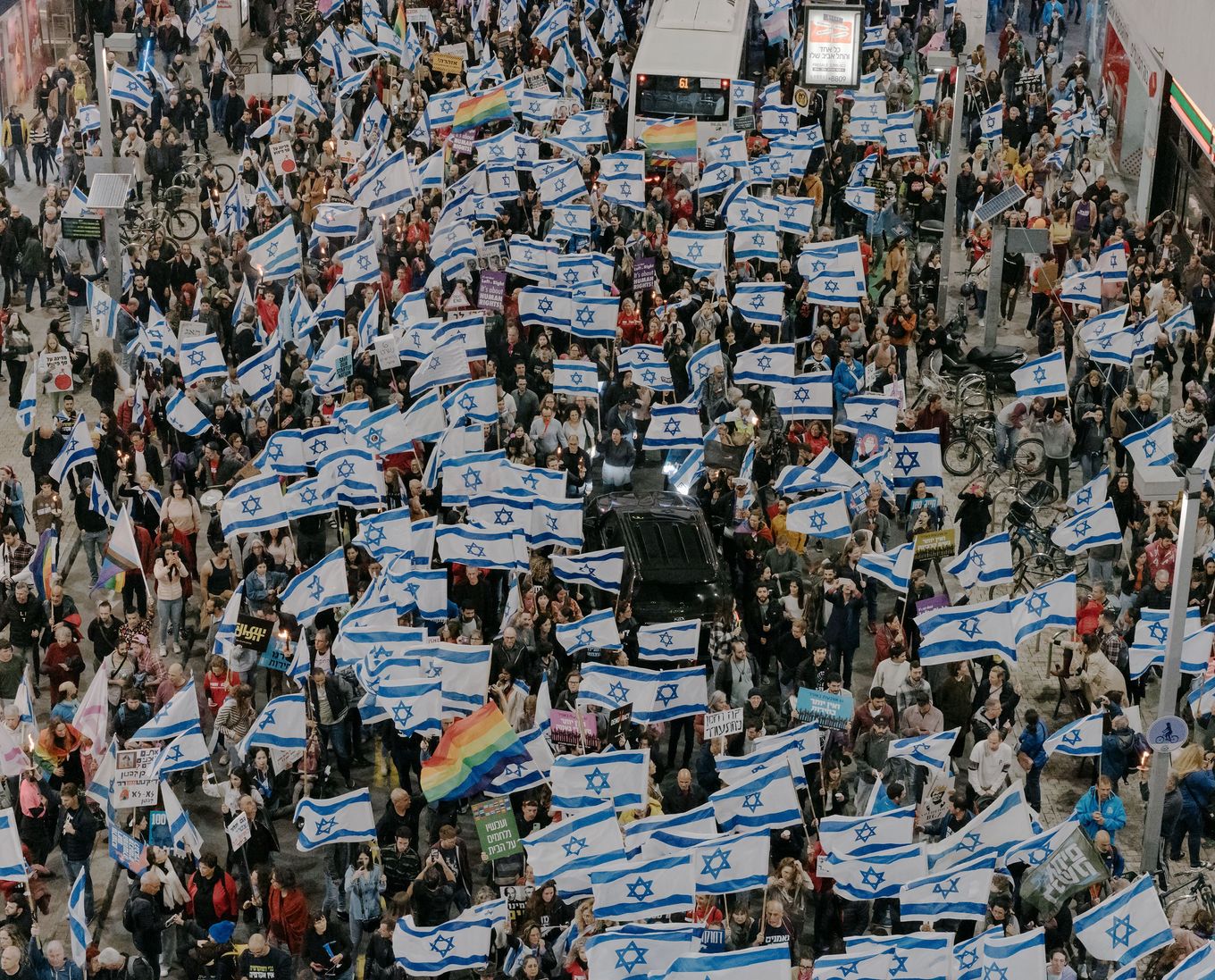
(Ofir Berman)
From Tel Aviv, my colleagues Steve Hendrix and Shira Rubin, with photographer Ofir Berman, introduce us to a few of the hundreds of thousands of Israelis out demonstrating.
Tahel Ilan Ber of Herzliya. (Ofir Berman for The Washington Post)
Tahel Ilan Ber, 35
Tahel Ilan Ber manages a biogenetics company, part of the explosion of tech innovation that has turbocharged Israel’s reputation as the “start-up nation.” But she grew up in Jerusalem, a center of ultra-Orthodox life, and is attuned to the widening split between religious and secular Israelis.
Ilan Ber has become more worried about the growing dominance of fundamentalism in public life. “We have political parties that prohibit women from running as candidates,” she said.
Already, many communities won’t allow public transportation to operate on the Saturday sabbath, and some venues won’t allow men and women to attend events together.
The push to limit the Supreme Court’s ability to curb the government would embolden the religious parties in the coalition to go further, she said. She doesn’t want her children to grow up in a “theocratic” state.
“People from the high-tech world did not used to do this,” she said of the mass protest. “But I want my daughter to be able to go to the same beach as her brothers.”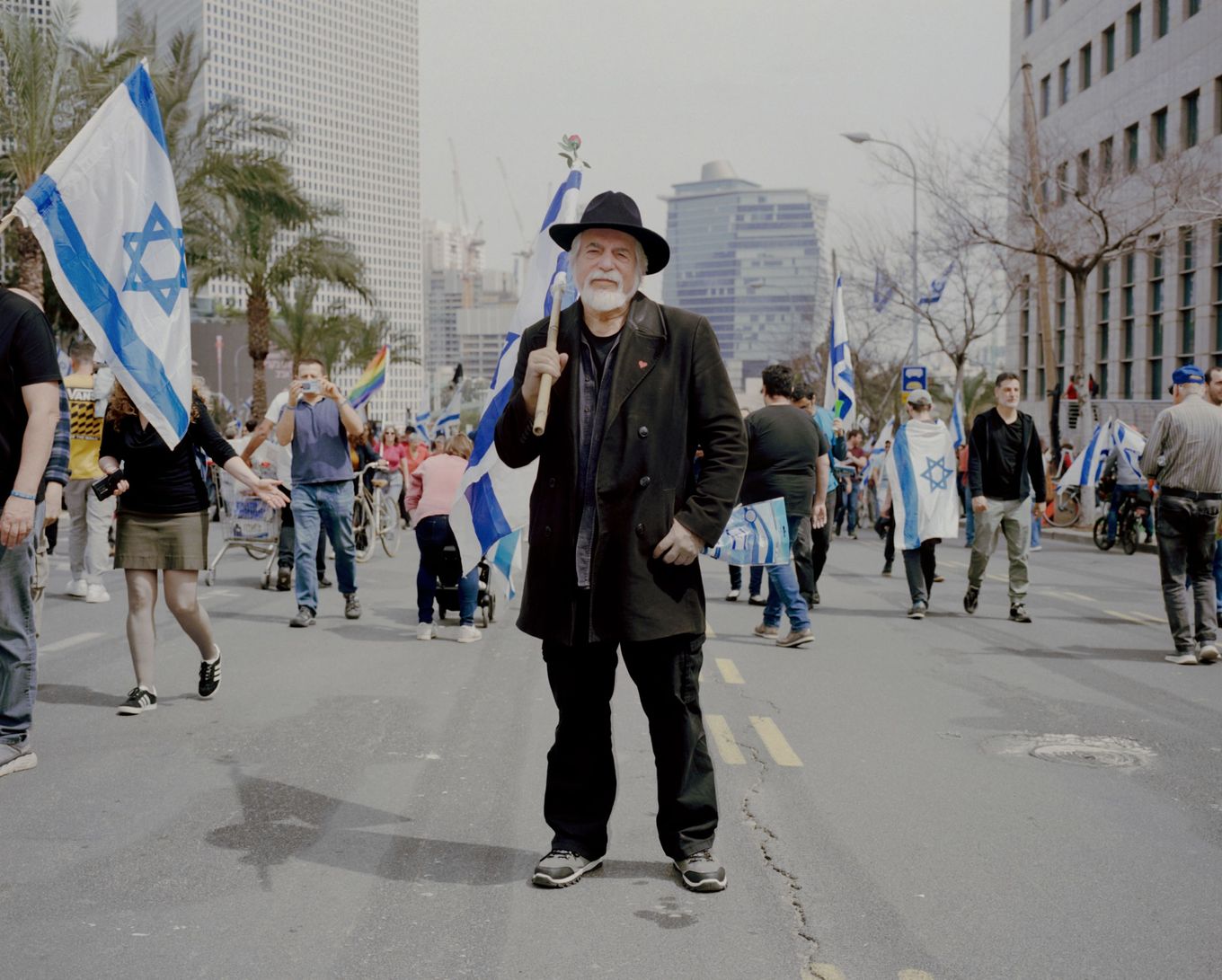
David Shalita of Jaffa. (Ofir Berman for The Washington Post)
David Shalita, 79
David Shalita is one of the thousands of protesters wearing or waving the Israeli flag.
“This is the symbol of everybody, not only the right wing,” said Shalita, a retired animated-film maker who lives in the ancient port city of Jaffa.
Shalita normally feels no need to display his patriotism. He was an active-duty and reserve soldier for more than 25 years and a paratrooper in the Golan Heights in 1968. He and his wife, Brava, have come out to demonstrate weekly, sometimes more, because he fears for the democracy that he defended with his life.
All three of their sons have long careers in the military, and all have publicly opposed the judicial overhaul. His only daughter married into an Orthodox family and moved to Jerusalem.
They remain close, he said, but “now we don’t discuss politics.”
 Centre for Nigeria Progress