

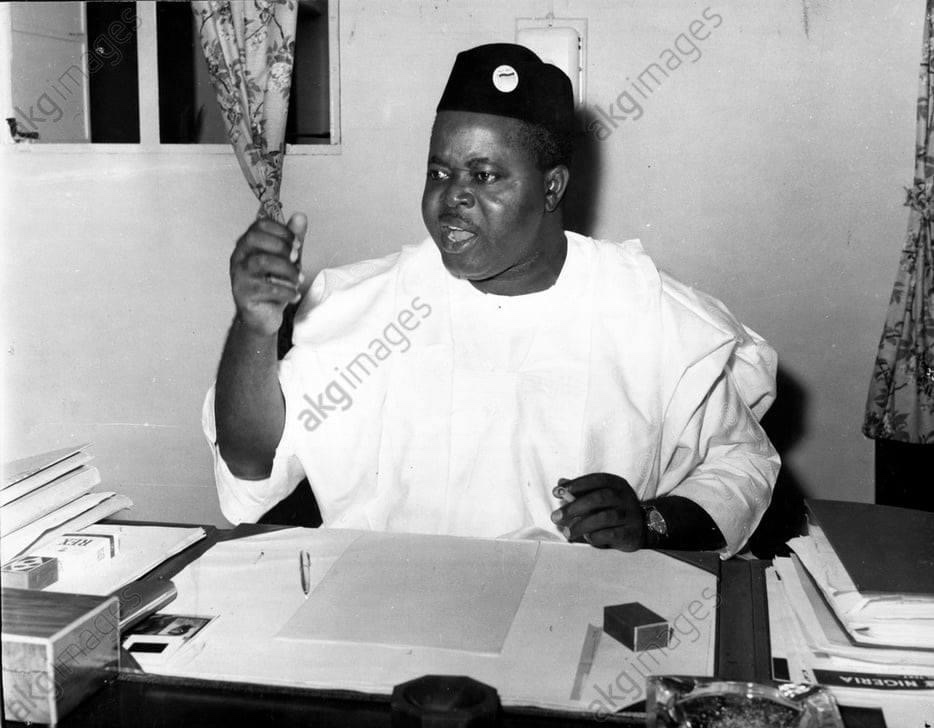
Republican Constitution, 1963
” By 1963, Balewa’s government had begun to tie together thoughts on the ills of the Independence Constitution. At the Federal Prime Ministers initiative, a conference was called in Lagos to be attended by politicians of all viewpoints (except for those who were restricted to their homes, or in jail).
The most publicized change agreed on by the conference was the creation of a Republic. In simple terms this transferred the role of Governor-General as surrogate Head-of-State (acting on behalf of the English Queen) to an indirectly elected President who would serve 5 years.
Except for its symbolic significance, to be treated in Chapter Five, this move was of far less consequence than other results of the conference. The Republican Constitution fully demonstrated Balewa’s desire to strengthen the hand of northern-led coalition by increasing the power of the parliamentary executive (Council of Ministers) while limiting the roles of Head of State and judiciary.
In spite of the protests by Nnamdi Azikiwe, already the Governor-General and likely to be chosen by the Federal Parliament as Nigeria’s first President, the chief of state’s powers were reduced. Azikiwe s view was that the office’s executive role should be expanded. The NPC leaders argued that such a change would obviously give northerners control of the office.
In the final document the presidency lost ground; ambiguities that had previously appeared to give the Governor-General some area for initiative in removing the Prime Minister were replaced by a firm statement that the Prime Minister could be dismissed only through a no-confidence vote in Parliament….
The legal realm witnessed the most serious changes brought by the Republican Constitution. A decision made earlier to abolish final appeals to the Privy Council in London was formally included, making the Nigerian Federal Supreme Court the highest court of appeal.
More important, after long argument the Judicial Services Commission was abolished, giving the Federal Prime Minister power over judicial appointments. A third procedural change in the area of law was attempted, but the provisions of the Preventive Detention Act failed because of popular opposition….
These political wars led to a rearrangement of Nigeria’s party coalitions.
In 1964, the main contestants gathered for what was to be the last major event of Nigeria’s short period of democratic experiment. New political party alignments were creating the very situation most feared by northern leaders.
Up to that time, the Ibo-dominated NCNC had served as junior partners in the federal coalition, whose main victims had been Awolowo and his Yoruba followers.
Now the census fiasco convinced Okpara that alliance with the Hausa-Fulani was untenable. Angered by Akintola’s support of the revised 1964 census results (an issue which should have united all southerners) Okpara influenced NCNC participants in Akintola’s Western Region government to leave the regional coalition.
Okpara’s NCNC then formed the United Progressive Grand Alliance (UPGA) consisting of NCNC, Awolowo’s AG, and northern minority and opposition parties. The sole basis of this alliance was anti-northern feeling.
The UPGA confronted a new coalition, the Nigeria National Alliance (NNA) headed by NPC and including Akintola’s segment of Yoruba, then known as Nigerian National Democratic Party (NNDP), plus several other small southern parties opposed to NCNC.
Elections which occasioned these plans and alliances were to be held on the federal level in December 1964, and in Western Region a year later. At first, UPGA anticipated victory, if electoral malpractice could be kept down.
But as UPGA affiliates controlled only two of the four regional governments (the East and Midwest) and victory in all three southern regions was a requisite for ousting the northerners from control of the Federal Government, there was a reason to be anxious.
After observing several real and imagined abuses, UPGA ordered a boycott of the elections. Because the regional governments were responsible for electoral machinery in their regions, the UPGA boycott was successfully carried out in most of their constituencies.
In March 1965, the federal government held elections in those regions in spite of the boycott, but the UPGA leaders had successfully undercut any emotional support which might have been awarded the victors.
Both the Yoruba and Ibo grew progressively more sullen during these events. The undermining of public confidence in the motives of the federal government was completed by the regional election which followed in the West.
NNDP victory, owing heavily to the ability of the despised Akintola government to manipulate electoral machinery, combined with falling cocoa prices to produce virtual chaos there by the year’s end.
By December 1965, Nigeria was on the brink of collapse.
- Change In Eastern Nigeria, March 1962 – “I’m satisfied with my cabinet,” says Dr. Michael Okpara, winner of the elections. In what political direction is Eastern Nigeria moving? Just over a year ago many Nigerians, hearing that Dr Azikiwe was leaving the party to become the Governor General of Nigeria, forecast that the National Council of Nigeria and the Cameroons would weaken and break up after his withdrawal. But the success of the NCNC in the general elections in Eastern Nigeria last November has shown that the party is still a force to reckon with in its own right.
 Centre for Nigeria Progress