


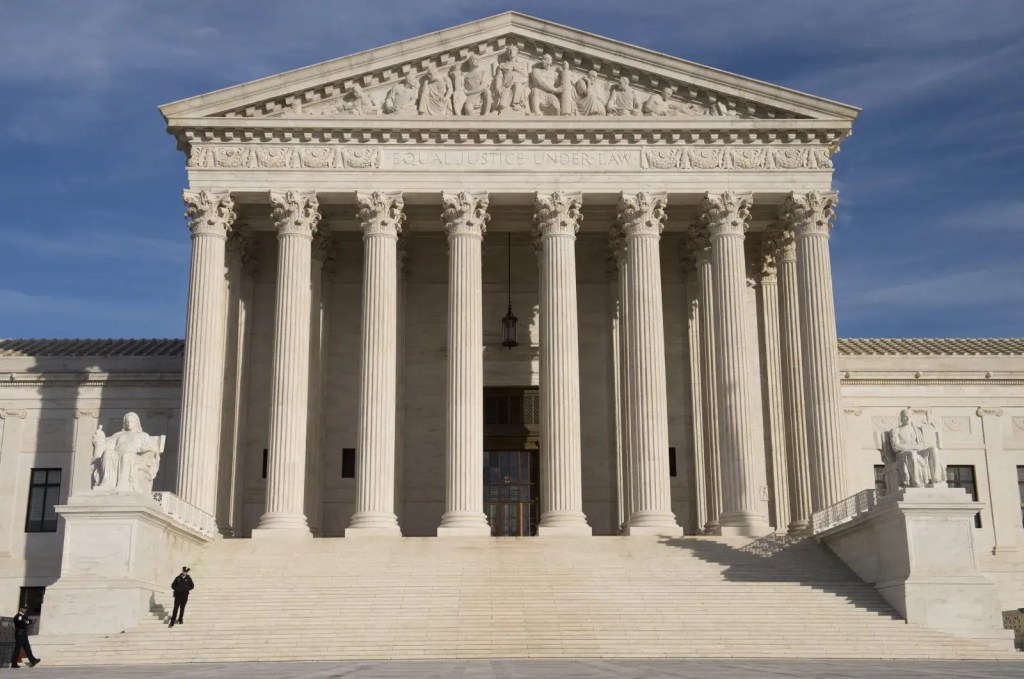
The U.S. Supreme Court will reargue Louisiana v. Callais on October 15, an unusual move that signals the justices may revisit the extent to which states can use race to protect minority voting power.
At stake is whether creating majority-Black districts under the Voting Rights Act violates the Constitution—a decision that could redefine federal voting protections and alter redistricting nationwide.
The Supreme Court’s upcoming decision in Louisiana v. Callais could determine how far states may go to protect minority voters under the Voting Rights Act of 1965 (VRA). The outcome could determine whether creating majority-Black districts to avoid diluting Black voting power violates the Constitution’s ban on race-based discrimination.
The ruling could reshape redistricting nationwide, affecting how states draw congressional maps, the future strength of the VRA, and the balance of political power heading into the 2026 midterm elections and beyond.
What To Know
Section 2 of the VRA prohibits any voting practice or districting plan that results in racial or language-minority voters having less opportunity than others to participate in the political process and elect candidates of their choice.
The dispute, consolidated with Robinson v. Callais, stems from Louisiana’s 2022 redistricting and raises fundamental questions about how states balance the protection of minority voters with constitutional limits on race-based decision-making.
At the center is Louisiana’s congressional map known as Senate Bill 8, adopted after a federal court ordered creation of a second majority-Black district to remedy “vote dilution” under Section 2. That court later struck SB8 down, concluding it amounted to a racial gerrymander that “violates the Equal Protection Clause” of the Fourteenth Amendment.
Two of Louisiana’s six congressional districts are now majority-Black, roughly matching the state’s one-third Black population; earlier maps had only one.
The Supreme Court first heard arguments last term but has not yet issued a decision. Instead, the justices ordered a rare reargument and added a new question: whether intentionally creating a second majority-minority district to comply with the VRA itself violates the Fourteenth or Fifteenth Amendments.
That reframing suggests some justices are prepared to revisit how far Section 2 can go in requiring race-conscious remedies.
Justice Clarence Thomas has been openly skeptical of the Court’s Section 2 precedents.
In a June dissent when the Court delayed ruling, he wrote, “Where this Court’s interpretation of §2 breaches the Constitution’s equal protection guarantee, the Constitution controls,” arguing current doctrine effectively requires “a ‘proportional allocation of political power according to race,’” even when the link to past discrimination is weak.
The Timing Underscores the Stakes
The Supreme Court’s new term began on October 6, and redistricting outcomes could shape Congress for years.
Former U.S. Attorney Joyce Vance warned in a Substack post that “if the Court rules in favor of white voters, in combination with…unprecedented mid-century map redrawing, Republicans could secure majorities in Congress…for a generation.”
Louisiana’s own position has shifted.
The state initially defended adding a second Black district, but now argues that “all race-based redistricting is unconstitutional.”
Plaintiffs challenging SB8 contend the legislature’s focus on creating a Black opportunity district amounted to racial discrimination against white voters. Supporters of Section 2 argue that the law remains essential to prevent vote dilution and ensure that minority voters can elect candidates of their choice.
Critics argue the Court’s precedents have pushed states into racial balancing, and the Callaisreargument squarely presents that tension.
The Court’s Broader Shift
The Court’s approach to voting rights has been evolving. In Shelby County v. Holder (2013), Chief Justice John Roberts wrote the opinion striking down the VRA’s Section 5 preclearance formula, reasoning that “things have changed dramatically” in the South.
Section 2 remained as a nationwide ban on discriminatory voting practices, but later rulings narrowed it: In Brnovich v. Democratic National Committee (2021), the Court made proving Section 2 violations harder, and Allen v. Milligan (2023) temporarily reinforced Section 2 by requiring Alabama to add a Black district, but Thomas and others dissented.
This term’s Callais case could push further.
By reframing the question to focus on whether race-based districting itself violates the Constitution, the Court may establish new limits on when states can use race to comply with the VRA.
A decision sharply restricting such remedies would mark another retrenchment of the central statute of the Civil Rights era.
Other States Are Watching Closely
If the Court rules that majority-minority districts are constitutionally suspect, challenges could follow in states that recently redrew maps under Section 2 settlements.
The political control of the House could hinge on the outcome, as several southern seats were added or reshaped under standards now at risk.
The October and November calendars show the term’s wide stakes—cases on LGBTQ+ rights, presidential powers, and regulatory authority join Callais—but voting rights remain central.
Justice Ketanji Brown Jackson has emphasized the Reconstruction-era purpose of the Fourteenth and Fifteenth Amendments, noting that their drafters aimed “to secure rights of formerly enslaved people.”
How that historical view resonates with the current majority could shape the Court’s direction.
What People Are Saying
Justice Clarence Thomas, on the Voting Rights Act’s tension with the Constitution in June 2025:“States do not know how to draw maps that ‘survive both constitutional and VRA review,’” and on the importance of deciding redistricting cases quickly in his dissenting opinion in Louisiana v. Callais, said: “Congress requires this Court to exercise jurisdiction over constitutional challenges to congressional redistricting, and we accordingly have an obligation to resolve such challenges promptly.”
Former Louisiana Governor John Bel Edwards, on vetoing the map of Louisiana redistricting in February 2022: “This map is simply not fair to the people of Louisiana and does not meet the standards set forth in the federal Voting Rights Act. The Legislature should immediately begin the work of drawing a map that ensures Black voices can be properly heard in the voting booth. It can be done and it should be done.”
Louisiana Governor Jeff Landry, opening the first special session on court-ordered redistricting, said January 16, 2024: “These maps will satisfy the Court…and ensure that the congressional districts of our State—are made right here in the Legislature and not by some heavy-handed member of the Federal Judiciary.”
What Happens Next
The Supreme Court will hear reargument in Louisiana v. Callais on October 15, after asking lawyers to address whether creating majority-Black districts to comply with the Voting Rights Act violates the Constitution’s ban on racial discrimination.
Once arguments conclude, the justices will deliberate and issue a decision by June 2026.
That ruling could reaffirm states’ ability to use race to avoid diluting minority voting power, restrict or redefine the Voting Rights Act’s protections, and trigger new map-drawing and lawsuits ahead of the 2026 midterms, potentially shifting political representation nationwide.
 Centre for Nigeria Progress