

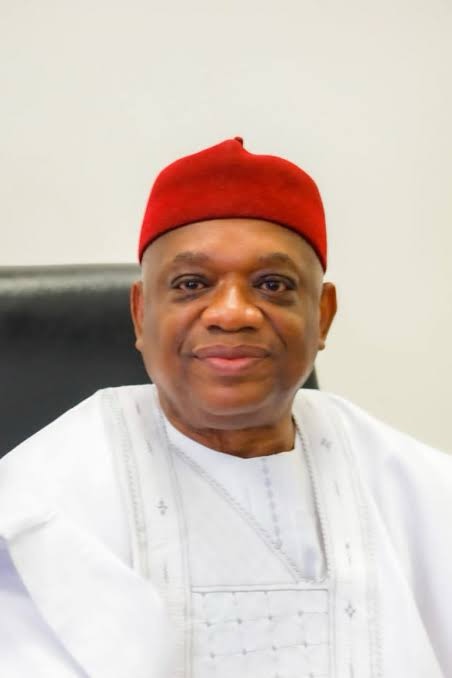

Orji Uzor Kalu’s continued relevance in Nigeria’s politics reveals a deeper story — about political recycling, national amnesia, and the culture of immunity that keeps old politicians forever young in power.
If Nigeria were a reality show, Orji Uzor Kalu would be one of its longest-running cast members — unvoted, unbothered, and unretired. Each time the audience gasps, “Surely, this is his last episode,” he pops up in another scene, smiling beside a president, hugging a senate president, or offering unsolicited advice on national unity. The man is a political cat with nine lives — and possibly a few spare ones stashed in Abia.
1. The Art of Political Survival
Orji Uzor Kalu’s continued presence in Nigeria’s political space is a masterclass in adaptation. He has changed political parties more times than some Nigerians have changed phone networks. From the PDP to PPA to APC, and whatever acronym sounds promising next, Kalu has remained relevant by perfecting one trick — never stand still long enough for a scandal to catch you.
When others run from political storms, Kalu simply changes umbrella. In a country where ideology is optional and defection is an Olympic sport, he’s a gold medallist.
2. The Nigerian Tolerance for the Familiar
Nigerians have an astonishing ability to recycle their politicians — perhaps out of nostalgia, or perhaps out of collective amnesia. Once a name is known, it’s as if it cannot be deleted from the national political playlist.
Even after his conviction for corruption and the brief vacation to Kuje Correctional Centre, he returned to the Senate as if nothing happened. Nigerians greeted him not with protest, but with resignation. “Na so this country be,” we said — and carried on.
3. The Immunity of Influence
In Nigeria, political influence is like an invisibility cloak. Once you’ve been a governor, you gain immunity not just in office, but in perpetuity. Kalu has networks — from his days as Abia’s helmsman, through his media empire, to his connections in every ruling party since Obasanjo. These connections don’t just protect him; they recycle him.
He understands the system — how to flatter it, feed it, and when to fight it. And the system, being a sentimental old creature, keeps him around.
4. The Poverty of Political Alternatives
The real reason Kalu and others like him remain in public space is not because they are particularly exceptional, but because the competition is catastrophically poor. Nigeria’s political system has become a gated estate where the old guards hold the keys — and the youths, busy posting quotes on X (Twitter), are too divided to build a new gate.
So the same names keep returning, like political reruns. Orji Uzor Kalu is simply one of the most enduring episodes in that never-ending season.
5. The Culture of Forgiveness (Without Reform)
Nigerians are forgiving — sometimes excessively so. A man could mismanage a state, face corruption charges, and still be welcomed at national prayers. We believe in second chances, third chances, and infinite redemption arcs.
Kalu has mastered this national weakness. His rebranding always comes with a tone of contrition and patriotism: “I only want to serve Nigeria.” And we, eager to believe in miracles, let him back in.
6. The Media Machine
Let’s not forget that Kalu owns The Sun newspaper — one of Nigeria’s loudest platforms. In a country where controlling the narrative is half the job, having a media house means you never truly leave the stage. Every week, there’s a glowing editorial about his latest “visionary” statement or a headline that quietly keeps his name alive.
The rest of us may have moved on, but his newspaper ensures we never really do.
Conclusion: The Man, the Myth, the Meme
Orji Uzor Kalu’s continued presence in Nigeria’s public life is not about brilliance or even resilience — it’s about the Nigerian system itself: a political recycling plant that never runs out of old materials.
Until Nigerians decide that politics should be about service, not survival; integrity, not influence — figures like Kalu will remain fixtures. They are symptoms, not the disease.
For now, Kalu will keep smiling at the cameras, dropping press statements, and reminding us that in Nigeria, once you enter the public space, it’s almost impossible to leave.
 Centre for Nigeria Progress