


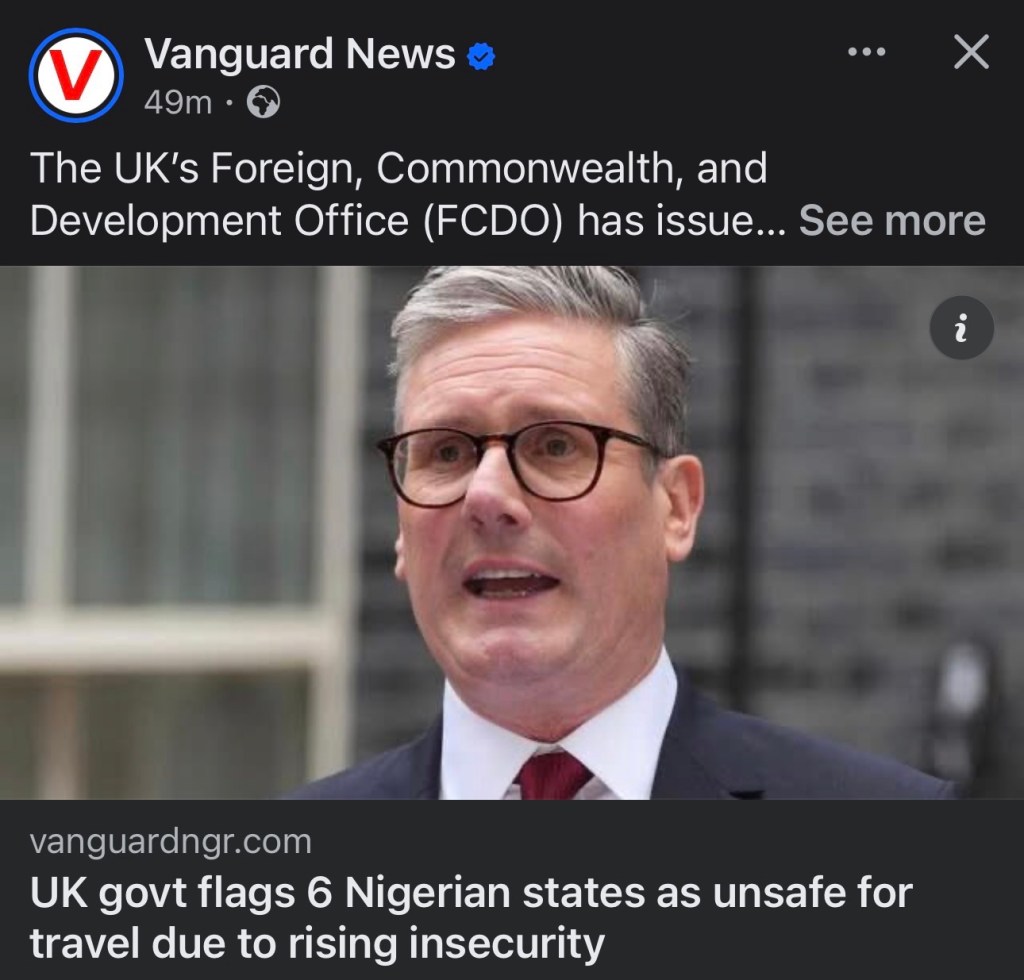
It was a story that spread through the Nigerian digital landscape with the speed of a wildfire fanned by a Harmattan wind. Headlines blared, social media posts multiplied, and talk show hosts dissected the latest “security alert”: the British government, in an official advisory to its citizens, had declared 12 states in Nigeria unsafe for travel.
The glee was palpable. Not the glee of a people receiving vital, new information from their own protectors, but the perverse glee of the messenger who relishes the drama of the message, regardless of its source or intent. In this unsettling episode, we witnessed a profound national pathology laid bare: a crippling intellectual dependency where the pronouncements of a former coloniser are treated as gospel truth, eagerly echoed by a press that has forgotten its primary duty is to its own people.
Let us be clear on the sequence of events. The Nigerian government, through its own security apparatus, did not issue a sweeping, public proclamation declaring these 12 states as official no-go zones. The Nigeria Police Force did not hold a press conference to announce a collective collapse of law and order in these regions. The warning came from outside. It was crafted in Whitehall, designed for British passports, and predicated on British risk assessments. And yet, our media houses, like obedient town criers, restated this external verdict as breaking news to the very people living in those states.
One must ask: why this unwavering echo? Why does the British sneeze and the Nigerian press catch a cold? The answer lies in a deep-seated inferiority complex that remains the most damaging legacy of colonialism. It is the unshakable belief that the West, particularly our former colonialists, has a clearer lens, a more objective analysis, and a higher standard of truth than we ourselves can muster. It is an astounding admission of intellectual surrender.
This is not merely about hurt pride. This is about information warfare. Nations like the UK and the US are not simply offering travel tips; they are meticulously preparing the ground for future actions. When they consistently paint a picture of a nation perpetually on the brink in specific regions, they are building a narrative archive. This archive will be referenced to justify future travel bans, economic sanctions, or even, when it suits their strategic interests, military “humanitarian” interventions. This is their long walk to a war against your sovereignty, and unpatriotic Nigerian news outlets, by parroting these warnings without critical context, are laying the paving stones for them.
The advisory itself, stripped of its diplomatic language, is a masterpiece of arrogant generalization. It tars vast, diverse regions with the same brush of peril, disregarding the local realities, the efforts of local security agencies, and the millions of Nigerians living their lives in these states. Our press does not challenge this. It does not juxtapose the warning with on-the-ground reports from its own correspondents. It does not question the political and economic motivations behind such advisories. It simply repeats, thereby legitimising a foreign government’s simplistic and often damaging perspective to its own citizens.
This phenomenon forces a painful historical reflection. One has always wondered how a handful of British men, vastly outnumbered, were able to conquer and colonise the vast, populous, and diverse territories that became Nigeria. The answer was never solely in the Maxim gun. It was in the manipulation of existing divisions, the co-opting of local intermediaries who saw more benefit in serving the new power than in unifying against it, and the imposition of a narrative that framed the coloniser as the superior, civilising force.
Today, we see a modern, digital-era parallel. We are a nation of lions—resilient, resourceful, and powerful—being led by donkeys in newsrooms and editorial boards who lack the strategic vision and patriotic courage to frame our own story. They have traded their role as the nation’s watchdog for the role of the West’s megaphone.
Until the Nigerian media finds the courage to decouple its news agenda from the risk assessments of Western embassies, until it invests in its own investigative capacity and trusts its own analysis over that of a foreign government, we will remain a colony of the mind. The battle for true sovereignty is not just fought on the physical battlefield; it is won in the headlines, on the airwaves, and in the refusal to let others define our reality.
 Centre for Nigeria Progress