


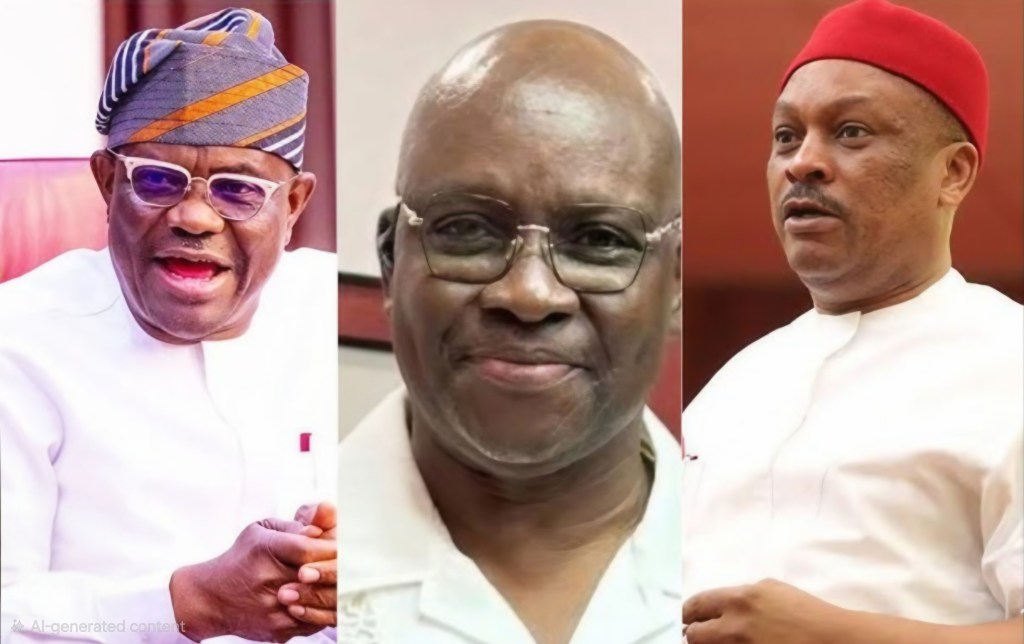
If Nigerian politics feels like a relentless, high-stakes drama right now, you’re not mistaken. While the nation fights tangible insurgents in the bushes, a different kind of insurgency is tearing through the halls of power in Abuja. The main opposition, the Peoples Democratic Party (PDP), is engaged in a civil war, and the ruling All Progressives Congress (APC) isn’t just watching from the sidelines—it’s actively fanning the flames.
The stage is set for a fundamental political realignment, one where the APC seeks nothing less than total dominance, mirroring its iron-clad control of Lagos State on a national scale. But is this a masterstroke destined for long-term success, or is it a fragile empire building on sand?
Nyesom Wike: The PDP’s Insider Insurgent
The most captivating plotline in this drama features Nyesom Wike, the pugnacious FCT Minister. Once a PDP stalwart, Wike is now acting as a de facto fifth column within the opposition. His strategy is pure political guerrilla warfare: disrupt, destabilize, and dismantle from the inside.
The PDP is now a house divided against itself, split into two clear factions:
· The Mainstream PDP: Led by figures like Governor Seyi Makinde and the newly elected National Chairman, Kabiru Turaki, this group has taken the nuclear option. They’ve expelled Nyesom Wike and his allies for “anti-party activities” following their national convention in Ibadan. Their goal is to reclaim the party’s identity and mount a credible opposition.
· The Wike Faction: Operating through the National Secretary, Sam Anyanwu, this group dismisses the Ibadan convention as an “illegal jamboree.” They’ve attempted to hold parallel meetings and have been involved in physical clashes over control of the party’s secretariat, a scene recently cordoned off by police amid tear gas and violence.
Wike’s endgame seems clear: it’s him, or there is no PDP. By keeping his former party perpetually off-balance and consumed with internal squabbles, he ensures it cannot effectively challenge the government in which he now holds a powerful cabinet position.
Tinubu’s Bushfires: The APC’s Strategy of Total Absorption
While Wike plays the insurgent, President Bola Tinubu and the APC are playing the long game of strategic consolidation. Their goal is not merely to win elections but to create a political landscape where competition is suffocated. This isn’t about winning the battle; it’s about ensuring there is no one left to fight.
Their tactics are multifaceted:
1. Co-optation of Rivals: The appointment of Wike, a top PDP figure, as FCT Minister was a political masterstroke. It removed a formidable adversary from the opposition bench and placed him inside the government, where his energies are now directed against his old party. As Wike himself has boasted, the PDP “will not stand a chance” against Tinubu in 2027.
2. Projecting Inevitability: Nigeria’s Minister of Information, Mohammed Idris, has publicly projected that the APC will control 30 of Nigeria’s 36 states by 2026. This isn’t just a prediction; it’s a statement of intent designed to demoralize opponents and encourage a bandwagon effect.
3. A Subtler Form of Control: Analysts point to the use of “soft repression”—the alleged selective application of legal and state apparatus to pressure opposition figures into defection, all while maintaining plausible deniability.
The Lagos Playbook, Scaled Nationally
For those familiar with Nigerian politics, this strategy feels eerily familiar. It is the “Lagos Model,” perfected by Tinubu over the past two decades, now being deployed on a national scale. In Lagos, the APC (and its predecessor alliances) created a political machine so dominant that opposition became virtually irrelevant. The goal is to replicate this across the country, creating a de facto one-party state.
The Cracks in the Fortress: Why Total Dominance May Be Fragile
However, history teaches us that oversized political coalitions in Nigeria are often more fragile than they appear. The APC’s very success may be planting the seeds of its own future crisis.
· The Problem of Too Many Winners: The APC is becoming a “broad church” filled with politicians of all stripes, including former rivals. This influx creates intense internal strain. Who gets the coveted gubernatorial or presidential tickets in 2027? The old guard or the powerful new defectors?
· The Inevitable Flashpoint: The primary elections for the 2027 polls will be the ultimate test. When a handful of tickets must be divided among a crowd of heavyweights, the result is often a bitter, explosive internal war. The losers in these battles may well become the nucleus of a new opposition exodus.
· A Precedent from the Past: Let’s not forget that the PDP itself once dreamed of ruling for 60 years. Its expansive coalition, which once seemed unbreakable, ultimately collapsed under the weight of its own internal contradictions and elite defections in 2015.
The Final Word
The current political landscape is defined by Wike’s insurgency within the PDP and Tinubu’s strategic bushfires against all opposition. In the short term, the APC’s path to total dominance seems clear and largely unchecked.
But Nigerians have seen this story before. The very forces of co-optation and expansion that bring short-term strength can create the internal pressures that lead to long-term collapse. The question for 2027 may not be whether the opposition can unite, but whether the APC’s sprawling empire can hold itself together.
 Centre for Nigeria Progress