


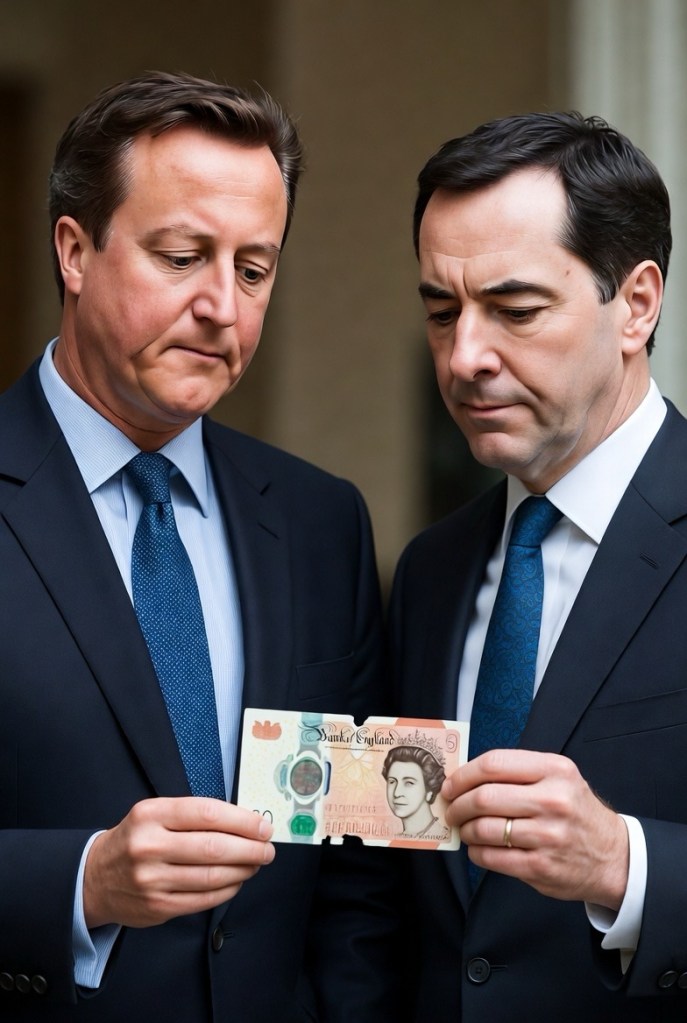
The political obituaries have been written many times, but the patient refuses to die. The United Kingdom, a political entity forged over three centuries of union, now finds itself in a protracted, painful, and paradoxical labour. The midwives presiding over this fraught delivery were not radicals, but establishment figures: David Cameron and George Osborne. The child they helped bring into the world, squalling and disruptive, was the premiership of Boris Johnson. And now, in a stunning political irony, that child may be the force that finally midwives the arrival of Nigel Farage’s ultimate influence and the potential implosion of the UK itself.
Cameron and Osborne, the smooth heirs to Blairite modernisation, believed they could manage the UK’s contradictions with a blend of economic austerity and social liberalism. Their fatal miscalculation was treating Euroscepticism as a manageable fringe concern, a card to be played in intra-party games. Cameron’s decision to hold the 2016 referendum was not an ideological crusade but a tactical manoeuvre designed to unify the Conservative Party and see off the threat of UKIP. Osborne’s project of “the austerity state” meanwhile, created a fertile ground of disaffection—in hollowed-out towns and a generation feeling robbed of its future—where the simple, potent message of “Take Back Control” could take root like a weed in cracked concrete.
They midwifed a new political reality not by design, but by accident. They opened the door to a style of politics where truth was elastic, where complex institutions could be scapegoated, and where English nationalism was unleashed as a legitimate force within the mainstream. Into this new delivery room strode Boris Johnson, the perfect progeny of their miscalculation. He was the man who could weaponise the grievances they had inadvertently amplified, wrap them in the Union Flag and Latin quips, and—crucially—deliver the electoral victory that had eluded Farage.
Johnson’s 2019 triumph, sealing Brexit and redrawing the electoral map with his “Red Wall” landslide, was the apparent culmination. But it was not an end; it was a transfer of power. Johnson’s tenure normalised political bombast over detail, personalised the state in one figure, and, most damagingly for the Union, treated “Getting Brexit Done” as an English imperative that overrode the delicate, devolved sensibilities of Scotland and Northern Ireland.
Now, as the Conservative Party he leaves behind fragments into warring factions, the spectre at the feast is no longer just UKIP, but its spiritual successor: Reform UK, and its indefatigable prophet, Nigel Farage. Farage no longer needs to be Prime Minister; he has achieved something more profound. He has become the definitive frame of reference. The entire Conservative Party now operates in the shadow of his arguments on immigration, net zero, and “woke” culture. He is the political lodestar, pulling the centre of gravity relentlessly to the right. In this election and beyond, the Tories are not fighting Labour alone; they are fighting to avoid being replaced as the standard-bearer of a Farageist realignment.
And here lies the ultimate implosion. This realignment is not a British project; it is an overwhelmingly English one. The political revolution Cameron and Osborne set in motion has accelerated centrifugal forces that threaten to unravel the centuries-old Union. Scotland, having voted overwhelmingly to remain in the EU, now sees a Westminster political class consumed by debates framed by Farage—a man who embodies the English nationalist sentiment many Scots reject. Northern Ireland’s fragile peace and place in the Union have been treated as a negotiating counter in the Brexit game Johnson championed.
The United Kingdom as we have known it—a multinational state with a sometimes grudging but enduring solidarity—is in its twilight. Its potential end is not being midwifed by Scottish nationalists alone, but by an English political revolution that began in the Cameron-Osborne salons, was birthed in the chaotic theatre of the Johnson premiership, and is now reaching its logical, disruptive conclusion under the long shadow of Nigel Farage. They sought to manage a party, and in doing so, they set in motion the unmanageable unravelling of a nation. The midwives, gazing upon their creation, may finally understand that they have delivered not a new Britain, but its protracted and perilous dissolution.
 Centre for Nigeria Progress