


In the months before the 2023 general election, Nigeria experienced what theologians would classify as a minor miracle: agreement among politicians. Peter Obi agreed. Atiku Abubakar agreed. Bola Ahmed Tinubu agreed. Even the petroleum marketers — professional parasites — agreed.
Petrol subsidy had to go.
Not because of economic enlightenment, but because subsidy had become Africa’s most lucrative fictional genre. Nigeria was paying trillions for petrol that never arrived, ships that never docked, and companies that existed only between “Ltd” and “RC Number Pending.” A whole underground economy emerged — not in fuel supply, but in paperwork. The real refineries were printers in Lagos and Abuja.
Then Bola Ahmed Tinubu won the election and decided to perform governance like an ambush.
Without ministers. Without an economic buffer. Without consulting the National Economic Council. Without warning the people. Tinubu casually announced subsidy removal on inauguration day, like a man cancelling DSTV because Arsenal lost again. The country went into shock. Transport prices quadrupled. Food prices sprinted. Salaries stood still, watching in disbelief.
But don’t worry — someone benefited.
The governors.
Under the watchful eye of Babajide Sanwo-Olu, Hope Uzodinma, Dapo Abiodun, Seyi Makinde, Nyesom Wike (now wearing a federal agbada of confusion), and the rest of the Governors’ Forum Investment Club, subsidy “savings” arrived. And promptly disappeared. Tinubu removed subsidy from the poor and introduced direct cash transfers to thieves.
The economy bled. The people groaned. The governors smiled.
Yet this mess has older roots. In 1973, during the oil boom under General Yakubu Gowon and his successors in uniform and babanriga, Nigeria snapped the link between citizens and government revenue. Taxes became decorative. Oil money took over. Accountability died quietly.
A new Nigerian philosophy was born: government money no be anybody money. Corruption was no longer theft — it was redistribution without consent. Nigerians felt bad roads and bad hospitals, but not the pain of paying for them. Democracy without taxation is like marriage without fidelity — noisy, expensive, and meaningless.
This is where tax reform should have been Tinubu’s redemption arc.
But Tinubu is incapable of doing the right thing cleanly. There must always be a whiff of forgery. A hint of illegality. A faint smell of “how far now?”
The National Assembly — led by obedient foot soldiers like Godswill Akpabio and Tajudeen Abbas — passed the tax bills. Tinubu assented. The final step was gazetting. Clerical work. Simple. Foolproof.
That’s where the crime scene began.
The laws gazetted were not the laws passed.
Somewhere between the printer, the presidency and the Federal Gazette, the laws shape-shifted. Clauses were altered. Provisions were rearranged. Legal sleight of hand occurred. An illegality was birthed — not by accident, but by clever stupidity.
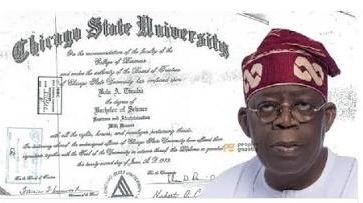
This is the same Tinubu whose academic records perform vanishing acts, whose certificates inspire more litigation than learning, and whose relationship with documentation is best described as fluid. So nobody should be shocked.
What makes this unforgivable is that Tinubu controls the National Assembly like a remote-controlled toy. If he wanted amendments, Akpabio would have read them out loud with pride, Abbas would have nodded vigorously, and the bills would have passed in record time. But no. Why obey due process when you can outsmart it?
The result? Nigeria is not debating taxation. We are debating illegality. We are not discussing who should pay more or less. We are arguing about forged gazettes. Again.
This is not opposition sabotage. This is self-inflicted stupidity.
Tax reform could have transformed Nigerian politics. Elections would revolve around economic choices. Politicians advocating higher taxes would explain what Nigerians get in return. Those advocating lower taxes would explain how infrastructure will magically appear. Voters would demand value. Accountability would become unavoidable.
Bread-and-butter politics.
Instead, Tinubu has turned a necessary reform into another courtroom drama — Nigeria’s favourite genre after corruption and condolences.
The tragedy is simple: Bola Ahmed Tinubu has the correct diagnosis, the correct prescription, and the absolute worst bedside manner in the history of governance.
Nigeria does not need another clever man. It needs an honest one.
Unfortunately, Tinubu insists on being clever by half, and Nigeria keeps paying the full price.
 Centre for Nigeria Progress