

In Britain, political parties don’t just lose elections — they lose their minds.
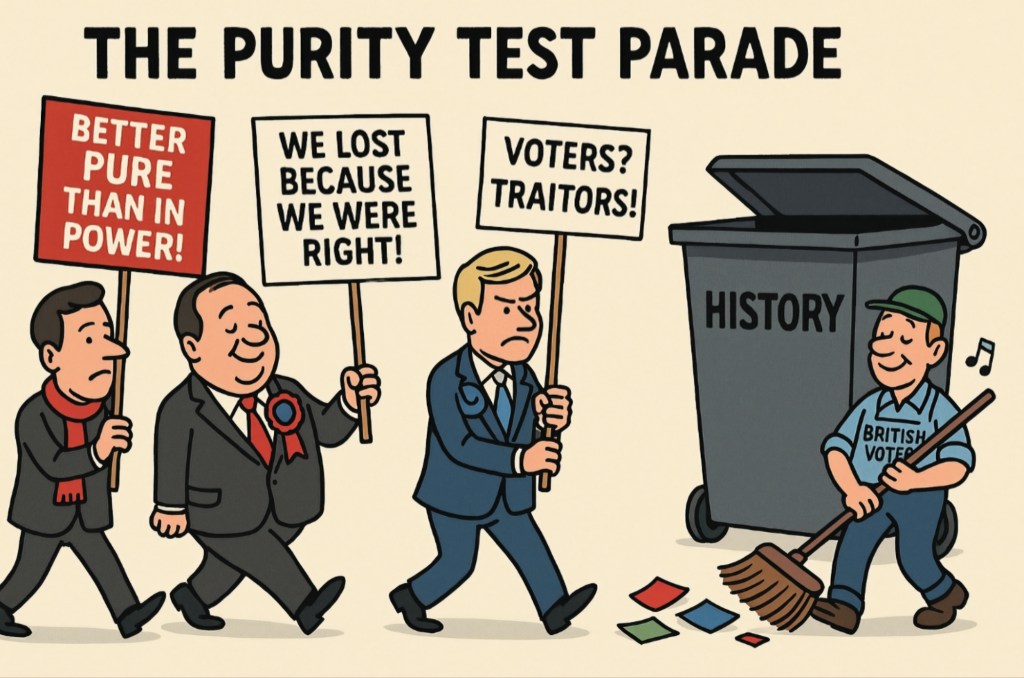
Once the ballots are counted and the concession speeches mumbled through clenched teeth, the losing party doesn’t reflect, regroup, or rebrand. No, that would be too logical. Instead, they turn inward, declare themselves victims of treachery and moral decay, and begin the sacred ritual known as the Purity Test.
The Purity Ritual
The Purity Test begins innocently enough — a few heartfelt discussions about principles. But within weeks, it escalates into a political version of a witch trial.
“Who was loyal enough?”
“Who sold out?”
“Who clapped too hard for Keir Starmer?”
Soon, MPs are being metaphorically burned at the stake for not quoting Karl Marx or Margaret Thatcher with enough enthusiasm. The moderates flee, the extremists take over, and by the next election the party manifesto reads like a combination of Revenge Fantasy and Religious Scripture.
The Moral Gymnastics
After losing an election, a normal person might say:
> “Maybe the voters didn’t like our policies.”
A British politician, however, says:
> “The voters didn’t deserve us.”
And thus begins the descent into self-righteous martyrdom — a proud national tradition that ensures political parties stay pure, principled, and utterly unelectable.
Twitter, the Delusion Factory
No purity test is complete without Twitter.
There, in the echo chamber of moral outrage and digital clapping, the losing party convinces itself that everyone online agrees with them — forgetting that Twitter is not Britain, and the average voter is more likely to be in a pub than on a hashtag crusade.
By the time the next election rolls around, the faithful are shocked to discover that the public — those dreadful centrists — once again voted for the less holy but more practical option.
The Dustbin of History (Crowded, but Pure)
From the Whigs to UKIP, from the SDP to the Brexit Party — Britain’s dustbin of history is filled with parties that preferred purity to power.
Each entered with a trumpet of righteousness and left with a whimper of self-congratulation.
Because in Britain, you can either win elections or win arguments — never both.
The Moral of the Story
In politics, as in life, ideological purity is a lovely way to go extinct.
The electorate doesn’t want saints. They want plumbers who can fix the leak — not priests who can quote scripture about the water pressure.
So the next time a losing party leader insists, “We just need to be more true to ourselves,” remember: that’s usually the last thing you hear before they vanish from history.
 Centre for Nigeria Progress