

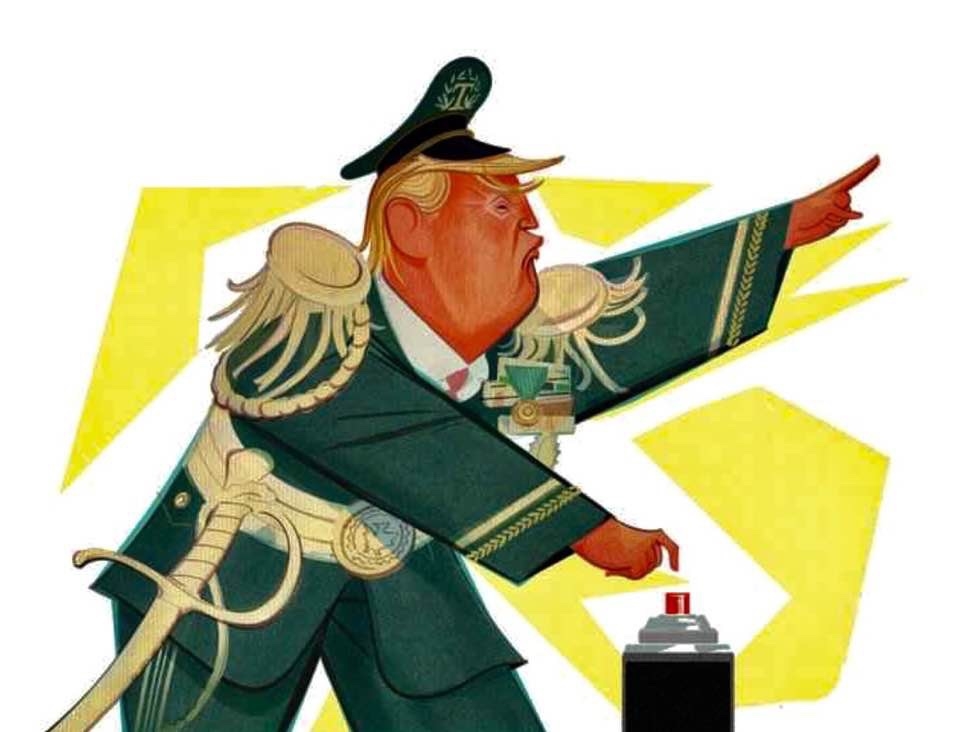

“American dominance in the Western Hemisphere will never be questioned again,” President Donald Trump declared Saturday, after U.S. forces hit various Venezuelan targets and elite commandos carried out the capture and rendition of Venezuelan President Nicolás Maduro and his wife with an audacious raid in the dead of night. “Under the Trump administration we are reasserting American power in a very powerful way in our home region.”
The world is still digesting the consequences of the U.S. intervention, which the Trump administration has tried to characterize as a “law enforcement” mission against Maduro, indicted in U.S. federal court on charges of narco-trafficking, rather than the clear military operation in a foreign nation that it appeared to be. Some Venezuelan military positions were leveled by U.S. strikes, with officials reporting an unspecified number of casualties.
Maduro is already in New York City, awaiting an appearance in court. For many Venezuelans, especially millions of people compelled to flee from the country over the past decade of economic catastrophe under Maduro’s watch, his removal is joyous news, and the first step to a happier future. On that count, the U.S. operation was a clear tactical success in its brazen precision and efficacy.
Still, the likelihood of a strategic failure looms. A dark history of failed U.S. interventions and regime-change projects haunt the current action. Boosters of the move liken it to the capture of Panamanian dictator Manuel Antonio Noriega in 1989, with U.S. criminal investigations into money laundering and drug smuggling justifying the operation. But the analogy to the present collapses amid Trump’s talk of open-ended control over Venezuela and its tremendous oil wealth.
By the end of the weekend, the White House had done little to dispel the confusion about what comes next in Venezuela. Trump himself suggested the United States would somehow “run” the South American nation until a proper transition away from the current dispensation could be forged. His lieutenants were more circumspect, emphasizing U.S. interests in dismantling alleged criminal networks within the Venezuelan state apparatus and reasserting American control or influence over Venezuela’s vast oil sector.
Venezuela’s pro-democracy opposition voiced fears that they would be cut outin a Trump-brokered deal with the remnants of Maduro’s regime. Speaking to the Atlantic, Trump said that he expected Maduro’s former vice president — and hastily installed successor — Delcy Rodriguez to essentially do the White House’s bidding. “If she doesn’t do what’s right,” he said, “she is going to pay a very big price, probably bigger than Maduro.”Advertisement
The rest of the world has watched with mixed emotions. Many in Latin America, especially among the ascendant, Trump-aligned political right, cheered Maduro’s ouster and what seems a grievous blow to the region’s remaining left-leaning autocracies.
Elsewhere, world leaders feared a grim precedent. “The bombing of Venezuelan territory and the capture of its president crosses an unacceptable line,” Brazilian President Luiz Inácio Lula da Silva said. “The action recalls the worst moments of interference in Latin American and Caribbean politics, and threatens the regional preservation as a zone of peace.”
French Foreign Minister Jean-Noël Barrot shed no tears for Maduro in a statement but said the U.S. action “contravenes the principle of the nonuse of force that underpins international law.” He warned that it was part of the steady erosion of international norms, worsened by countries such as Russia that are supposedly the guarantors of the rules-based order. “The growing number of violations of this principle by nations vested with the primary responsibility of permanent membership on the United Nations Security Council will have grave consequences for global security, sparing no one,” he said.
Trump’s move into Venezuela is another nail in the coffin of the old postwar status quo. The White House reneged on commitments to receive authorization from Congress before deploying the U.S. military in Venezuela. Ahead of Monday’s emergency U.N. Security Council session on Venezuela, Trump’s U.N. ambassador, Mike Waltz, scoffed at the “hand-wringing” of his diplomatic counterparts. In a Sunday television interview, Secretary of State Marco Rubio waved away concerns about an open-ended regime change mission as a kind of “phobia.”
“Part of what’s troubling here is not just that the president has used force in clear violation of domestic law and international law but that it’s clear he couldn’t care less about the fact that he’s breaking these rules,” observedOona Hathaway, a leading international legal scholar at Yale Law School. Speaking to the New Yorker, she concluded that Trump is “just going to do what he thinks is warranted based on his own kind of reasoning, as opposed to any kind of constraints or legal limits or having to seek advice or consent from the international community or the U.S. Congress.”Advertisement
The sense of a paradigm shift is overwhelming. Oliver Stuenkel, an analyst of international affairs at Fundação Getulio Vargas, a Brazilian university, suggested that the raid on Venezuela was the first “concrete” sign of Trump putting into practice the White House’s National Security Strategy, which declares the Western Hemisphere to be a U.S. sphere of influence, rekindling the instincts of an era of gunboat diplomacy and neo-imperialism from a century ago.
“This is a completely new age,” Stuenkel told me. “Trump doesn’t say he wants to bring democracy. It’s petro-imperialism. Latin American policy elites are slowly grasping that it would be a mistake to believe that just because Maduro is a dictator, that other countries that are democratic would be safe from the United States.”
The timid responses of most European leaders betrays the deepening anxiety on the continent about the future of the alliance with the United States. “Maduro’s capture is no regional anomaly; it is a signal event,” noted Asli Aydintasbas and Chris Hermann of the European Council on Foreign Relations. “It highlights the volatility of Trump’s foreign policy, his comfort with military solutions and his apparent openness to a world governed by spheres of influence rather than rules.”
That opens the door further for a new geopolitical Wild West, where might makes right, and laws and rules fall away. In a separate context, C. Raja Mohan, a prominent Indian geopolitical analyst, saw this already in action in Israel’s recognition last month of the breakaway republic of Somaliland.
“Declarations about the inviolability of borders ring hollow when aggression goes unpunished or is tacitly accepted,” he wrote. “With major powers embracing territorial revisionism — China in Asia, Russia in Europe, and the U.S. in the Western Hemisphere — it is naïve for lesser states to depend on the presumed protective shield” of the rules-based international order.
Armed civilians patrol in La Guaira, Venezuela, on Saturday. (Matias Delacroix/AP)
Drawing from interviews with senior administration officials, our colleagues give an account of how, under cover of darkness, highly trained Delta Force troops arrived by helicopter and descended into a compound to grab the Venezuelan president and his wife. They scrambled out of bed to get to a safe room behind steel doors, as Trump watched a live feed from his Florida residence, Mar-a-Lago. The commandos, armed with blow torches to cut through steel barriers, “bum-rushed” the couple, Trump said, adding that they did not put up much of a fight.
For the people of Caracas, Venezuelans are struggling to understand what just happened, and what might come next,
VICEROY OF VENEZUELA
Marco Rubio has held many titles during Donald Trump’s presidency. He may have just acquired his most challenging one yet: Viceroy of Venezuela.
The secretary of state, national security adviser, acting archivist and administrator of the now-defunct U.S. Agency for International Development was central to masterminding the ouster of Venezuelan President Nicolás Maduro on Saturday, officials familiar with the planning said.
But with no immediate successor to govern the country of roughly 29 million, Trump is leaning on Rubio to help “run” Venezuela, divvy up its oil assets and usher in a new government, a fraught and daunting task for someone with so many other responsibilities.
“The task in front of him is stupefying,” said a senior U.S. official, noting the dizzying array of policy decisions related to energy, elections, sanctions and security that await. This person, like others interviewed for this article, spoke on the condition of anonymity to respond freely.
The moment marks the realization of a long-held goal for Rubio, who has voiced his criticisms of Maduro and desire for change in Venezuela for well over a decade. Those who have worked closely with Rubio, whose parents left Cuba before the Communist takeover in 1959, say the issues of the region are close to his heart.
“Marco’s parents’ experience … is hardwired in him,” said Cesar Conda, a Republican strategist who worked as the former senator’s chief of staff between 2011 and 2014.
U.S. officials say Rubio will play an outsize role in guiding U.S. policy as the Trump administration attempts to stabilize Venezuela.
His Spanish proficiency, familiarity with Latin American leaders and the Venezuelan opposition make him a natural point man for Trump, said another senior U.S. official. But this person emphasized that the administration will need to appoint a full-time envoy to assist Rubio given the vast scope of decisions and responsibilities inherent in such a task.Trump, speaking to reporters after the operation, was vague when addressing questions about whether his administration is capable of running the Latin American country, saying “the people that are standing right behind me” will do so for a “period of time.”
 Centre for Nigeria Progress