


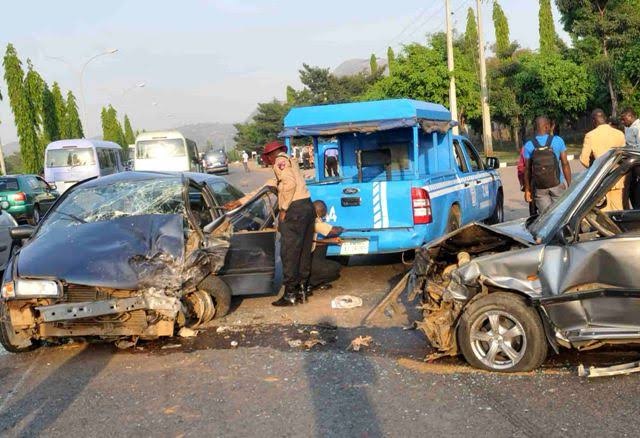
The statistics from the Federal Road Safety Corps (FRSC) are not just numbers — they represent shattered families, stolen futures, and dreams buried on Nigeria’s highways.
Over 3,400 people were killed in crashes between January and September 2025.
The 5,421 fatalities recorded in 2024 marked a seven per cent increase from 2023, despite a 10 per cent reduction in total crashes. Behind these figures lies a story of preventable tragedy enabled by systemic failures in enforcement, technology deployment, and accountability.
Then came one of the most public reminders yet that Nigeria’s road crisis is not distant or abstract — it claimed two close members of Anthony Joshua’s team.
On 29 December 2025, a vehicle carrying Joshua and three others on the bustling Lagos-Ibadan Expressway in Ogun State was involved in a catastrophic collision with a stationary truck. The crash claimed the lives of his personal trainer, Latif “Latz” Ayodele, and strength and conditioning coach, Sina Ghami — both long-time members of his camp. Joshua, who was a passenger, sustained minor injuries and was released from hospital days later.
This tragedy put a stark human face on statistics most people only read about. A superstar athlete and two devoted professionals — lost, not to fate, but to what preliminary authorities described as excessive speed and a dangerous passing maneuver.
And yet, still the hard questions remain:
What happens to drivers who kill through reckless driving? Does Nigeria treat these incidents as crimes or simply “accidents”?
In this latest case, there is an attempt at accountability: Ogun State police have charged the driver of the SUV, Adeniyi Mobolaji Kayode, 46, with dangerous driving causing death, reckless and negligent driving, driving without due care and attention, and operating without a valid driver’s licence. He was granted bail but remains in custody pending further court proceedings scheduled for January 20, 2026.
But charging a driver — even one connected to an international figure like Joshua — should not be seen as the exception. It must be the rule. Year after year, the same causes — over-speeding, driver fatigue, overloading, dangerous driving, and poor vehicle maintenance — yield the same tragic outcomes. And year after year, drivers who kill people on Nigerian roads too often face light penalties or none at all.
The message this sends is devastatingly clear: human life is cheap. The current system too often treats road deaths as “accidents,” not crimes. However, a driver who knowingly speeds, drives while exhausted, or overloads a vehicle makes deliberate choices that put human lives in danger. These are not accidents; they are acts of criminal negligence.
Until Nigeria establishes a legal framework that sends such drivers to prison — not just traffic school or a short bail period — the carnage will continue.
A Vision for Real Change
1. Mandatory Speed Limiters
The first critical step is to make speed limiters compulsory for all commercial and high-risk passenger vehicles. This single policy could dramatically reduce the primary cause of road fatalities — excessive speed — by removing human indiscretion from the equation. Proven, affordable speed-limiting technology is widely used in countries that prioritise road safety.
2. Automated Enforcement Technology
Nigeria should deploy automated speed cameras and digital enforcement systems linked to vehicle registration databases along major highways and city corridors. These systems detect violations, capture licence plates, and automatically issue fines — no police officer required. Fines should be directly tied to vehicle registration renewals, blocking renewals until they are paid. This approach reduces corruption and makes compliance the easiest choice.
3. Clear, Enforced Speed Limits
Expressways must have precisely defined limits with graduated enforcement zones; urban areas must have lower limits — especially near schools, hospitals, and residential neighbourhoods. The culture of ignoring limits must end. Technology-enabled enforcement can make violations costly and compliance automatic.
4. Reforming the Legal Treatment of Road Deaths
Nigeria must reform how the legal system treats road deaths. The law must clearly define causing death through reckless driving — by speeding, fatigue, over-loading, or operating unroadworthy vehicles — as manslaughter, punishable by significant prison terms. A system that characterises these fatal outcomes as minor traffic mishaps will never deter negligent behaviour.
Only visible convictions and consistent imprisonment will deter others.
5. Insurance and Corporate Accountability
Insurance systems can reinforce deterrence. Drivers and transport firms with repeated violations should face sharply higher premiums — or suspension from operation altogether. Transport unions and companies must take responsibility for their members; when a commercial driver kills passengers, the company should face civil liability alongside the driver’s criminal trial.
Shared accountability forces operators to screen drivers, maintain vehicles properly, and prioritise safety.
Nigeria’s FRSC has done well in gathering data and diagnosing causes, but the nation now needs action — firm, consistent, and technology-driven. Mandatory speed limiters, automated enforcement, and genuine criminal accountability are not optional — they are urgent moral imperatives.
Every month of delay costs 300–400 lives; each death leaves behind a family grieving because the system refused to act. It is no longer enough to preach caution or launch “ember month” campaigns. The time for slogans has expired. Nigeria must build permanent systems that make speeding physically impossible, make violations financially painful, and make killing through reckless driving legally catastrophic.
When drivers understand that a single act of negligence could cost them their freedom — not just their earnings — the highways will finally begin to claim fewer lives.
 Centre for Nigeria Progress