

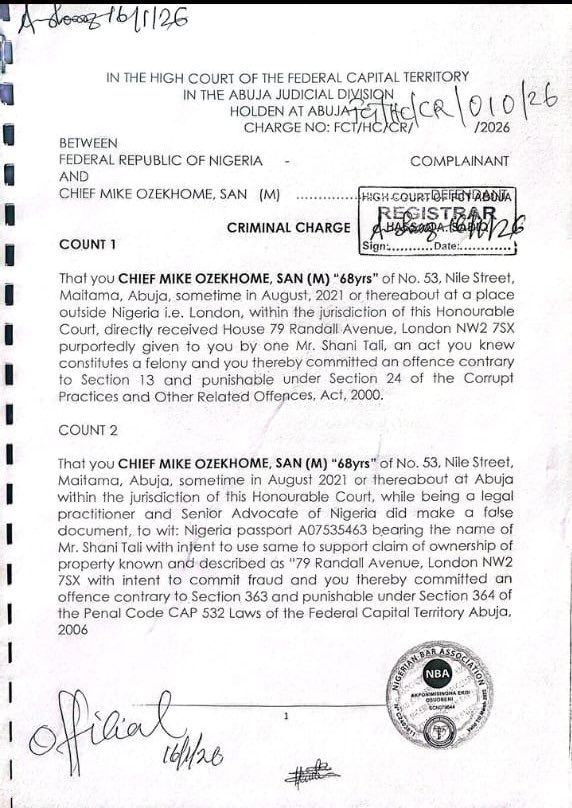
Count 1: Alleging corrupt receipt of the property at 79 Randall Avenue, London NW2 7SX, purportedly as a gift from Mr. Shani Tali (contrary to Section 13 and punishable under Section 24 of the Corrupt Practices and Other Related Offences Act, 2000).
Count 2: Making a false document, to wit: a Nigerian passport No. A07535463 bearing the name of Mr. Shani Tali, with intent to commit fraud (contrary to Section 363 and punishable under Section 364 of the Penal Code, CAP 532, Laws of the FCT, Abuja, 2006).
Count 3: Dishonestly using the false passport as genuine to support the property ownership claim, knowing or having reason to believe it was false (contrary to Section 366 and punishable under Section 364 of the Penal Code).
Any successful prosecution of the extraterritorial fraud and forgery charges against CHIEF MIKE OZEKHOME rests on establishing two major points: the court’s jurisdiction and the proof of the offenses.
Based on the newly filed formal charges, the analysis of the evidentiary and legal burdens facing the prosecution has significantly crystallized. The key case details are:
· Case Title: Federal Republic of Nigeria v. Chief Mike Ozekhome, SAN
· Court: High Court of the Federal Capital Territory (FCT), Abuja
· Charge Number: FCT/HC/CR/010/26
· Prosecution Body: Independent Corrupt Practices and Other Related Offences Commission (ICPC) on behalf of the Attorney-General
Detailed Breakdown of Charges & Evidentiary Burdens
The prosecution must prove every element of each of the three charges beyond reasonable doubt as required by Section 135 of Nigeria’s Evidence Act.
Count 1: Corrupt Receipt of Property (Corrupt Practices and Other Related Offences Act, 2000)
· The Charge: That you, in London in August 2021, directly received a house at 79 Randall Avenue, London NW2 7SX, purportedly a gift from Mr. Shani Tali, knowing this act constituted a felony.
· Relevant Law: Contrary to Section 13, punishable under Section 24 of the Act.
· What the Prosecution Must Prove:
1. The accused received the specified London property.
2. The property was given by a person identified as “Mr. Shani Tali”.
3. The receipt of the property was connected to a corrupt act or constituted a felony.
4. The accused knew that receiving the property constituted a felony.
· Potential Defence Strategy: Challenge the existence of a genuine “Mr. Shani Tali” (the UK tribunal found this identity was fabricated), argues the transaction was a legitimate gift, and contests the proof of the requisite knowledge.
Count 2: Making a False Document [Forgery] (Penal Code, FCT)
· The Charge: That you, in Abuja in August 2021, made a false Nigerian passport (No. A07535463) in the name of Shani Tali, intending to use it to claim ownership of the London property and commit fraud.
· Relevant Law: Contrary to Section 363, punishable under Section 364 of the Penal Code (punishable by up to 14 years’ imprisonment).
· What the Prosecution Must Prove: Based on the legal definition, the prosecution must establish the accused:
1. Made, signed, sealed, or executed a document (the passport).
2. Did so dishonestly or fraudulently.
3. Had the specific intent that the false document would be used to support a claim or title (to the property) or to commit fraud.
· Potential Defence Strategy: Deny creating the passport, argue a lack of fraudulent intent, or claim actions were performed in a professional legal capacity.
Count 3: Using a False Document as Genuine (Penal Code, FCT)
· The Charge: That you dishonestly used the false Shani Tali passport as a genuine document to support the property claim, having reason to believe it was false.
· Relevant Law: Contrary to Section 366, punishable under Section 364 of the Penal Code.
· What the Prosecution Must Prove: The essential ingredients are:
1. The accused used a document as genuine.
2. The accused knew or had reason to believe the document was forged.
3. The accused did so fraudulently or dishonestly.
· Potential Defence Strategy: Argue a lack of knowledge that the document was false, or challenge the proof of dishonest use.
Key Legal & Strategic Implications
· Jurisdiction: The prosecution asserts jurisdiction by filing in the FCT High Court. Count 1 is based on an act outside Nigeria (London), while Counts 2 & 3 are for acts allegedly committed within Abuja. The defence may challenge this, but Nigerian law, particularly anti-corruption statutes, often claims extraterritorial jurisdiction.
· Core of the Case: The forgery charges (Counts 2 & 3) appear to be the gravamen. The “Shani Tali” identity was central to the UK property dispute and has been declared false by a UK Tribunal. The prosecution’s success hinges on proving Ozekhome’s direct involvement in creating or knowingly using this fabricated identity.
· Critical Evidence: The judgment of the UK First-tier Tribunal (Property Chamber) dated September 11, 2025, is listed as a key exhibit. This judgment, which found a “large number of documents… produced or procured by forgery or deception” and that “Tali Shani” was a false identity used by the late General Jeremiah Useni, will be pivotal for the prosecution.
· Standard of Proof: As reiterated in cases like Alhaji Tijjani Hamidu v. FRN (2022), the prosecution bears the ultimate burden to prove all ingredients of the offences beyond reasonable doubt. The charges require proving specific states of mind: knowledge (Count 1), fraudulent intent (Count 2), and dishonest knowledge (Count 3).
Summary of Prosecution’s Burden of Proof
Count 1: Corrupt Receipt
· Core Evidentiary Focus: Proof of receipt, link to a felony, and the accused’s knowledge.
· Key Legal Standard: “Knowing” receipt of a benefit from a corrupt act.
Count 2: Making a False Document
· Core Evidentiary Focus: Forensic evidence linking the accused to the creation of the passport and demonstrating fraudulent intent.
· Key Legal Standard: Dishonest making of a document with intent to commit fraud or support a false claim.
Count 3: Using a False Document
· Core Evidentiary Focus: Evidence of the accused presenting the passport and his awareness of its falsity.
· Key Legal Standard: Dishonest use of a document known or believed to be forged.
This case presents substantial legal hurdles for the prosecution, requiring concrete evidence to meet the high standard of proof for serious criminal charges, particularly those involving complex cross-border facts and specific intent.
The main mischiefs/defects in the drafting and presentation:
The document appears to be a scanned or photographed criminal charge sheet filed by the Independent Corrupt Practices and Other Related Offences Commission (ICPC) against Chief Mike Ozekhome, SAN, at the High Court of the Federal Capital Territory (FCT), Abuja. It matches recent public reports (dated around January 18, 2026) of a three-count charge relating to an alleged London property transaction involving a purported gift from one Mr. Shani Tali, and the use/making of a false Nigerian passport document.
1. Jurisdictional and Extra-Territorial Wording Defects
– The charge claims jurisdiction over acts in London (“outside Nigeria i.e. London”) while asserting the FCT High Court’s jurisdiction.
– This relies on extra-territorial application under the Corrupt Practices Act 2000 (which does allow it for certain offences), but the wording is sloppy (“within the jurisdiction of this Honourable Court” for an act in London). It should more clearly invoke the extra-territorial clause and explain why the FCT court has competence (e.g., conspiracy, receipt in Nigeria, or effects felt in Nigeria).
2. Incomplete / Erroneous Citation of Penal Code Provisions
– Count 2 cites “contrary to Section 364 of the Penal Code CAP 532 Laws of the Federal Capital Territory, Abuja, 2006” — but then the text says “punishable under Section 364” after mentioning Section 364 twice.
– Standard Nigerian charges for forgery typically cite the creating/making offence contrary to Section 363 Penal Code (FCT), punishable under Section 364. The document misstates or confuses this (says “contrary to Section 364” in one place).
– Similar confusion appears in related reports (some say Section 366 for “use as genuine”, punishable under 364). This inconsistency in citation can make the count defective for failing to properly disclose the offence.
3. Poor Particularization of the Offence
– The particulars are vague: e.g., “directly received… an act you knew constitutes a felony” — does not clearly specify the underlying corrupt act or felony.
– In Count 2: “did make a false document… passport… with intent to commit fraud” — lacks detail on how the document was falsified, when/where exactly in Abuja, etc.
– Nigerian law requires sufficient particulars to enable the accused to know the case and prepare a defence (Sections 194–196 ACJA 2015). Vagueness here is a classic defect.
In Nigerian criminal practice, minor clerical errors may be amended (even by the court suo motu under ACJA), but fundamental defects (vague particulars, wrong section, jurisdictional ambiguity, or failure to disclose an offence) can lead to the charge being quashed or the trial vitiated if objected to before plea. Here, the combination of sloppy drafting, inconsistencies, and incompleteness constitutes significant mischiefs that would likely prompt an objection or amendment application.
 Centre for Nigeria Progress