

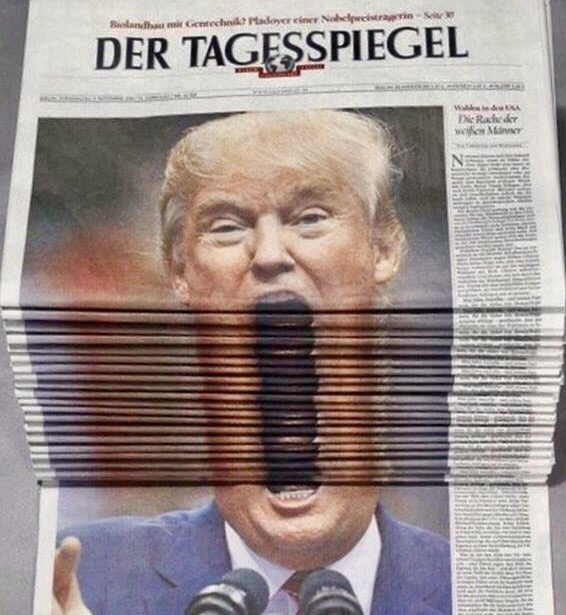

When Donald Trump speaks, he does not speak in paragraphs. He speaks in slogans. He does not traffic in nuance, equivocation, or—God forbid—context. His sentences arrive like fast food: hot, salty, instantly gratifying, and with no visible nutritional value. You don’t think about them; you consume them.
And yet, when sensible and reasonable people respond to Trump, they do so like they’re submitting a PhD thesis to the Supreme Court of Academia. Caveats here. Context there. Historical background. Moral framing. A brief detour into Aristotle. By the time they finish explaining, the audience has already left the room, checked Instagram, and voted.
What we are witnessing is not a political debate. It is a language problem.
Trump is speaking Fast Food English.
His critics insist on replying in Policy English (Annotated Edition).
Both sides are technically using English, but they are not communicating with each other. More importantly, they are not communicating with the same audience.
Trump speaks to the audience.
His critics speak about the issue.
Trump says: “They’re stealing your jobs.”
The response comes back: “Well, actually, when one examines labor migration flows in a post-industrial economy…”
At which point the audience’s brain quietly powers down like a laptop at 3% battery.
This mismatch is not accidental. It is structural.
Thanks to modern lifestyle choices—doomscrolling, algorithmic outrage, TikTok attention spans, and the general exhaustion of being alive in late capitalism—audiences now operate in bite sizes. Information must be small, loud, and emotionally flavoured. Analytical depth has become a luxury item, like offshore banking or owning property.
Truth-tellers, therefore, face an uphill task. Truth is usually inconvenient, layered, and requires thinking. Lies, on the other hand, are efficient. They travel light. They don’t carry footnotes.
A simplistic, bombastic lie can travel around the world while a nuanced explanation is still asking for permission to clear its throat.
So what is to be done?
Clearly, the current strategy is failing. You cannot fight a megaphone with a seminar. You cannot counter a chant with a white paper. You cannot defeat a slogan with a TED Talk.
A change of tact is required.
Respond in kind.
Remove the long-winded explanations.
Remove the nuances.
Remove the equivocations.
Speak the same language.
Not because nuance is wrong—but because nuance is currently unemployed.
This does not mean abandoning truth. It means compressing it. Distilling it. Turning it into something that can survive contact with the modern attention span.
Trump says: “I alone can fix it.”
The response should not be: “Well, democratic governance is inherently collaborative…”
It should be: “No, you can’t. And you didn’t.”
Short. Sharp. No subtitles required.
Until reasonable people learn that clarity beats complexity in a shouting match, they will continue to lose arguments they are objectively winning. Politics is no longer a courtroom; it is a marketplace. And right now, Trump is selling hot dogs while everyone else is explaining the benefits of a balanced diet.
The truth is still the truth.
But if you whisper it while someone else is shouting nonsense, don’t be surprised when the nonsense wins the election.
 Centre for Nigeria Progress