

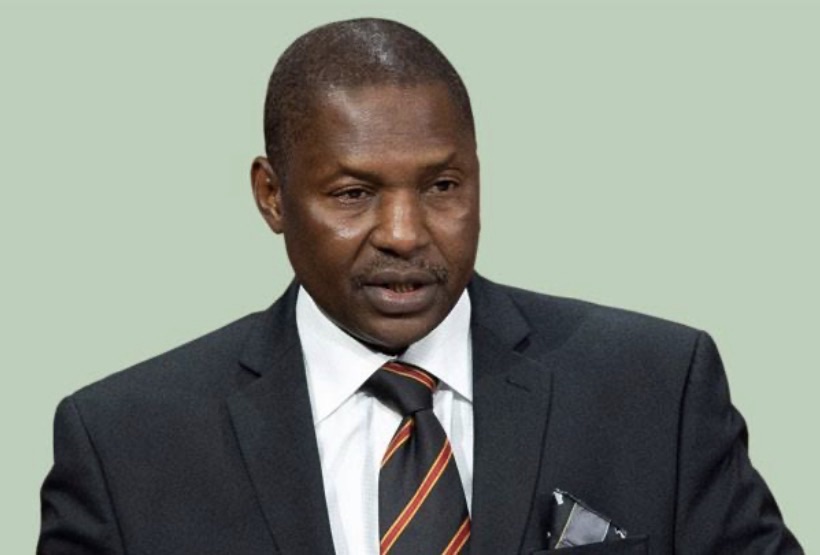

The Department of State Services (DSS) has arraigned a former Attorney-General of the Federation, Abubakar Malami, and his son before the Federal High Court in Abuja over alleged terrorism. According to the charge sheet, Malami is accused of knowingly aiding terrorism financing by allegedly refusing to prosecute suspected terrorism financiers whose case files were forwarded to his office during his tenure as Attorney-General of the Federation.
Short Answer: No. Long Answer: Still No — But With Nigerian-Style Footnotes
There is a recurring Nigerian fantasy that whenever something smells of injustice, corruption, or elite inconvenience, the solution is simple: “Arrest the Attorney-General.” Preferably before breakfast.
So let us examine the latest edition of this national pastime: can Nigeria prosecute its Attorney-General for refusing to prosecute a terrorism charge?
Brace yourselves. The Constitution is about to ruin everyone’s fun.
The Attorney-General: Nigeria’s Legal Final Boss
Under section 174 of the 1999 Constitution, the Attorney-General of the Federation (AGF) enjoys powers so wide they should probably come with a seatbelt. He may:
institute criminal proceedings, take over criminal proceedings, and discontinue criminal proceedings whenever the spirit moves him — via the majestic Latin spell known as nolle prosequi.
The Constitution adds that he should exercise these powers in the public interest, interest of justice, and to prevent abuse of legal process.
Notice what it does not say:
“to the satisfaction of Twitter,” “subject to WhatsApp forwards,” or “unless a radio presenter is angry.”
The Supreme Court has repeatedly confirmed that these powers are discretionary and quasi-judicial. In plain English: the courts will not sit behind the AG peering over his shoulder saying, “Are you sure? Try again.”
“But It’s Terrorism!” — The Emotional Argument
This is usually where someone bangs the table.
“How can he refuse to prosecute terrorism?”
Legally speaking: the same way he can refuse to prosecute anything else.
A decision not to prosecute is still a prosecutorial decision. Nigerian courts have long held that they cannot compel the AG to prosecute anyone — not armed robbers, not pension thieves, not even terrorists with a CV longer than their charge sheet.
Why?
Because prosecution is not vibes-based governance. It involves:
evidence, intelligence reports no judge wants read aloud in open court, national security considerations, and the small matter of whether the case will collapse like a badly poured Guinness.
Courts understand this. Social media does not.
So Can We Arrest the AG for Doing Nothing?
Short answer: No.
Long answer: Still no, unless he did something else.
Failing to prosecute — even in terrorism cases — is not a crime. It is constitutionally protected discretion. If we criminalised that discretion, every Attorney-General would need a lawyer, a bodyguard, and a therapist.
However, and this is important, the AG is not a demigod.
When the AG Can Be Prosecuted
If the Attorney-General:
collected a bribe to suppress a case, deliberately destroyed evidence, conspired with suspects, abused his office for personal gain,
then congratulations — you are no longer dealing with “failure to prosecute,” but criminal conduct.
At that point, section 174 cannot save him. Latin maxims pack up and go home. Handcuffs become a realistic accessory.
But absent bribery, conspiracy, or obstruction, the courts will not entertain a prosecution based on “he should have charged them.”
Can the Courts Review His Decision?
In theory, yes.
In practice, don’t hold your breath.
Judicial review is only available in exceptional cases — bad faith, constitutional abuse, or decisions so irrational they look like performance art. Even then, the court will not order prosecution. At most, it may issue a declaration politely expressing disappointment, which the AG may frame or ignore.
When terrorism and national security enter the conversation, judicial courage tends to develop a limp.
The Real Remedy (Spoiler: It’s Political)
This is the part Nigerians hate.
The remedy for an Attorney-General who refuses to prosecute sensitive crimes is not legal. It is political:
removal by the President or Governor, legislative pressure, public embarrassment, international side-eye.
Courts are not designed to run prosecution policy. If they did, judges would need uniforms and sirens.
Final Verdict
So, can you prosecute Nigeria’s Attorney-General for not prosecuting a terrorism charge?
➡️ No.
Unless you can show bribery, conspiracy, or personal criminal conduct, the refusal to prosecute — however morally offensive or politically convenient — remains constitutionally protected.
Or, to put it the Nigerian way:
The Attorney-General may refuse to prosecute terrorists,
but you cannot prosecute him for refusing —
unless money exchanged hands, files disappeared, or WhatsApp chats leaked.
The Constitution giveth discretion.
Public outrage taketh nothing away.
 Centre for Nigeria Progress