


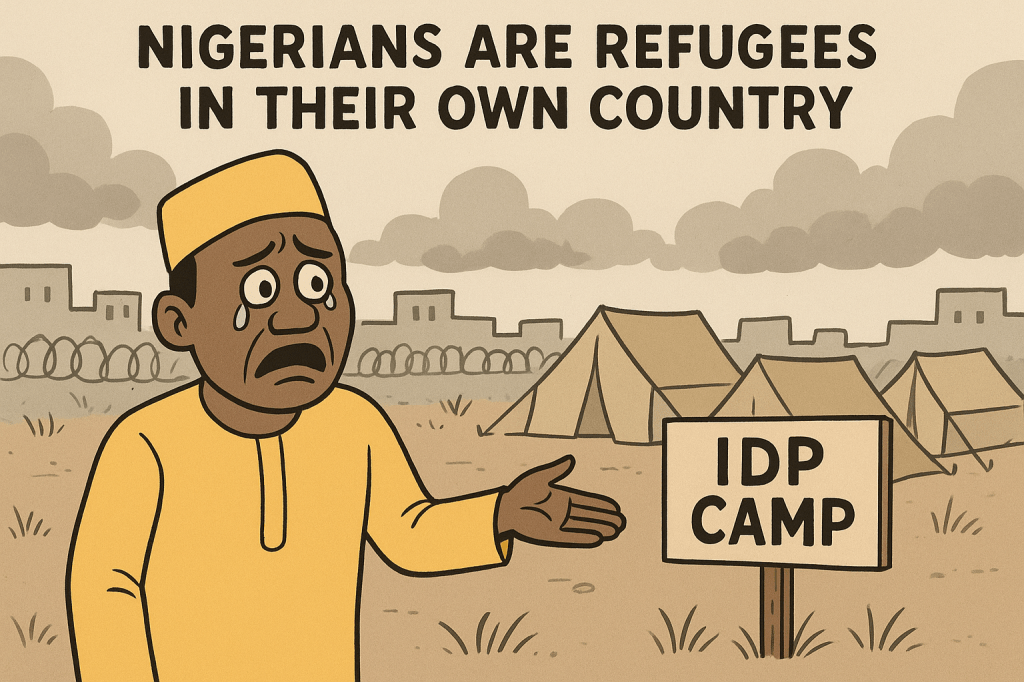
Nigeria is a country where the Constitution guarantees you the freedom to roam from Sokoto to Sagamu, from Bauchi to Benin, without police asking unnecessary questions—well, in theory. In practice, some Nigerians cannot travel from the front of their village to the back of it without risking an encounter with men who believe AK-47s are a form of traditional attire. So much for freedom of movement; even the Constitution must be looking for its receipt.
Under Section 41 of the 1999 Constitution, every Nigerian is free to move, reside, and live anywhere within the borders of the country. Beautiful right? Very democratic. Very orderly. A kind of “Come and Go” policy—only that in some areas, the “Go” part requires sprinting for your life. And this is where the mystery begins: Why do we even have Internally Displaced Persons (IDP) camps if the Constitution says all Nigerians can move freely across the federation?
It’s like telling someone they can eat anywhere in the restaurant, but half the building is on fire. Sure—technically they are free, but practically, unless they enjoy the aroma of burning ceiling boards, their choices are limited.
Why Are Nigerians Refugees in Their Own Country?
IDP camps exist because the Nigerian state has slowly developed the habit of outsourcing its job description. Security? “We will look into it.” Governance? “Committee loading…” Protecting lives and property? “It is well.”
And while the government is “looking into it”, entire communities are looking for the nearest safe ground to pitch tents—tents that typically come with overcrowding, hunger, poor sanitation, and that uniquely Nigerian feature: a politician who suddenly remembers them during election season.
Let’s call it what it is: Nigerians have become refugees in their own country because armed conflict has quietly grown into a thriving industry. A whole warfare economy—complete with contractors, middlemen, procurement hustlers, and people who have no intention of letting peace spoil their business model.
If you don’t believe warfare is now an industry, consider that IDP camps are expanding in a country that isn’t officially at war. Only in Nigeria can you be in “peacetime” and still pack your bag like a World War III evacuee.
So Why Not Relocate or Resettle Them Properly?
Countries with functioning systems do not store displaced citizens in warehouses called camps. They relocate them into communities—real neighbourhoods—with houses, schools, health centres and a path back to normal life. But in Nigeria? Resettlement is treated like a luxury item. Government spokespeople announce “plans” so often that one begins to wonder if “Plan” is the national anthem.
Let’s be honest: resettling IDPs properly would require governance, logistics, resources, accountability, and long-term planning—five things that cannot be photographed at a groundbreaking ceremony. An IDP camp on the other hand? Ah! Perfect photo-op. Bring your agbada, bring your entourage, bring your media crew. Shake hands, hand out blankets, shed one or two scripted tears… and off you go.
The Larger Problem: A Shrinking Nigerian State
The real tragedy is not just the camps. It is what they represent: a Nigerian state that is slowly withdrawing from large portions of the map—ceding land to non-state actors like it’s sharing suya at a naming ceremony. A government that cannot protect its citizens eventually ends up governing an audience, not a country.
When the state retreats, people retreat with it. First from their farms, then from their homes, and eventually into IDP camps—pockets of existence where the Constitution is framed neatly on paper but useless on the ground.
Conclusion: Freedom of Movement, But Nowhere to Move
Nigeria’s constitutional promise of freedom of movement is beginning to look like those “Terms and Conditions” promises you find in telecom adverts: technically true, practically useless.
Until the Nigerian state reclaims lost territories, resettles displaced families, and dismantles the booming conflict economy, IDP camps will continue to mock the idea of one nation bound in freedom, peace, and unity.
For now, massive portions of the population remain free to move—as long as they don’t mind moving into tents.
 Centre for Nigeria Progress