

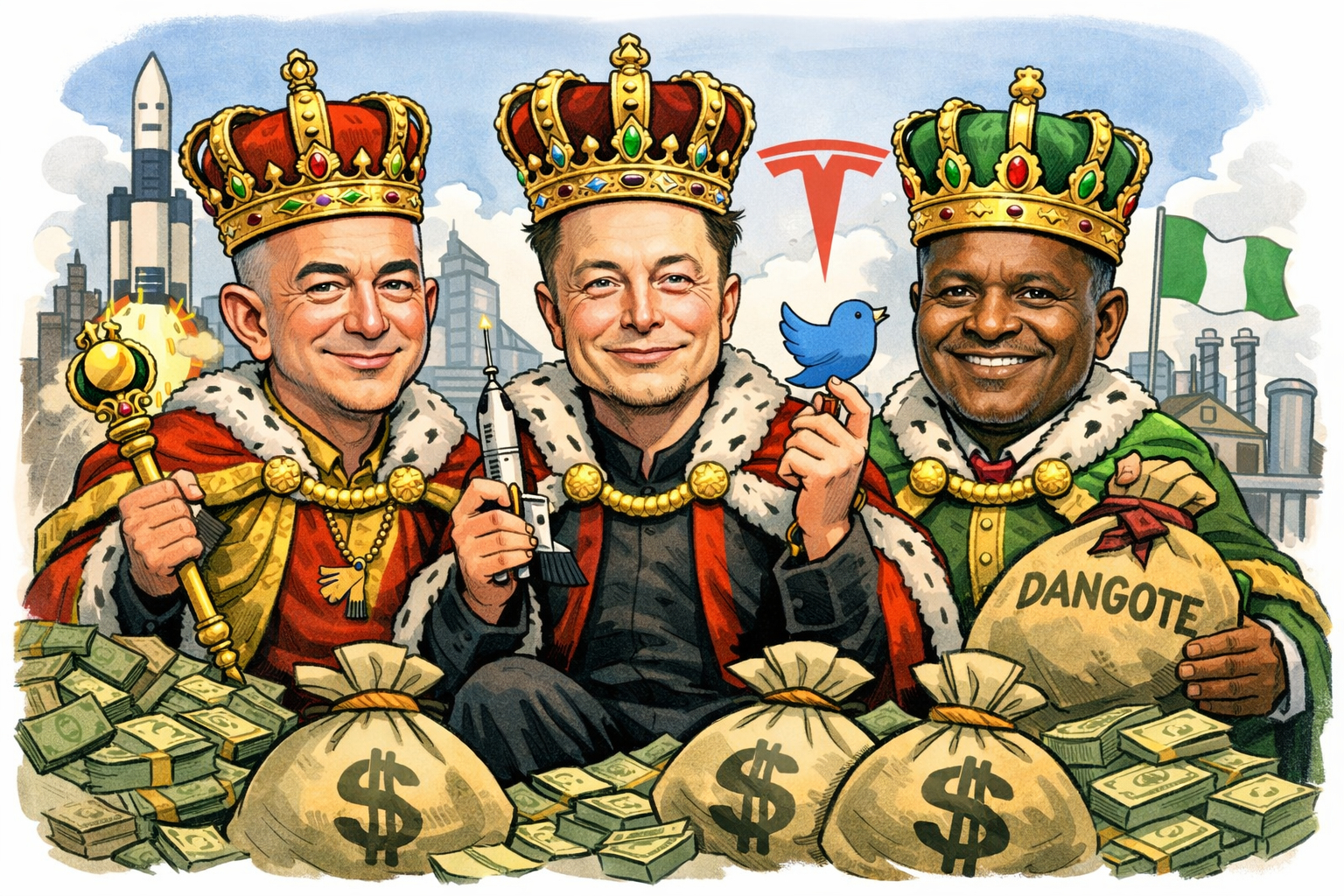

From time immemorial, societies have wrestled with power. Kings once ruled by divine right, their word indistinguishable from law. The only real constraint was conscience—if they possessed one. As even Donald Trump recently suggested in a moment of candour about executive power, a ruler’s restraint may lie chiefly in the mind of the ruler himself. History, however, teaches us that self-restraint is a fragile constitutional doctrine.
From Divine Right to Democratic Checks
Europe’s political evolution was, at its core, an answer to absolutism. The arc from the Magna Carta to parliamentary supremacy established a foundational principle: power must be checked. Monarchs were constrained. Legislatures emerged to represent the governed. Courts were instituted to interpret and limit executive authority.
Even in republics and military regimes, internal guardrails developed. Presidents and prime ministers became subject to legislative scrutiny. Judicial review matured as an institutional safeguard. Separation of powers was not ornamental—it was structural. The state was designed to prevent the concentration of authority in one hand.
But what if power has not vanished—only changed form?
The Rise of the Billionaire Class
We now witness the emergence of a new aristocracy. Not crowned, but capitalised.
Billionaires have become an elite class with extraordinary reach—economic, political, informational. They fund campaigns. They underwrite think tanks. They influence regulatory frameworks. They shape judicial appointments indirectly through political financing. The result is not merely influence, but structural insulation.
In the United States, the jurisprudential turning point came with Citizens United v. FEC. The Supreme Court of the United States held that corporations are entitled to extensive political spending rights under the First Amendment. Corporate personhood was not new, but its expansion into the realm of unlimited political expenditure recalibrated the democratic balance.
Money, in effect, became speech. And those with the most money gained the loudest voice.
Tax policy increasingly reflects this realignment. “Tax cuts” have evolved from fiscal instruments into political philosophy—often framed as economic liberation while functionally reducing the fiscal obligations of the wealthiest strata. Meanwhile, public services shrink, deficits expand, and austerity is presented as inevitability for the rest.
Power Without Portfolio
Consider Elon Musk, whose financial and digital infrastructure power extends beyond any formal cabinet position. Musk’s support for Trump was neither subtle nor inexpensive. The convergence of private capital and executive authority has blurred lines that constitutional theory once kept distinct.
When billionaires can influence administrative decisions—such as proposed restructuring of agencies like United States Agency for International Development (USAID)—or reshape national debates around diversity and inclusion frameworks, we are no longer observing mere lobbying. We are observing governance by proximity to capital.
The executive branch becomes responsive not only to voters, but to financiers. And financiers are accountable to no electorate.
Media as Modern Court Herald
In classical monarchies, royal proclamations were disseminated by loyal heralds. Today, media empires fulfil a similar function. Ownership concentration in the UK and elsewhere has created a feedback loop: billionaire proprietors shape editorial tone, influence public mood, and steer electoral outcomes.
Control of narrative is power. The marketplace of ideas is less competitive when the marketplace itself is owned by a handful of actors.
Nigeria and the Political Economy of Monopoly
The phenomenon is not uniquely American or British. In Nigeria, industrial titans such as Aliko Dangote operate at a scale where market dominance intersects with state policy. When a single corporate entity holds monopolistic leverage over key commodities, the distinction between public policy and private interest becomes blurred.
Legislative oversight grows cautious. Regulatory enforcement grows selective. The state risks becoming dependent on the very actors it ought to supervise.
The Democratic Paradox
Democracy was constructed to dismantle hereditary privilege. Yet we may be constructing something functionally similar—an economic nobility whose influence rivals or exceeds that of historic crowns.
The bottom half of society faces stagnating wages, housing precarity, and reduced public services. Meanwhile, capital consolidates. Wealth compounds. Political leverage intensifies. Absolute power, as Lord Acton warned, corrupts absolutely—not because individuals are uniquely wicked, but because concentrated power erodes accountability.
The question is not whether billionaires have influence. They always have. The question is whether institutional safeguards remain robust enough to prevent that influence from becoming sovereign.
Kings were restrained by parliaments. Presidents are restrained by courts.
Who restrains the billionaires?
Until that question is answered with structural clarity rather than rhetorical comfort, the crown has merely changed heads.
 Centre for Nigeria Progress