

On Saturday, 21 February 2026, the Federal Capital Territory conducted what was generously described as a council election.
Generously.
Because what Nigerians witnessed looked less like democracy and more like an executive construction project — complete with supervisors, instructions, and a clearly pre-approved blueprint.
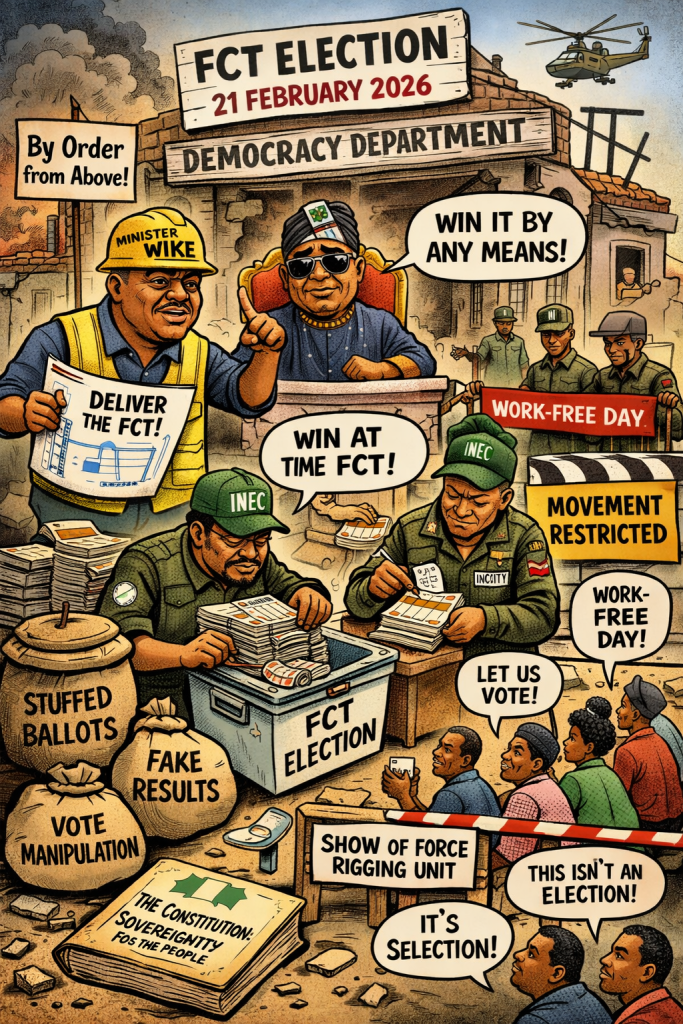
At the centre of the drama stood the FCT Minister, Nyesom Wike, a man who does not believe in half-measures. If politics were a contact sport, he would play it with steel-toed boots.
Hovering above the entire exercise, of course, was the political gravity of President Bola Ahmed Tinubu, whose well-publicised expectation that the FCT must be “won” turned what should have been a civic exercise into a performance review.
Democracy Is Not a Ministry
Let us clarify a constitutional fact.
The 1999 Constitution provides that Nigeria shall be a democratic state and that sovereignty belongs to the people. Not to ministers. Not to political strategists. Not to federal directives.
Yet, what unfolded in the FCT had the flavour of an administrative operation. A work-free day was declared on Friday, 20 February 2026. Movement restrictions followed on election day.
Now, in advanced democracies, such measures are taken to facilitate participation. In our context, they looked suspiciously like traffic management for a predetermined outcome.
Because when you announce that a territory must be delivered — politically delivered — you have subtly redefined an election as a target.
And when politics becomes target-driven, voters become obstacles.
“We Must Win” — By All Administrative Means Necessary
It is no secret that the FCT is politically symbolic. Winning Abuja is not just about councillors; it is about optics, dominance, and narrative.
The Minister’s activities in the build-up to the election were vigorous. Rally after rally. Public statements heavy with confidence. Political theatre performed with the conviction of a man who does not enter contests he intends to lose.
But democracy is not boxing. You do not intimidate the ballot box into submission.
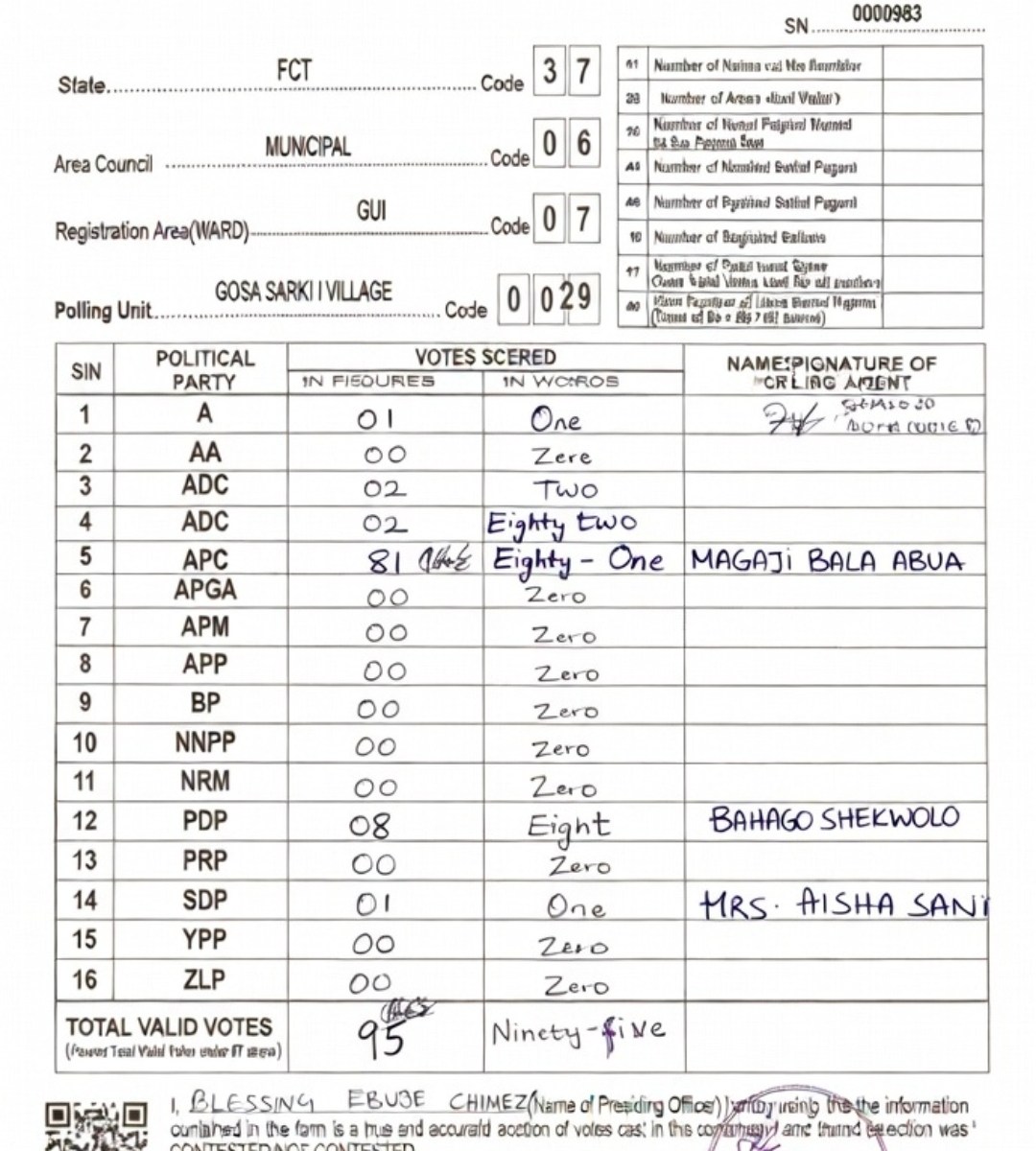
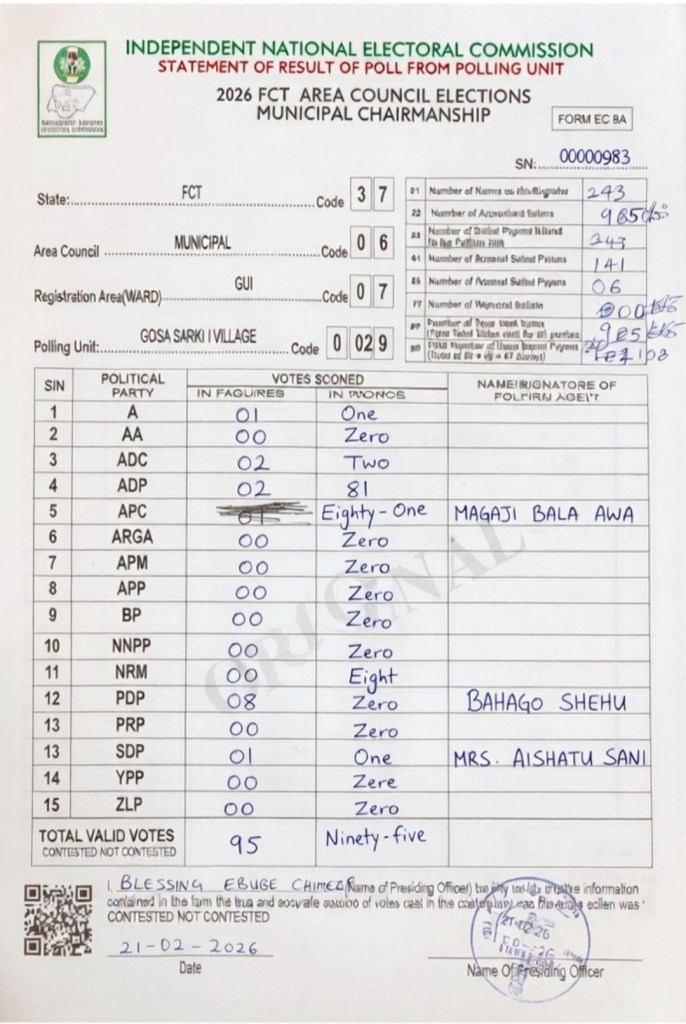
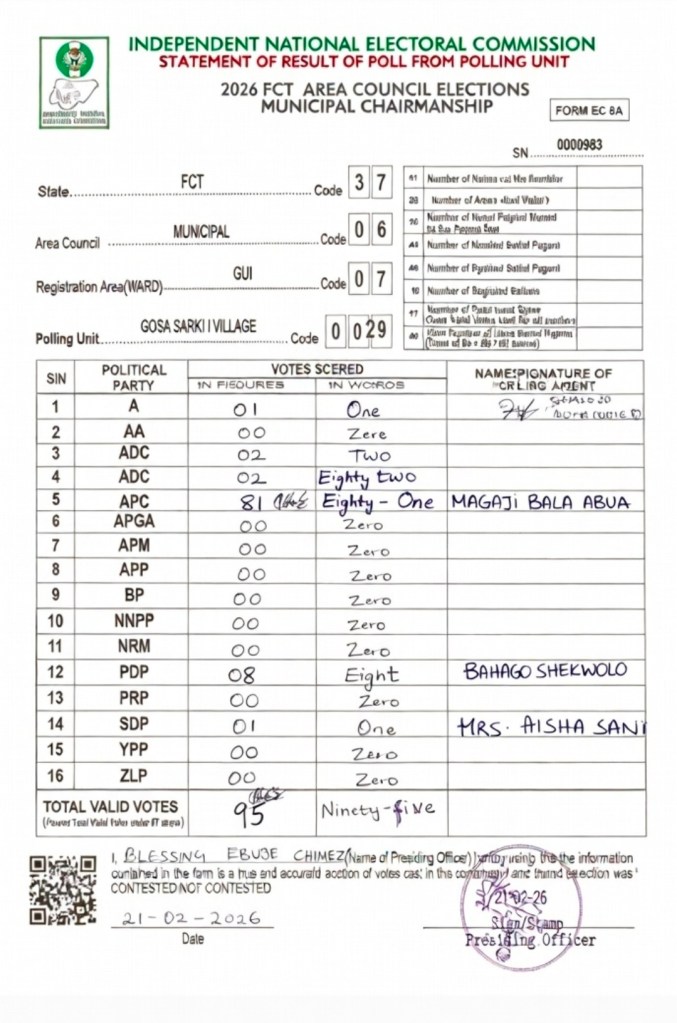
When presidential authority is perceived to have issued marching orders — “deliver the FCT” — then every administrative action becomes suspect. Every security deployment becomes political. Every altered figure on Form EC8A becomes part of a larger choreography.
It stops being an election and starts resembling a compliance exercise.
The Magical Mathematics of Collation
As results surfaced online, Nigerians observed familiar phenomena: mutilations, cancellations, suspicious arithmetic, and creative additions.
It is remarkable how Nigerian electoral figures sometimes behave like cryptocurrency — volatile, unpredictable, and detached from visible reality.
When numbers are “adjusted” at collation centres, sovereignty is adjusted with them.
And if sovereignty belongs to the people, then tampering with their votes is not strategy. It is constitutional vandalism.
Treason Against Democracy
Let us use accurate language.
Stuffing ballot papers. Thumb-printing en masse. Arbitrary additions of votes. Preventing citizens from participating freely. These are not procedural irregularities.
They are acts that undermine constitutional order.
The Constitution does not say Nigeria shall be governed by directive. It does not say sovereignty belongs to those who can mobilise the most convoys. It says sovereignty belongs to the people.
If the people vote one way and results emerge another way, that is not democracy evolving. That is democracy being edited.
The Opposition: Spectators in Their Own Drama
While the executive machinery operated with precision, the opposition performed its usual circus routine.
Factional disputes. Leadership tussles. Strategic confusion. Public disagreements.
You cannot defeat a coordinated political machine with press statements and ego battles. If power is organised and opposition is fragmented, the outcome is predictable.
An election cannot be defended by people who cannot defend their own party headquarters from internal coups.
Poverty: The Silent Campaign Manager
Meanwhile, poverty continues to function as Nigeria’s most efficient electoral technology.
Impoverish the population deeply enough and votes become negotiable. When survival is urgent, sovereignty becomes abstract.
What profit is there in adding fictional votes for a candidate who will not fictionalise school fees or hospital bills? Yet poverty makes that transaction possible.
Manual Collation in 2026 — A National Embarrassment
At a time when banking, commerce, and communication are digitised, Nigeria still clings to paper collation as if we are preserving a museum exhibit.
Manual collation has become the black hole of Nigerian democracy: votes enter; legitimacy disappears.
Any result bearing cancellations, overwriting, or suspicious alterations should be void automatically. INEC leadership must have institutional courage. Without it, the system rewards manipulation.
The Bigger Picture
The real danger is not one election.
It is the normalisation of executive dominance over electoral processes.
If ministers begin to function as political project managers and presidential expectations are interpreted as operational commands, then democracy becomes subordinate to power — rather than power subordinate to democracy.
And when that inversion becomes routine, 2027 will not be an election year.
It will be a confirmation ceremony.
Final Thought
What happened in the FCT on 21 February 2026 was presented as an election. But when victory appears pre-engineered, when administrative tools align conveniently with political objectives, and when altered results circulate freely, citizens are entitled to scepticism.
Democracy is not a directive from above.
It is consent from below.
The question now is simple:
Will Nigerians insist that sovereignty truly belongs to them — or will they allow it to remain an executive memo?
 Centre for Nigeria Progress
Re “advanced democracies”
Any alleged expert or layperson who talks about “democracies” AS IF a real democracy ACTUALLY EXISTS ANYWHERE IN THE WORLD (or has existed at any time in ‘human civilization’) is evidently either a fool who’s repeating mindlessly and blindly the propaganda fed to them since they were a kid and/or is a member of the corrupt establishment minions whose job is to disseminate this total lie because any “democracy” of ‘human civilization’ has always been a covert structure of the rule of a few over the many operating behind the pretense name and facade of a “democracy”: https://www.rolf-hefti.com/covid-19-coronavirus.html
“There is no America. There is no democracy. There is only IBM and ITT and AT&T and DuPont, Dow, Union Carbide, and Exxon. Those are the nations of the world today. […]. We no longer live in a world of nations and ideologies […]. The world is a college of corporations, inexorably determined by the immutable laws of business. The world is a business […].” — from the 1976 movie “Network”
“We can either have democracy in this country or we can have great wealth concentrated in the hands of a few, but we can’t have both.” — Louis Brandeis, Supreme Court Justice
Watch this, https://www.youtube.com/watch?v=TC5EVkKfvbQ, to see for yourself that there’s zero democracy in the US empire (or any other imperial nations controlled by the US empire), and that a criminal gang of Jewish psychopaths rule globally!
Does anyone still not see how the deadly game on the foolish public is played … or still does not WANT to see it?
Isn’t it about time for anyone to wake up to the ULTIMATE DEPTH of the human rabbit hole — rather than remain blissfully willfully ignorant in a narcissistic fantasy land and play victim like a little child?
“We’ll know our Disinformation Program is complete when everything the American public [and global public] believes is false.” —William Casey, a former CIA director=a leading psychopathic criminal of the genocidal US regime
“Elites are afraid of equality, they are afraid of real democracy, and they are afraid of justice.” —Scott Noble, filmmaker
If you have been injected with Covid jabs/bioweapons and are concerned, then verify what batch number you were injected with at https://howbadismybatch.com
LikeLiked by 1 person