


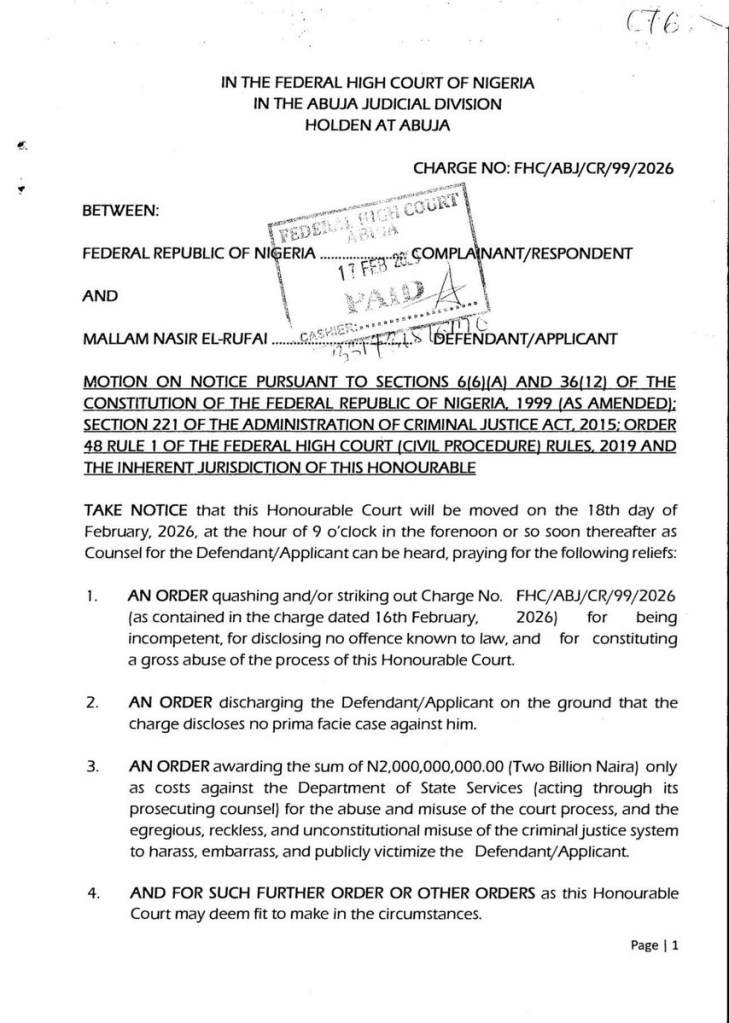
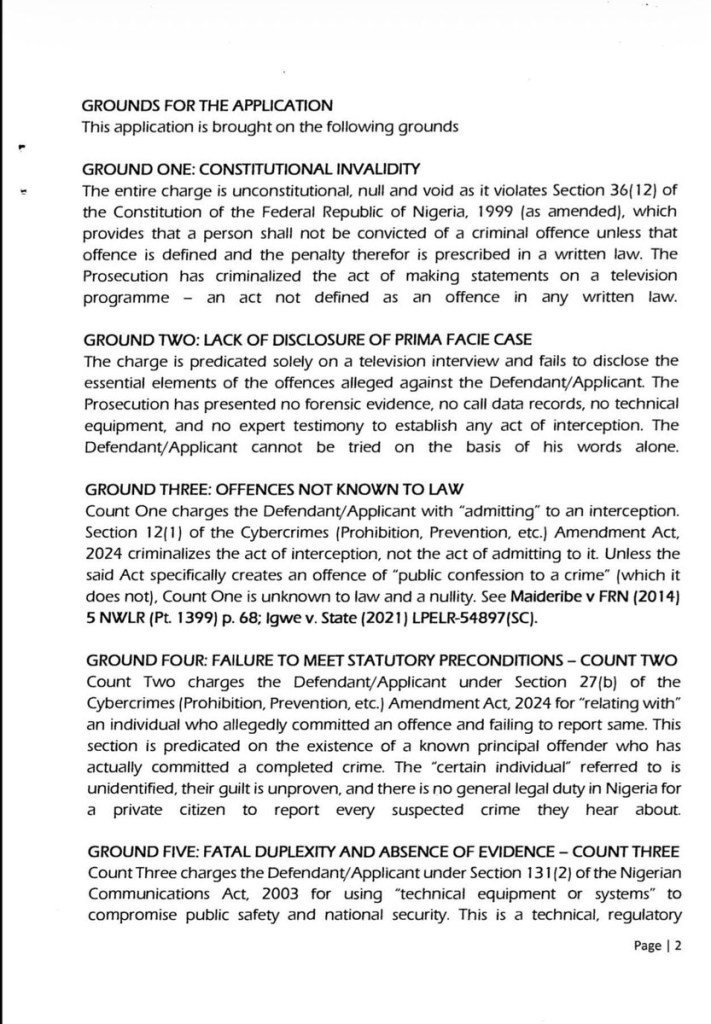
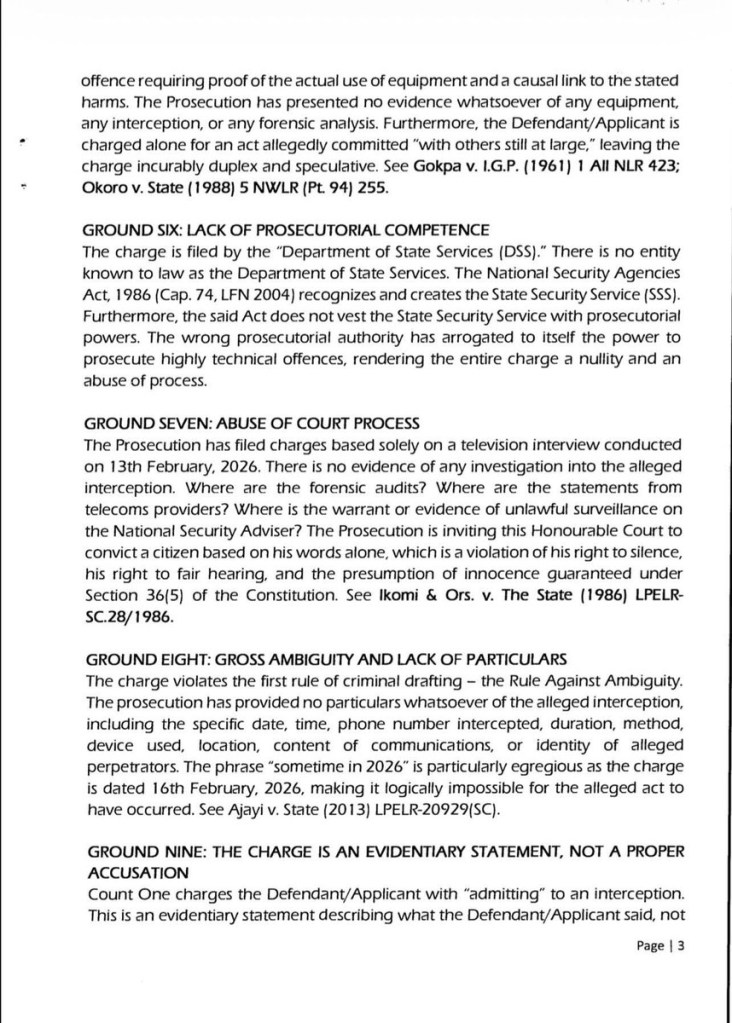
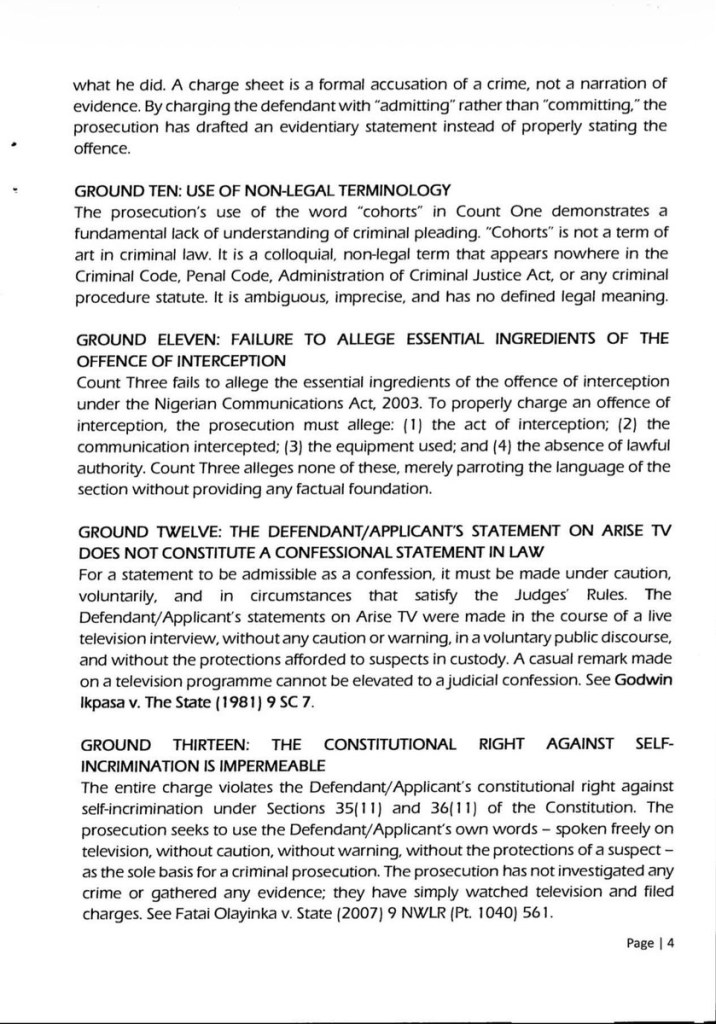
In Charge No. FHC/ABJ/CR/99/2026 pending before the Federal High Court of Nigeria, Mallam Nasir El-Rufai has mounted what can only be described as a full-spectrum constitutional assault on the prosecution initiated by the security services of the Nigeria.
The motion seeks to quash the charge in limine on grounds that range from constitutional invalidity to abuse of process. Having reviewed the originating processes, the legal issues raised are not trivial. They go to the architecture of criminal justice itself: What is a crime? Who may prosecute? What must a charge disclose? And, perhaps most deliciously, can a television interview substitute for investigation?
Let us proceed clinically.
1. Section 36(12): The “No Written Law, No Crime” Principle
The motion relies heavily on Section 36(12) of the 1999 Constitution (as amended), which provides that no person shall be convicted of a criminal offence unless that offence is defined and the penalty prescribed in a written law.
This is the constitutional embodiment of the doctrine of nullum crimen sine lege. Nigerian courts have repeatedly enforced it with rigour. In Maideribe v FRN, the appellate courts made it clear that criminal liability must be anchored in precise statutory definition, not implication or prosecutorial enthusiasm.
If, as alleged, Count One criminalises an “admission” rather than an act defined in statute, the charge risks collapsing under its own drafting. The Cybercrimes Act criminalises interception; it does not criminalise speaking about interception on morning television.
A charge must allege conduct, not commentary.
2. Prima Facie Case and the Problem of Evidence by Broadcast
Ground Two strikes at evidential sufficiency. The prosecution appears to rely substantially — perhaps exclusively — on statements made during a television interview.
The Supreme Court in Ikomi v State affirmed that a criminal trial is not a theatre of speculation. Essential ingredients of the offence must be disclosed in the charge and supported by evidence capable of proof.
If there are no call data records, no forensic extractions, no device seizure, no expert analysis, and no complainant testimony, then the prosecution faces a structural defect: words alone rarely establish technical cyber offences requiring proof of interception infrastructure.
One cannot prove packet-sniffing with vibes.
3. Failure to Identify a Principal Offender
Count Two reportedly invokes Section 27(b) of the Cybercrimes Amendment Act 2024, alleging “relating with” an unidentified person who committed an offence.
Accessory liability presupposes a principal offence and a principal offender. You cannot relate with a ghost. Criminal law does not operate on metaphysics.
If no identifiable principal offender is alleged, and no completed offence established, the accessory count becomes jurisprudentially weightless.
4. The Nigerian Communications Act and Technical Offences
Count Three invokes Section 131(2) of the Nigerian Communications Act.
Offences under this Act are technical and regulatory in nature. They require specificity:
- What communication was intercepted?
- What device or system was deployed?
- On what date?
- Without what lawful authority?
In Ajayi v State, the Supreme Court emphasised that criminal charges must not be ambiguous. The phrase “sometime in 2026” — particularly when the charge is dated February 2026 — is not merely inelegant drafting. It risks fatal uncertainty.
Criminal pleading is not creative writing.
5. Prosecutorial Competence: DSS vs SSS
Perhaps the most institutionally significant argument concerns prosecutorial competence.
The motion contends that the “Department of State Services” is not a juristic entity recognised under the National Security Agencies Act, which establishes the State Security Service (SSS).
More critically, even if nomenclature were forgiven, the Act does not expressly vest prosecutorial authority in the Service. Under Nigerian constitutional structure, prosecutorial powers primarily vest in the Attorney-General under Section 174 of the Constitution.
If an agency files charges without lawful delegation or authority, the proceedings may be void ab initio. Nigerian courts have treated prosecutorial standing as jurisdictional — and jurisdiction, as we know, is everything.
When jurisdiction is absent, even the most eloquent charge sheet is decorative.
6. Confession Law and the Arise TV Question
The prosecution reportedly treats statements made on Arise TV as effectively confessional.
But confession law in Nigeria is not casual. In Ikpasa v State, the Supreme Court underscored that confessions must be voluntary and subjected to procedural safeguards. Judges’ Rules, cautioning, and admissibility standards exist for a reason.
A televised political interview is not custodial interrogation. It lacks caution, controlled environment, and evidentiary safeguards.
If the state’s theory is that appearing on television is equivalent to entering the confessional booth of the Federal Republic, then every talk-show guest should travel with defence counsel.
7. Abuse of Process and the Optics of Power
Ground Seven alleges abuse of process — that the prosecution is punitive rather than investigative.
Abuse of process doctrine is invoked where criminal procedure is used for collateral purposes: harassment, intimidation, or political theatre. Nigerian courts have recognised this as a basis to terminate proceedings where prosecutorial discretion degenerates into oppression.
In constitutional democracies, the criminal process is not an instrument of reputation management.
8. The Larger Constitutional Context
This case sits at the intersection of:
- Freedom of expression
- Right against self-incrimination
- Prosecutorial authority
- Cyber-regulation
- Drafting competence in criminal pleadings
The Constitution does not merely protect the innocent. It regulates the powerful.
If the state can convert televised speech into a criminal charge without forensic foundation, then investigative journalism, political commentary, and even reckless boasting may all become indictable.
Today it is interception. Tomorrow it may be sarcasm.
9. Comparing Previous Controversies
In prior controversies involving alleged surveillance or national security breaches, Nigerian prosecutions have typically relied on:
- Seizure of devices
- Forensic reports
- Telecom cooperation
- Expert testimony
- Clear statutory anchoring
The present charge — if accurately reflected in the motion — appears comparatively thin. It reads less like a forensic indictment and more like a reaction to a broadcast.
Criminal law is not triggered by irritation.
Conclusion: A Constitutional Stress Test
This case will likely turn not on politics but on drafting discipline and constitutional orthodoxy.
If the court applies established principles — statutory definition of offences, strict construction of penal statutes, prosecutorial competence, evidential sufficiency, and precision in pleading — then the outcome will hinge on whether the prosecution has met minimum constitutional thresholds.
If it has not, the charge will not fail because of who the defendant is.
It will fail because the Constitution still means what it says.
And in a republic frequently tempted by spectacle, that would be the most important holding of all.
 Centre for Nigeria Progress