
If Nigeria were a patient, the doctors would have long agreed that the country suffers from a chronic condition called “Unresolved Foundational Wahala Syndrome.” And like every Nigerian patient, the country keeps ignoring the prescription while swallowing political paracetamol.
One of the earliest missed prescriptions was Decree No. 8 — the federal government’s so-called “implementation” of the Aburi Accord — a document so diluted that even the homeopathic community rejected it.
Let us rewind.
The Aburi Agreement: When the Family Meeting Looked Promising
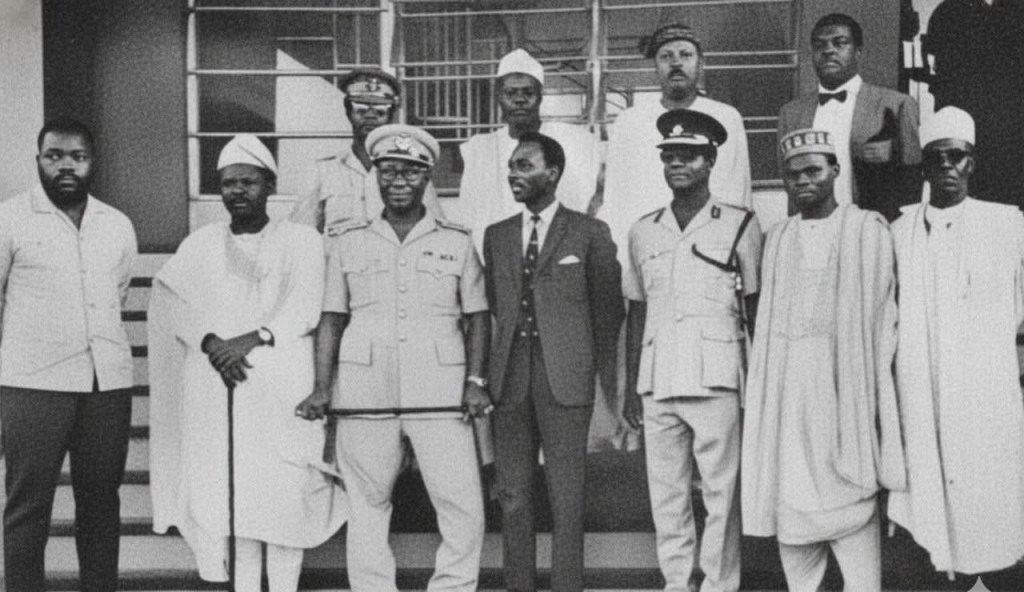
In January 1967, Nigeria’s military leaders gathered in Aburi, Ghana, for what was supposed to be a national reconciliation meeting. Think of it as a Nigerian family WhatsApp group deciding to meet physically to stop the drama. For a brief moment, it worked.
The Aburi spirit was clear:
Decentralise power
Respect regional autonomy
Make major decisions collectively
Avoid unilateral overreach
Everyone agreed, took photographs, shook hands, and even pretended to trust each other.
Then they returned to Nigeria.
Enter Decree No. 8: The Aburi Spirit After Passing Through Lagos Traffic
Back in Lagos, the Gowon-led government produced Decree No. 8 — the official attempt to implement the Aburi Agreement. But instead of adopting Aburi, the decree treated it like a Nigerian recipe:
> “Add one cup of Aburi, mix with three cups of Federal power, stir vigorously, and serve hot to suspicious regions.”
The result was:
A partial decentralisation that still left the centre smelling like amala inside a lift
Regional autonomy that came with asterisks, footnotes, and legal potholes
A federal government still able to act unilaterally in “special cases” (Nigerians know that ‘special case’ means anything from national security to national mosquito control)
Ojukwu called it a fraudulent reversal of Aburi, and the rest — tragically — became the road to civil war.
But Let’s Be Honest: Decree No. 8’s Principles Are Still Nigeria’s To-Do List
Fast-forward to 2025. Nigeria is still arguing about the same things Aburi tried to solve before your parents bought their first television.
1. True Federalism
Aburi said: decentralise.
Nigeria said: “Yes, but from Abuja.”
Today, states are glorified tenants depending on monthly rent from the Federation Account. Even local governments have become political hostages. Times change, but our problems remain faithful.
2. Autonomy and Self-Management
Aburi envisioned regions managing resources, security, and development.
In today’s Nigeria, states cannot even recruit 200 hunters without federal approval, but the federal government can approve 200 new taxes without blinking.
3. Collective Governance
Aburi wanted major decisions reached through consensus.
Modern Nigeria prefers “announcements.” Usually by press conference. Sometimes by presidential tweet.
Where Decree No. 8 No Longer Works
Nigeria has evolved — or rather, multiplied its complications.
1. From 4 Regions to 36 States
The regional giants of the 1960s have become 36 unequal siblings, some wealthy, some struggling, some basically still waiting for NEPA to restore their destiny.
2. Demographic Explosion
Back then, decisions were made by a few military officers.
Today, you need:
36 governors
109 senators
360 reps
774 local government chairmen
and 120 ethnic groups
to agree.
Even agreeing on who brings Maltina to a meeting is war.
3. Politics Has Replaced Military Command
Aburi assumed a structured chain of command.
Today’s Nigeria is governed by:
> Party caucuses, godfather summons, federal character mathematics, and WhatsApp forward messages from Uncle Joe.
Consensus is now a luxury item.
So, Does the Spirit of Decree No. 8 Still Hold Solutions?
Absolutely — in principle.
Decentralisation
Resource control
Regional responsibility
Consensus-driven governance
These are not just historical ideas; they are Nigeria’s eternally pending assignments. Every debate about restructuring, devolution of powers, fiscal federalism, state policing or regional coordination is simply Aburi stretching its old bones and reminding Nigeria:
> “Oga, we discussed this in 1967. Why are you still asking?”
But in practical terms, Decree No. 8 itself is not applicable. What Nigeria needs is not the decree, but the wisdom that the decree tried (and failed) to encode.
In summary:
> Aburi gave Nigeria the answers. Decree No. 8 gave Nigeria a loophole.
And Nigeria has spent 58 years living inside the loophole.
 Centre for Nigeria Progress