

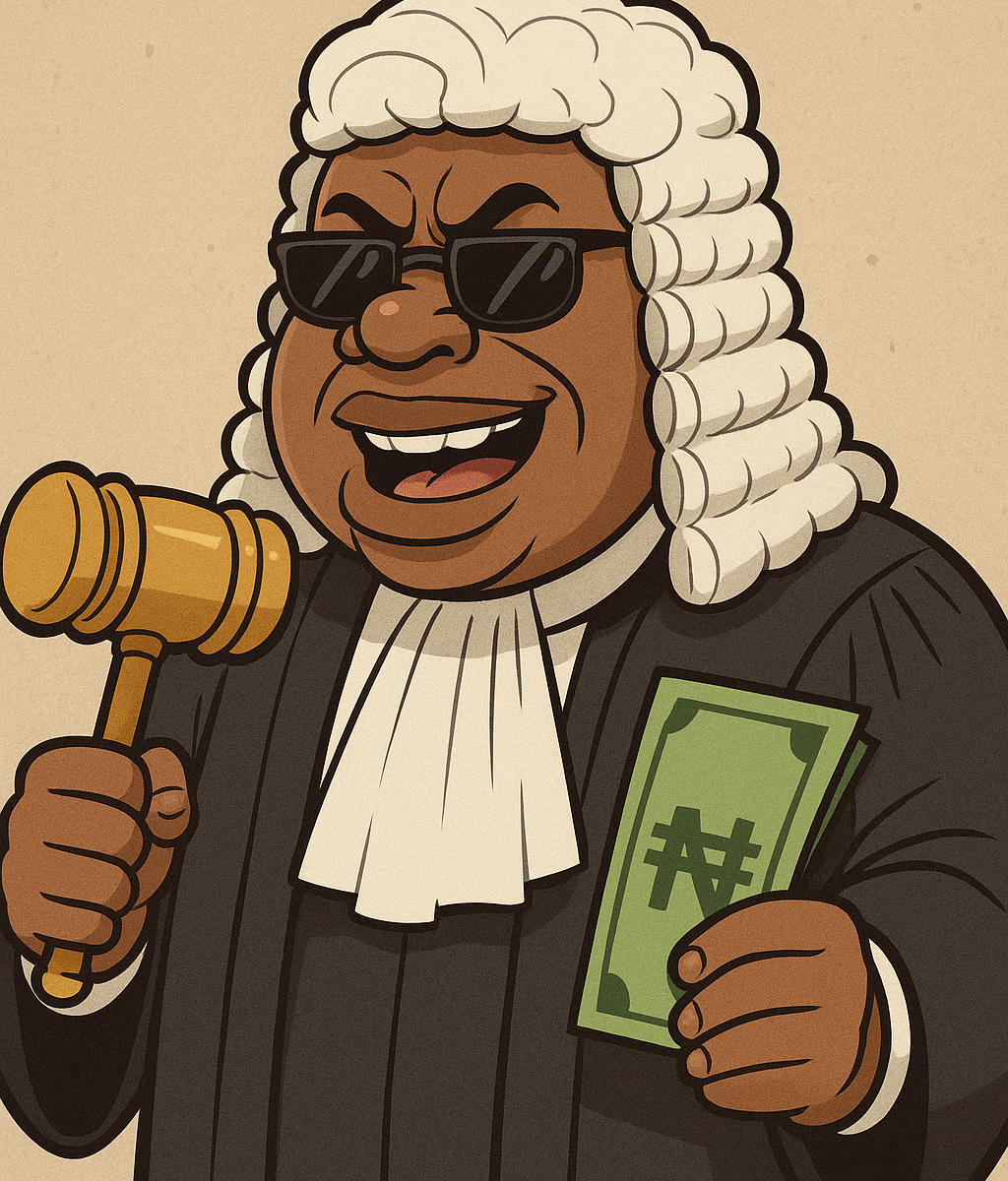
Judicial corruption remains one of the most entrenched and corrosive problems in Nigeria’s governance architecture. It is not merely anecdotal; it is consistently documented by surveys, investigative reports, high-profile scandals, and public perception studies. Across multiple independent assessments, the judiciary is routinely identified as one of the most corrupt institutions in the country—arguably the most damaging, given its role as the final arbiter of disputes.
What the Data Says
Empirical evidence paints a bleak picture. The 2023/2024 UNODC–National Bureau of Statistics (NBS) survey on corruption patterns found that judges and magistrates receive the highest average cash bribes of any public officials—approximately ₦31,000 per incident, a figure that rises substantially in politically or financially significant cases. In total, Nigerians paid an estimated ₦721 billion in bribes in 2023, with judicial officers topping the list despite having relatively limited direct contact with the public.
A 2024 Chatham House report reinforces these findings. Over 60% of Nigerians surveyed believe judges are likely to accept bribes to influence rulings, particularly in political and electoral cases. The justice sector ranked as the most severely compromised institution, precisely because of its influence over outcomes that shape power and wealth.
Transparency International and earlier surveys tell a similar story. As far back as 2013, 66% of respondents described the judiciary as corrupt, with many admitting to having paid bribes to secure favourable outcomes. The consistency of these results over more than a decade suggests a structural problem rather than isolated misconduct.
Common manifestations of judicial corruption include bribery for favourable rulings, political interference, deliberate delays and adjournments, disappearance or manipulation of case files, and procurement fraud within court administration.
The 2016 DSS Raids: A Defining Moment
Judicial corruption burst into full public view in October 2016, when the Department of State Services (DSS) carried out overnight raids on the homes of several senior judges across the country. The operation reportedly uncovered large sums of cash—both naira and foreign currency—as well as documents alleged to show improper dealings between judges and politicians.
Among those implicated were Supreme Court Justices Sylvester Ngwuta and John Inyang Okoro, as well as Federal High Court judges Adeniyi Ademola and Muazu Pindiga. Justice Uche Nma Agomoh of the Federal High Court, Port Harcourt Division, was also named in connection with documents allegedly linked to bribery, although reports at the time were muddled and occasionally confused identities.
Despite the dramatic nature of the raids, outcomes were underwhelming. While several judges were suspended by the National Judicial Council (NJC), most criminal prosecutions collapsed, were withdrawn, or never reached conviction. Some judges were later reinstated, reinforcing the perception that the system is capable of dramatic gestures but incapable of sustained accountability.
The raids themselves divided opinion. The Nigerian Bar Association denounced them as “Gestapo-style” intimidation, while others viewed them as a long-overdue challenge to judicial impunity. What followed—cases quietly fizzling out—ultimately strengthened public cynicism.
Other Notable Episodes
Judicial corruption has not been confined to one moment. In 2019, Justice Walter Onnoghen, then Chief Justice of Nigeria, was suspended over failures to declare assets. While many viewed the action as politically motivated, it nevertheless highlighted chronic weaknesses in asset declaration and enforcement among senior judicial officers.
Other judges, such as Justice Mohammed Yunusa of the Federal High Court, have faced charges with mixed or unclear outcomes. More broadly, persistent delays in high-profile corruption trials—often involving former governors or senior officials—are widely attributed to judicial bottlenecks, serial adjournments, and perceived external influence.
Databases maintained by civil society organisations, including TransparencIT and CLEEN, document hundreds of corruption cases stalled in Nigerian courts. During the Obasanjo administration, dozens of judges were reportedly dismissed by the NJC, demonstrating that periodic crackdowns occur—but without lasting systemic reform.
The Agomoh Controversy and Judicial Credibility
In recent political disputes, including the January 2026 Federal High Court ruling in Ibadan concerning the PDP convention, critics have revived references to Justice Uche Nma Agomoh’s name in connection with the 2016 DSS allegations. Although no conviction was ever recorded, the mere association continues to fuel debate about credibility and impartiality in politically sensitive cases. This underscores a broader problem: unresolved allegations linger indefinitely, poisoning confidence in the courts.
The Cost to Justice and the Rule of Law
The consequences of judicial corruption are profound. It erodes public trust, delays justice, entrenches impunity in political and electoral disputes, and contributes to Nigeria’s consistently poor global rankings on rule of law indicators. While institutions such as the NJC, EFCC, and ICPC exist, and reform proposals abound—ranging from stricter asset declaration enforcement to faster adjudication—actual convictions of judges remain exceedingly rare.
Procedural complexity, peer protection, institutional inertia, and limited resources all play a role. The result is a persistent public belief, frequently echoed by legal practitioners and former diplomats alike, that in Nigeria “justice is for the highest bidder.”
For those seeking ongoing documentation, resources such as the Corruption Cases Database (corruptioncases.ng) and UNODC reports continue to track cases. What they reveal, year after year, is not just corruption—but a system struggling, and often failing, to confront itself.
 Centre for Nigeria Progress