

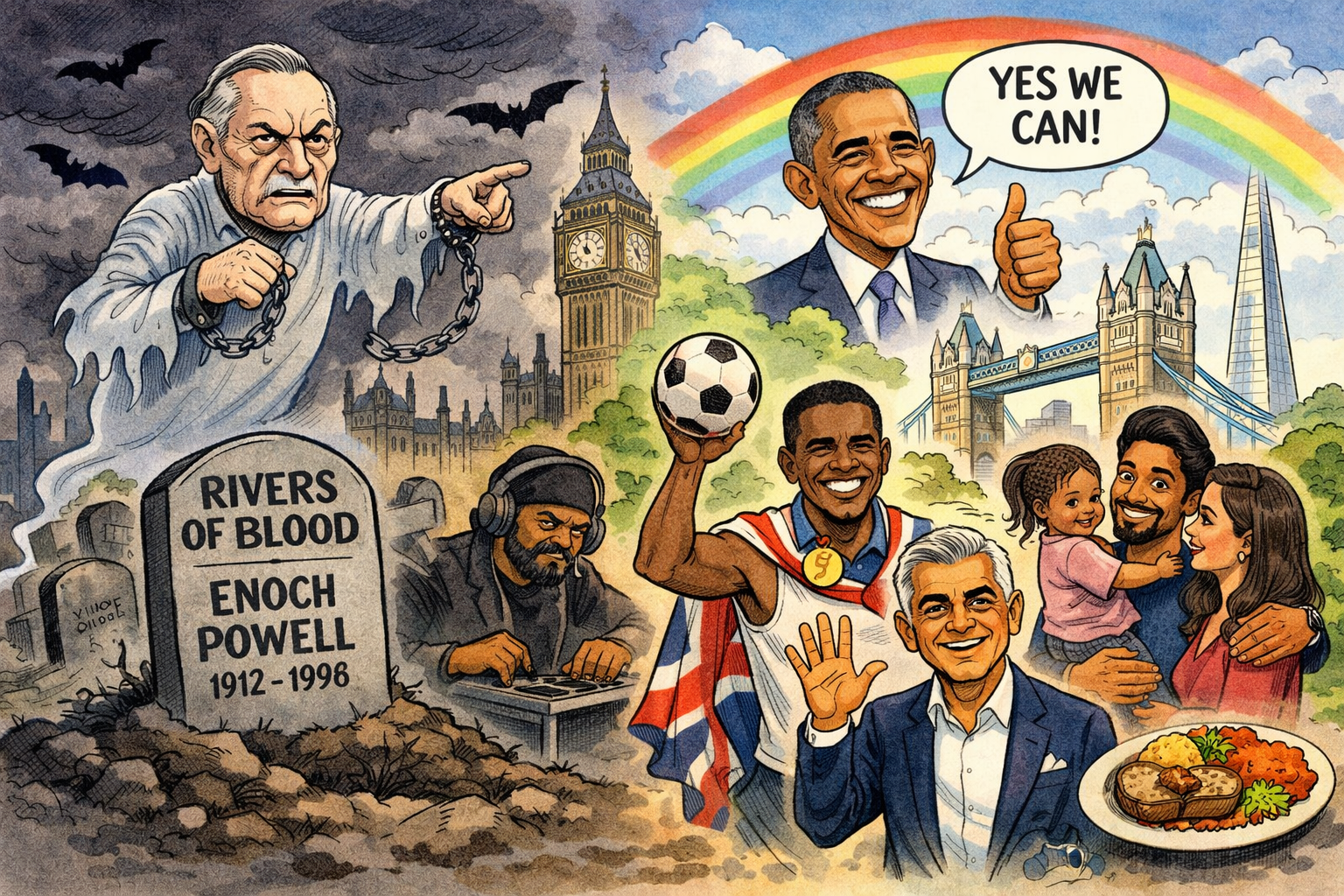

In 1968, in a hall in Birmingham, Enoch Powell warned of “rivers of blood.” Britain, he suggested, stood on the brink of racial cataclysm. Decades later, the phrase still echoes whenever non-white migration is discussed—as if demographic change were a prelude to civil war rather than to Sunday roast with jollof rice on the side.
And yet, where are these rivers?
What we see instead are Olympic champions draped in the Union Jack. We see footballing heroes whose names once troubled the tongues of commentators now chanted in stadiums from Manchester to Madrid. We see NHS wards staffed by Nigerians, Indians, Ghanaians, Jamaicans—keeping alive the very citizens once warned they would displace. The prophecy of blood dissolved into the banal miracle of coexistence.
The “island of strangers” turned out to be an island of mixed marriages and blended families. The supposed strangers are now in-laws. The accents have twangs—Multicultural London English sliding comfortably between Peckham and Parliament. Culture was not erased; it was remixed.
The alarmists promised cultural annihilation. Instead, Britain exported grime, Afro-swing and Premier League football to the world. That is not erasure. That is cultural arbitrage.
Across the Atlantic, a similar anxiety produced its own theatre. The election of Barack Obama was forecast in some quarters as the twilight of white America. What followed was eight years of steady governance, healthcare reform, and a president whose principal offence, in hindsight, seems to have been calm competence. White Americans did not vanish. They got the Affordable Care Act and a president who sang Al Green on television.
In London, Sadiq Khan was caricatured before he was evaluated. Yet the city did not fall. It functioned. It grew. It argued, as London always does, but it did not implode. The metric was always competence, never complexion.
Meanwhile, the nostalgia for character grows sharper when contrasted with the spectacle of Donald Trump—whose deficiency is not melanin but moral ballast. Leadership is not an exercise in pigmentation; it is an exercise in judgment. History has a way of reducing racial panic to footnotes while preserving questions of character in bold print.
Boris Johnson was not undone by diversity. He was undone by his own elastic relationship with the truth. The issue was never hue. It was habit.
Long before Powell, Martin Luther King Jr. dreamed aloud that people would be judged not by the colour of their skin but by the content of their character. The dream was aspirational, not naïve. It assumed struggle. But it also assumed progress.
Powell is dead and buried. His speech survives mainly as a cautionary tale in political rhetoric courses. King’s words, by contrast, are recited by schoolchildren of every shade in classrooms Powell would scarcely recognise. That is the scoreboard.
Today’s movements—whether Reform UK or the American strain branded Make America Great Again—trade in the same antique fear: that identity is a zero-sum game. That if one group rises, another must fall. History keeps embarrassing that thesis.
Demography changes. Societies blend. Accents bend. And institutions—when they hold—reward skill over skin. Not perfectly. Not permanently. But persistently.
Ghosts of grievance will always rattle their chains in quiet moments. Politics has a habit of rehearming old anxieties when times are tight. But the arc has been clear. From “rivers of blood” to Olympic gold. From “strangers” to step-parents.
As Obama once said, “Yes we can.”
And, inconveniently for the prophets of decline, we have.
 Centre for Nigeria Progress