

The Aburi Accord (also known as the Aburi Agreement) represents one of the most consequential yet tragically unfulfilled diplomatic efforts in modern Nigerian history. Held in January 1967 amid escalating ethnic and political tensions, it was a high-stakes meeting of Nigeria’s military leaders aimed at averting civil war. Far from a mere footnote, the Accord encapsulated debates over federalism, power-sharing, and national unity that continue to resonate in contemporary discussions on restructuring, fiscal federalism, and state autonomy. This exploration draws from primary accounts, historical analyses, declassified documents, and modern reinterpretations—including the recent article by Lawson Akhigbe—to unpack its details from multiple angles: historical context, key provisions, the role of Decree No. 8, points of failure, and enduring implications.
1. Historical Context: The Road to Aburi
Nigeria’s First Republic (1960–1966) collapsed under the weight of ethnic rivalries, electoral fraud, and military intervention. Key triggers included:
- The January 1966 Coup: Led by mostly Igbo officers, it overthrew the government but was perceived as ethnically biased.
- The July 1966 Counter-Coup: Northern officers retaliated, installing Lt. Col. Yakubu Gowon as Head of the Federal Military Government (FMG). This was followed by widespread anti-Igbo pogroms in the North, displacing hundreds of thousands from the Eastern Region.
- Eastern Region’s Grievances: Lt. Col. Chukwuemeka Odumegwu Ojukwu, the Eastern Military Governor, demanded protections for his region, including autonomy amid fears of domination by the North.
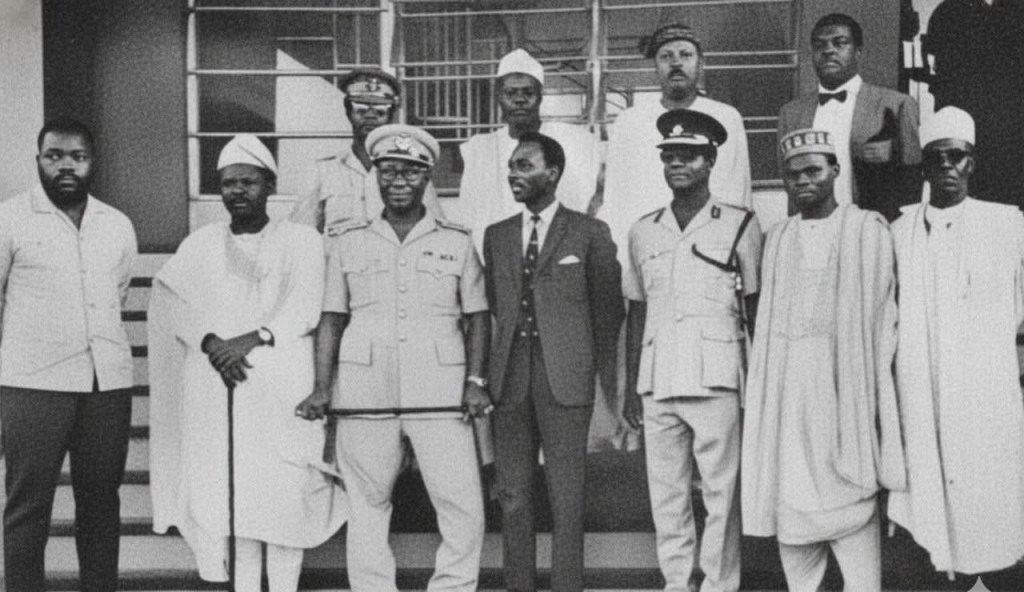
By late 1966, the country teetered on the brink. Gowon convened the Supreme Military Council (SMC)—comprising himself, Ojukwu, and the other regional governors—to negotiate. The venue – Aburi, Ghana, a neutral hilltop resort town, chosen to escape Lagos’ pressures. The meeting occurred on January 4–5, 1967, billed as “the last chance” to prevent war.
Nuances in Context:
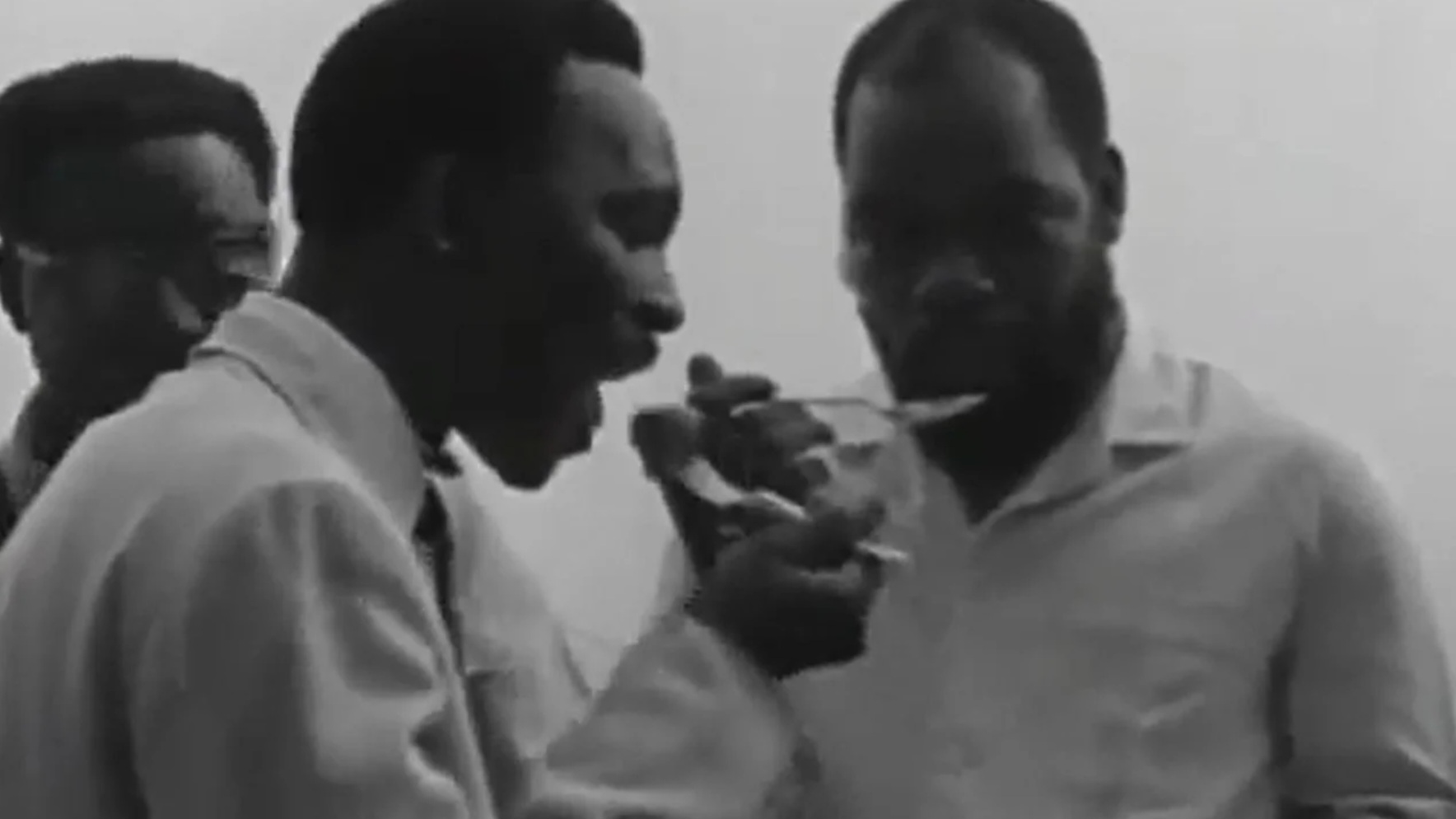
From the Eastern perspective, Aburi was a lifeline for survival post-pogroms. For the federal side, it was a containment exercise to preserve unity. International observers, including U.S. diplomats, viewed it as a genuine olive branch but noted underlying mistrust. The Accord’s “family meeting” vibe—handshakes, photos, and vows—masked deep divides, foreshadowing its fragility.
2. Key Provisions of the Aburi Accord: A Blueprint for Decentralization
The Accord was not a formal treaty but a set of unanimous resolutions recorded in minutes. It leaned toward a confederal structure, shifting power from a strong center in Lagos to the regions. Here’s a detailed breakdown of the core agreements, compiled from official records and analyses:
Renunciation of Force
All members pledged to renounce force as a means of settling disputes; reaffirmed commitment to dialogue and negotiation. No further arms imports until normalcy.
Immediate de-escalation; equitable sharing of existing arms across regions. This was Ojukwu’s opening proposal, accepted unanimously.
Power Structure and Governance –
Supreme Military Council (SMC) as the highest authority in the Federation.
– Decisions on national issues required unanimous concurrence (veto power) from the Head of FMG and all Regional Military Governors.
– Head of FMG to be styled “Chairman of SMC,” not “Supreme Commander.”
– Major policies (e.g., trade, commerce, industry, transport, armed forces, police, higher education) needed SMC approval.
Aimed to prevent unilateral federal actions; empowered regions as equal partners. Effectively created a “collective leadership” model.
Military and Security Reorganization –
Army restructured into Area Commands aligned with regions, each under the control of its Regional Military Governor.
– No troop deployments outside a region without the governor’s consent.
– Police and security matters largely regionalized.
Addressed Eastern fears of Northern military dominance; promoted “regional responsibility” for security.
Regional Autonomy and Fiscal Powers –
Restoration of legislative and executive powers to regions.
– Regions could legislate on local matters without federal interference, provided it didn’t “impede” federal functions.
– Resource control and revenue sharing implied greater regional leverage.
Core of the “Aburi Spirit”: Decentralization to heal ethnic fractures. Echoed pre-1966 regionalism but in a military framework.
Other Commitments –
Exchange of arms inventories for equitable distribution.
– No victimisation of officers post-coups.
– Future meetings for implementation.
Built trust through transparency; set stage for civilian rule transition.
Examples and Depth:
Ojukwu later read the full minutes publicly in Enugu, emphasizing the “unanimous” nature. A sample declaration: “We… solemnly and unequivocally DECLARE that we renounce the use of force…” This was groundbreaking—Nigeria’s first post-independence attempt at power-sharing beyond the 1963 Constitution.
Edge Cases: The Accord didn’t explicitly call for secession but implicitly allowed regions to “opt out” via vetoes, making it a high-wire act for unity.
3. Decree No. 8: The “Aburi Hangover” Takes Hold
Upon returning to Nigeria, the federal side faced pushback from permanent secretaries (bureaucrats), who argued full implementation would fragment the nation. Gowon, advised against it, promulgated Decree No. 8 (Constitution (Suspension and Modification) Decree 1967) on March 17, 1967, after SMC ratification in Benin.
How It Diluted Aburi (Per Akhigbe and historians):
- Partial Decentralization: Restored some regional powers but retained federal overrides (e.g., in “national interest”).
- Emergency Clauses (Sections 70–71): SMC could declare emergencies with the Head + 3 governors’ approval, then legislate for any region—bypassing that region’s governor. This was seen as a “loophole” for central control.
- Unanimity Compromised: Required “at least three governors” for some actions, not full consensus.
- Federal Safeguards: Prohibited regions from impeding federal authority; centralized key sectors like armed forces.
Ojukwu branded it a “fraudulent reversal,” citing 40 divergences in a Ghanaian analysis. The East rejected it outright, viewing it as Lagos “passing Aburi through traffic” (Akhigbe’s metaphor).
Nuances: Some federalists argue Decree 8 was a pragmatic compromise, granting 95% of Aburi’s intent while preserving unity.
Ojukwu’s hardline stance? A calculated bid for confederalism bordering on independence.
4. The Breakdown: From Accord to War
- May 1967: Gowon created 12 states, carving up the East (dividing Igbo heartlands).
- May 30, 1967: Ojukwu declared the Republic of Biafra.
- July 6, 1967: Civil war erupted, lasting 30 months and claiming 1–3 million lives.
Multiple Angles on Failure:
- Federal View: Ojukwu “misrepresented” the Accord; Decree 8 was faithful.
- Eastern View: Betrayal by “Lagos traffic” (bureaucrats) and Gowon’s duress claims.
- Analyst View: Bureaucratic sabotage + ethnic mistrust; Aburi exposed Nigeria’s “foundational wahala.”
Related Considerations: Post-war “No Victor, No Vanquished” policy ignored Aburi’s lessons, entrenching unitary tendencies.
5. Long-Term Implications and Legacy
The Accord’s collapse entrenched a unitary federalism—strong center, weak states—that persists. Key echoes:
- Institutional: From 4 regions to 36 states (plus FCT), but fiscal dependence on Abuja remains (e.g., states as “glorified tenants”).
- Security: State policing debates mirror Aburi’s Area Commands.
- Economy: Resource control (e.g., derivation principle) revives Eastern demands.
Modern Relevance (2026 Lens): Akhigbe’s “Aburi Hangover” frames it as Nigeria’s chronic ailment—58 years of dodging decentralization. Today’s restructuring calls (fiscal federalism, true federalism) are “eternally pending assignments” from Aburi. With 120+ ethnic groups, 36 governors, and announcement-driven governance, consensus is elusive. Yet, its spirit—autonomy, collective decisions—offers a roadmap amid insecurity, inequality, and federal overreach.
Edge Cases Today:
- Positive: Influences constitutional conferences (e.g., 2014 National Confab).
- Challenges: Northern resistance to devolution; elite capture of reforms.
- Hypotheticals: Full Aburi implementation might have prevented war but risked balkanization. In a multiparty democracy, it could inspire regional coalitions.
Broader Nuances: Aburi wasn’t perfect—military-led, Igbo-centric in execution—but it highlighted federalism’s adaptability. For multi-ethnic states globally (e.g., Ethiopia, Sudan), it warns: Ignore power-sharing at your peril.
In essence, the Aburi Accord wasn’t just a failed peace deal; it’s Nigeria’s mirror. As Akhigbe urges, the “solutions we still pretend not to see” lie in its wisdom: decentralize boldly, or risk perpetual hangover. For deeper dives, primary minutes or Akhigbe’s full piece provide unfiltered insight.
 Centre for Nigeria Progress