

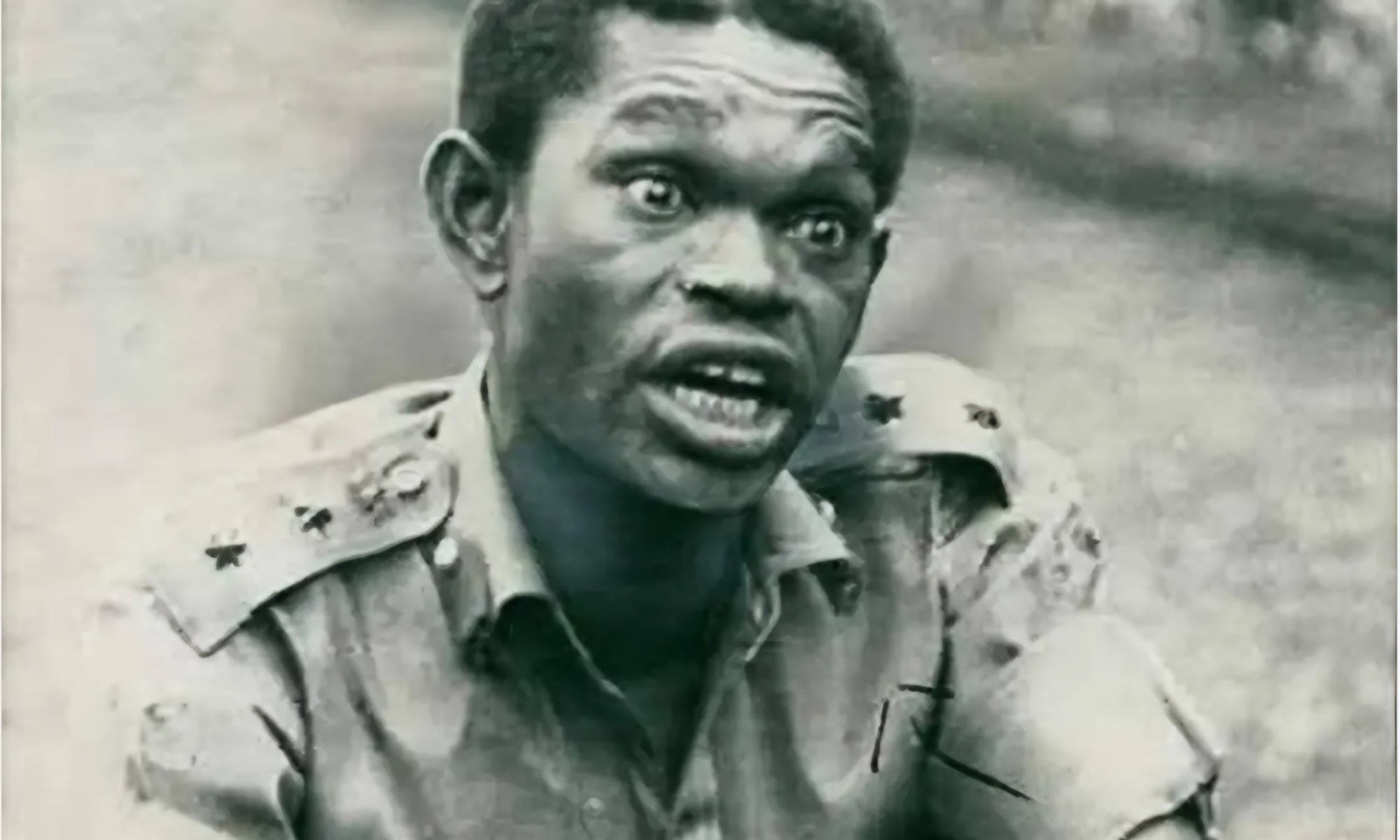
The “Black Scorpion” was a moniker associated with Brigadier General Benjamin Adekunle. He was the first commander of the 3rd Marine Commando (3MCDO) during the civil war. It was essentially about his operational strategy. He led the 3MCDO in an amphibious format, and this has remained a reference point in our military history. Is Déjà vu real? Are we on the verge of replicating another “Black Scorpion” with the recently established “Bushmen” by the Nigerian Navy? The resemblance is too striking to ignore. I will attempt to highlight the similarities in this article.
Is Déjà vu real?
There is an economic necessity to protect the oil and gas investments in the Niger Delta region. And most of these investments are offshore. The dynamics inherent in the offshore region are asymmetric, and navigation is usually cumbersome. After over 50 years, a special naval unit was established to protect the estimated $16.6 billion offshore oil and gas investments in the Niger Delta. In relation to the 3MCDO, the exploits of the unit led to the end of the civil war. The unit moved through riverine, swampy, and coastal terrains. This is the terrain the “Bushmen” would navigate. This is the first resemblance both units share.
According to Naval sources, the “Bushmen” is a 326-member trained naval personnel with aerial, ground, and amphibious capabilities. I tried to create a mental picture in my head after reading this. Thoughts of the operational strategy of the 3MCDO filled my head. This was corroborated by Brigadier General Godwin Alabi-Isama in his book, “The Tragedy of Victory.” He revealed that troops of the 3MCDO moved through “impossible” terrains. For example, in his analysis on the 480km trek from Calabar to Port Harcourt, he stated that “At the time, the traditional military approach would have been to move from Calabar to Port Harcourt via the direct 80km route. Instead of taking the main roads, which were heavily defended and prone to ambush, the 3MCDO moved through ‘impossible’ areas—the Oban Hills and the cross-river swamps—during the height of the dry season. While the main body moved silently through the swamps, other units were ordered to shell main road positions like Oban to trick the enemy into believing a frontal attack was coming.” This is an example of amphibious warfare.
The Bushmen
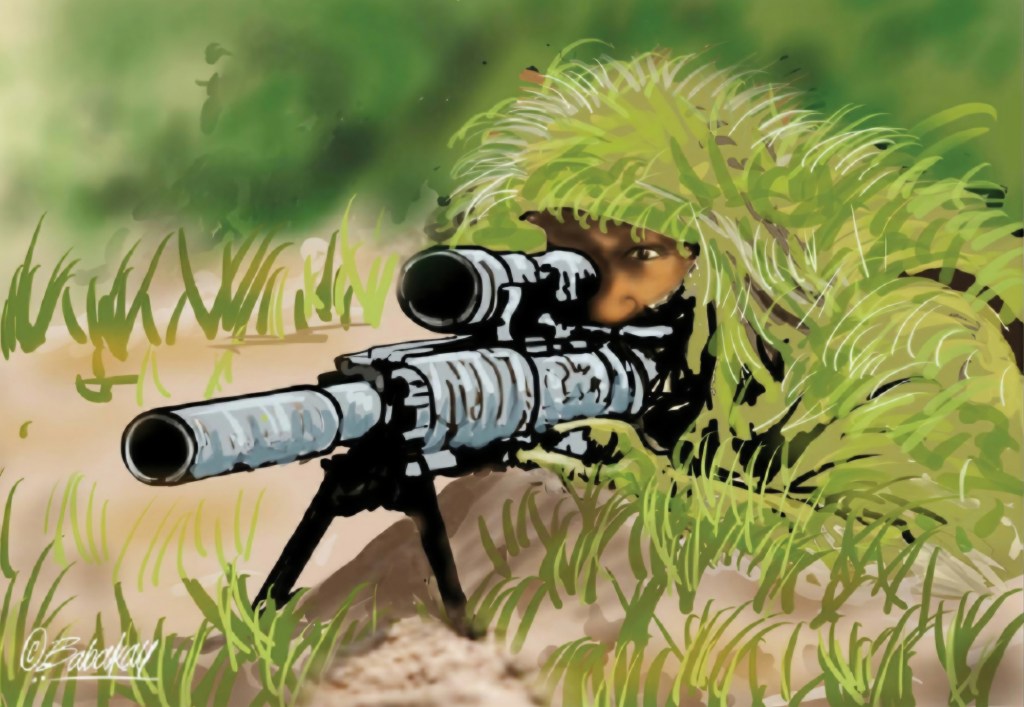
This is the strategy the “Bushmen” have adopted. Futuristically speaking, they are going to move through creeks and mangroves and lie motionless in a mound of sand for hours in some instances to hit target. The unit is going to face unconventional threats just like the 3MCDO in navigating difficult terrains to achieve their objectives. The Chief of Defence Staff, General Olufemi Oluyede, at the unveiling ceremony of the “Bushmen,” made a statement that I related to instantly. He said that the special unit would face “adaptive and unconventional” threats. In his words, “We face a complex mix of traditional and asymmetric challenges that have evolved with time.” This was instructive and hit the nail on the head. We are in the era of asymmetric warfare that has indeed evolved. The Chief of Naval Staff, Vice Admiral Idi Abass, in his speech, emphasised further by stating that “the broader strategic environment in which we operate is defined by volatility, complexity, and ambiguity.” These are what constitute the Niger Delta environment. In that region, it is a fierce regime, and the stakes are high.
The $16.6 billion oil and gas investment
The security threats in the Niger Delta region have economic consequences if things are left to chance. We have witnessed declines in crude oil production due to acts of economic sabotage. International Oil Companies (IOCs) such as Shell, ExxonMobil, and TotalEnergies have moved their operations onshore due to the volatility in the offshore environment. This is a huge divestment, and the impact is felt economically. Please be reminded that our primary source of revenue as a country is from the oil and gas sector. Our annual budget is premised on the estimated price of crude oil, and any disruption in our crude oil production capacity comes with economic consequences. This has been our lot.
In a previous article I authored, titled “Publish or Perish”, I argued that the military must innovate its strategies towards addressing the security challenges in the country. The security threats we face are asymmetric, and they require a blend of conventional and unconventional methods to address them. The resort to blending conventional and unconventional tactics as envisioned in the strategy of the “Bushmen” signals interesting times ahead. It appears the Chief of Naval Staff, Vice Admiral Idi Abbas, is excited about this. He beamed with smiles at the unveiling ceremony. This was suggestive. But we will wait for things to pan out when the “Bushmen” are fully operational.
The power of mystery in warfare.
I like the moniker “Bushmen”. It evokes curiosity. War monikers are not just labels – they are force multipliers. It is an aspect of psychological warfare. The idea is to keep the enemy guessing. In this case, it would take some mental effort to associate the moniker “Bushmen” with the operations of the Nigerian Navy. Questions around “what would naval personnel be doing in mangroves and swamps when they are meant to be on the sea? This is an example of the power of mystery in warfare. It acts as the “first wave” of an attack. And this is critical in amphibious warfare.
I recently watched a scene at the graduation ceremony of the “Bushmen”. It was a striking demonstration: a “Bushman”, dressed in full camouflage, lay buried motionless beneath a mound of sand. Then, in a dramatic instant, he sprang out – rifle in hand. It was a brilliant display, and it echoed the timeless counsel of Sun Tzu, the legendary Chinese military strategist, in “The Art of War”. He argued that the highest form of warfare is to convince the enemy that you are inactive until the moment you strike. This is an example of acting under the cover of darkness, and it was exemplified in the “Bushmen” demonstration.
The Nigerian Navy has stated that the “Bushmen” are not out for a patrol mission. It is an attack-oriented mission blending conventional and unconventional strategies. The inaugural display gave out the A-Z of the new unit. This, in my opinion, is our version of the U.S. Navy SEALs. The U.S. Navy SEALs is a special amphibious fighting unit of the U.S. Navy, and it has been recognised as an elite unit trained to fight on sea, air, and land. The acronym SEALs stands for Sea, Air, and Land. This is how I have pictured the “Bushmen” in my mind. And it comes with the burden of expectation. The expectation is for the “Bushmen” to do things differently to achieve their stated objectives. They are in for a herculean task. I wish that the outcome of their operations justifies the mien of the Chief of Naval Staff at the end of the day. Our fingers are crossed.
 Centre for Nigeria Progress