

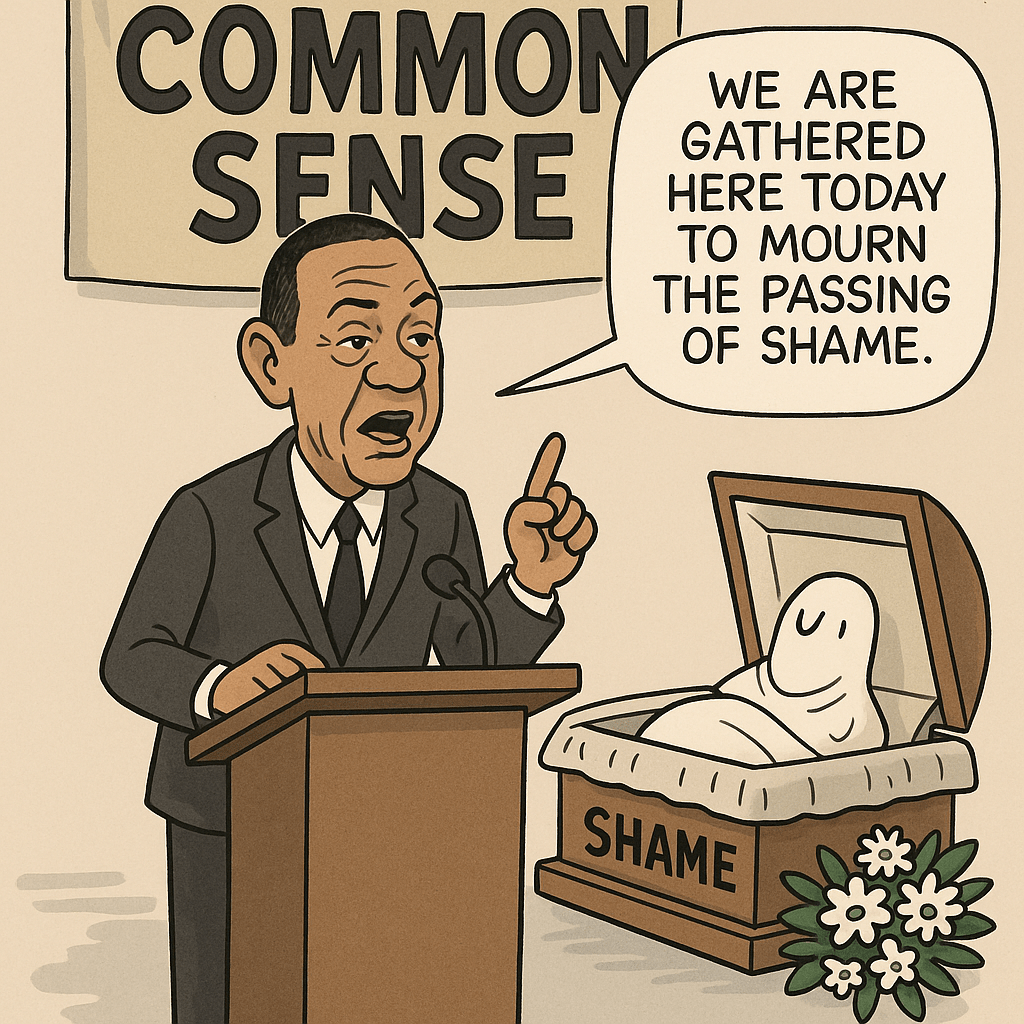
Nigerian politics has many unwritten rules, but one of the most enduring is this: alignment determines intensity. The case of Ben Murray-Bruce is not novel—it is textbook.
Strip away the rhetoric, ignore the official denials, and simply follow the chronology. What emerges is less a scandal and more a familiar institutional pattern.
The “Before”: Pressure as Policy
For nearly a decade, Murray-Bruce was entangled with the Asset Management Corporation of Nigeria over an alleged ₦11 billion debt—roughly $85–95 million using mid-2000s exchange rates.
AMCON is not known for subtlety when it decides to act.
2016: His flagship assets, including the Silverbird Galleria Lagos and its Abuja counterpart, were sealed. Receivers were appointed—effectively stripping operational control. The matter lingered, unresolved but very much alive.
Then came escalation.
July 2025: AMCON publicly listed the Silverbird Entertainment Centre Abuja for sale.
In enforcement terms, that is the endgame—liquidation. At this point, Murray-Bruce was still aligned with the opposition PDP. Pressure was not just present; it was peaking.
The “Pivot”: October Realignment
On October 15, 2025, the script flipped.
Murray-Bruce defected to the All Progressives Congress—the ruling party under President Bola Ahmed Tinubu.
The transformation was immediate and unambiguous:
A long-time critic became a vocal supporter. Public commentary shifted from skepticism to praise. The “Common Sense” brand—once a vehicle for critique—was recalibrated.
This was not ideological evolution. It was political repositioning.
The “After”: Enforcement Fatigue
Post-defection, something subtle but telling occurred: momentum dissipated.
Despite the July 2025 listing:
The Abuja Galleria was not visibly transferred to new ownership. The Silverbird brand remained operational. Public enforcement updates became scarce.
By early 2026, Murray-Bruce had re-emerged—not as a distressed debtor—but as a visible APC insider and delegate.
In Nigeria’s political economy, that transition is not cosmetic. It is protective.
Institutional Reality: Leverage, Not Justice
It is important to state clearly:
No court has publicly established that any explicit quid pro quo occurred.
But Nigerian governance often operates in a space where formal proof is unnecessary to observe functional outcomes.
Agencies like AMCON, alongside bodies such as the Economic and Financial Crimes Commission and the Independent Corrupt Practices Commission, do not act in a vacuum. Their intensity is frequently correlated with political context.
What changes is rarely the case file.
What changes is priority.
The Pattern Nigerians Recognize
This is why the Murray-Bruce episode resonates. It fits a well-established template:
Sustained pressure while outside power Strategic realignment Gradual de-escalation of enforcement Rehabilitation within the political establishment
It is less about innocence or guilt, and more about proximity to power.
The Bottom Line
The ₦11 billion AMCON case did not need to disappear to become irrelevant.
It simply needed to lose urgency.
And in Nigerian politics, urgency is rarely legal—it is political.
So when people say, “the case is gone,” they misunderstand the system.
The case is still there.
It has just been… deprioritized.
Welcome to the System
This is not an anomaly. It is continuity.
In Nigeria, accountability is often negotiable, enforcement is elastic, and affiliation can be the difference between liquidation and rehabilitation.
No dramatic courtroom twist.
No official announcement.
Just a quiet shift in the machinery.
And everyone who understands the system knows exactly when it happens.
 Centre for Nigeria Progress