


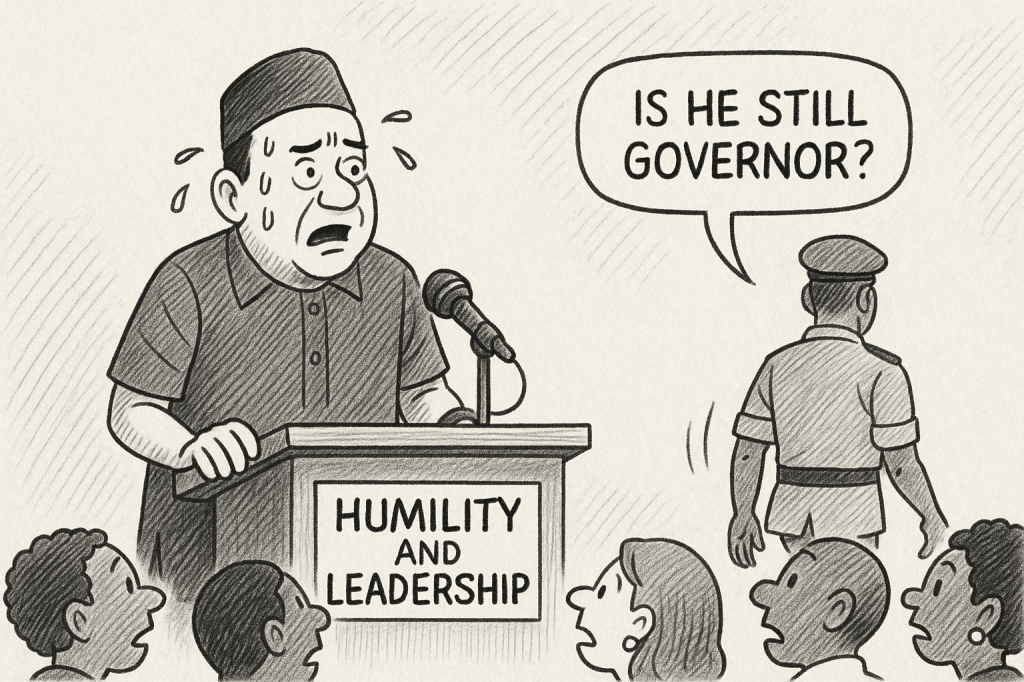
There are three things a Nigerian politician cannot do without: a convoy, dark sunglasses (indoors), and an ADC in crisp uniform standing directly behind them like a decorative piece of state furniture.
The ADC — Aide-de-Camp, in theory — is meant to be a disciplined military officer assigned to assist with protocol and security. In practice, however, in Nigeria, the ADC is an emotional support human in camouflage. A visible assurance that, “I am important enough to have someone frown on my behalf.”
Watch any event: whether it’s a governor commissioning a borehole or a minister launching a “digital economy” without internet, the ADC is always there — straight-backed, expressionless, and loyal to the end. They don’t blink. They don’t smile. They just stand there like a combination of statue, shadow, and body deodorant.
The politician could be addressing school children, cutting a ribbon, or explaining away missing billions — the ADC’s presence must be felt. Not doing so would risk the entire ceremony losing its sense of authority. Nigerians might begin to think, “Wait, is this man really in power? Where is his ADC?”
It’s a curious addiction — the visible ADC as an extension of ego. You could remove the microphone, the budget, even the national anthem, but remove the ADC, and the official would suddenly feel naked. In fact, there have been sightings of nervous ministers turning around mid-speech to make sure their ADC was still there.
Some even insist on two: one military, one police — just in case the first gets tired of standing still or, heaven forbid, blinks too much. A governor once allegedly cancelled a photo session because his ADC was wearing the wrong shade of ceremonial white — imagine that, the state on pause over mismatched starch levels.
In other countries, leaders want to appear relatable. They roll up their sleeves, shake hands, and maybe take a bus ride for the cameras. In Nigeria, relatability is for the weak. Power must be performed — and no performance is complete without the ADC prop behind the actor.
The funniest part? Half the time, the ADC looks more presidential than the politician. Immaculate uniform, posture straight, jaw set like he’s auditioning for a Nollywood remake of 24. Meanwhile, the principal is fumbling through a speech written by an intern who once failed English summary in WAEC.
It’s a national syndrome — call it ADC Dependency Disorder (ADD). Symptoms include:
inability to attend public events alone,
constant need for a uniformed presence behind one’s chair,
mild panic attacks when the ADC steps out to take a call.
Perhaps one day, a truly reformist leader will rise and say, “No ADC behind me. I stand with the people.” But until then, the nation shall continue to watch these decorated mannequins of authority, standing solemnly as our rulers give yet another speech on “transformational leadership.”
In Nigeria, power isn’t real until it’s flanked by khaki.

