

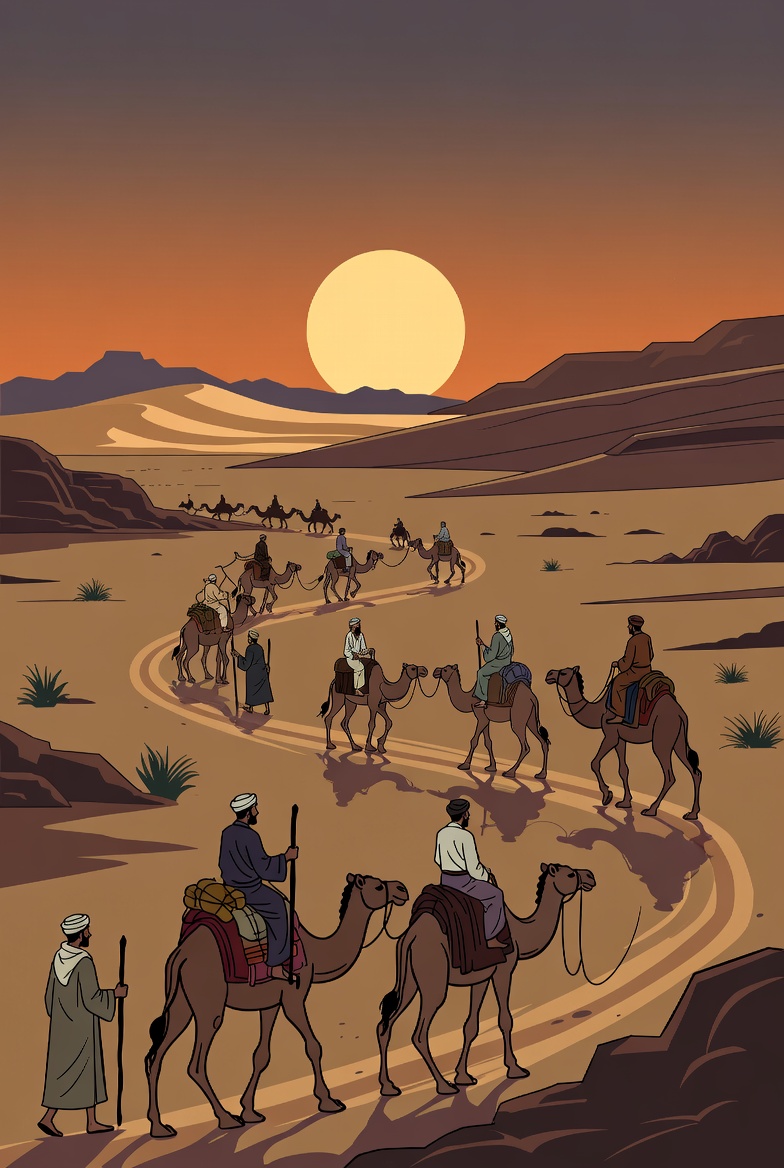

If history were a courtroom drama, the trans-Atlantic slave trade would be the loud, theatrical defendant—always in the dock, always in the documentaries, always in the schoolbooks. Meanwhile, its quieter accomplice, the trans-Saharan slave trade, would be the shady figure sitting in the back row wearing dark glasses and pretending to read the Qur’an, hoping nobody calls its name.
But call it we must, because Africa’s historical trauma didn’t just come from the West. A great deal of it rode on camels, crossed deserts, and settled into the cultural psyche of entire regions in ways we still haven’t fully unpacked.
The Shadow Empire Nobody Talks About
The Arab invasions and centuries of trans-Saharan slave trading carved deep psychological grooves across North and East Africa—grooves so subtle that many modern Africans don’t recognise the fingerprints on them.
In North Africa, Arabisation wasn’t simply a cultural influence; it was full reupholstering. Language, religion, aesthetics, even concepts of identity were wrapped in a new cloth. Many North Africans today will confidently declare, “We aren’t African—we are Arab,” while standing firmly on the African continent, drinking African water, and arguing over the African Cup of Nations.
Identity is a powerful thing… and colonialism—whether European or Arab—is extremely good at rearranging it.
Somalia: The Case Study in Identity Gymnastics
If you want to understand the long-term psychological impact of this forgotten trade, look no further than Somalia. Somalia is Africa’s identity paradox wearing a beautifully patterned macawiis.
Many Somalis today, faced with complex historical and social circumstances, culturally lean northward across the Red Sea rather than westward across the continent. Some speak of “Arabic heritage” with pride, distancing themselves from the very continent they inhabit—as though Africa were a rowdy neighbour they would rather not be associated with.
It’s the historical equivalent of someone in a London council flat insisting they are descended from the House of Windsor because their uncle once worked at Buckingham Palace.
But this identity crisis didn’t appear out of thin air. It’s rooted in the centuries-long trade system that moved millions of Africans northward and eastward, often under brutal and dehumanising conditions. A system so quiet, so unrecorded, and so conveniently unmentioned in Arab historical narratives that Africans themselves sometimes forget it happened.
If trauma had a publicist, the trans-Saharan trade’s one was brilliant—it kept everything off the record.
Africa’s North: The Continent-within-a-Continent
North Africans often see themselves as part of the broader Arab world, emotionally and culturally. And there is nothing inherently wrong with that—identity is complex and layered. But the insistence that Arabic heritage erases African identity is where the historical wound shows.
When an Egyptian insists, “We are not Africans,” Nigerians often respond: “But you play in the AFCON. You are literally in the group stage!”
Meanwhile, Morocco wins AFCON matches and still debates whether to celebrate like Africans or Arabians. Tunisia plays African teams but identifies as Middle Eastern. Algeria sends teams to African competitions while half the squad speaks about Africa like they’re visiting cousins.
Identity is fascinating until it becomes farce.
The Real Question: What Does Africa See in the Mirror?
History doesn’t just live in textbooks—it lives in how people see themselves. The trans-Saharan slave trade left psychological consequences that outlived its camel caravans:
A hierarchy that placed “Arab” identity above “African” identity
Social systems in East Africa where people tried to “whiten” their roots
Communities that internalised the idea that African identity was something to escape rather than embrace
It’s historical gaslighting, centuries in the making.
And while Africa has healed loudly from European colonialism, it has barely whispered about the internal scars left by the Arab one.
In Conclusion: Africa Deserves Its Whole Story Back
If the continent is ever to fully understand itself, it must face both halves of its trauma—the European ships and the Arab caravans. Both rearranged African identity, sometimes violently, often subtly, and always with long-term consequences.
The trans-Saharan trade may have been the quieter sibling of the Atlantic trade, but its psychological impact still echoes from Cairo to Mogadishu, and from Khartoum to the desert frontiers of Mali.
Africa must reclaim its story—not the edited version, not the convenient version, but the whole version. Because healing doesn’t come from pretending; it comes from telling the truth. Even the uncomfortable parts. Even the parts whispered over desert winds.
And perhaps, one day, we can all agree that everyone living on the African continent—Arab, Berber, Nilotic, Cushitic, Yoruba, Igbo, Hausa, Fulani, or Somali—is, in fact, African.
AFCON committees everywhere will breathe a sigh of relief.
 Centre for Nigeria Progress
Though I’m not a politician, my background in history has shown me a recurring pattern: Africa has long been exploited for its slaves and valuable resources like minerals, gold, and diamonds. Why has this cycle persisted for ages, relegating the continent to the status of a third-world country?
LikeLike
I am certain you meant to write Africa exploited for slaves not of its slaves. Semantics, I know but important. Others have had the African experience but with lesser degrees. There are greenshots of African recovery and growth. Part of that growth, is looking back to go forward. Thanks for engaging
LikeLiked by 1 person
You are right, I messed up with words
LikeLiked by 1 person
No messing, easy error to make, your empathy comes through and God bless your kind heart ❤️
LikeLiked by 1 person
God bless the world especially now.
LikeLiked by 1 person