

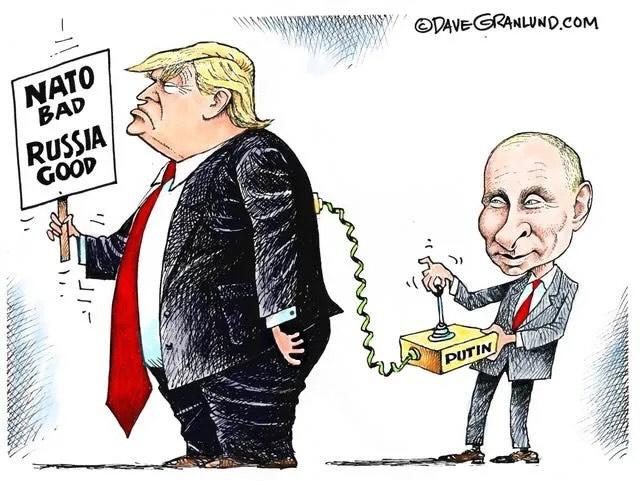

Donald Trump’s relationship with NATO has always resembled a landlord who inherited a building, refuses to fix the roof, then complains that the tenants are getting wet for free.
From his very first appearance on the NATO stage, Trump made it clear that he regarded the alliance not as a collective security arrangement but as a kind of geopolitical GoFundMe page—one where America pays too much, Europe freeloads shamelessly, and only he, Donald J. Trump, alone, uniquely, magnificently, can “solve it.” NATO, in Trumpian theology, was not a cornerstone of post-war stability but a bad business deal negotiated by idiots who clearly lacked his talents.
His demand was simple: pay up or else. Security, under Trump, became a transactional service. Article 5 was downgraded from a sacred commitment to something closer to an optional subscription—NATO Plus, billed annually, cancellation available if Europe annoyed him on Twitter. Protection was no longer a shared obligation; it was a quid pro quo, preferably prepaid and preferably accompanied by flattery.
Fast-forward to his second coming, and the contempt has only grown more casual. This time, he didn’t even bother turning up personally. Instead, his vice president was dispatched to Europe to deliver the message with barely concealed disdain: NATO is surplus to requirements. Outdated. A relic. A club that should perhaps be closed down and replaced with something leaner, cheaper, and—one suspects—more obedient.
Then came Greenland.
In what can only be described as imperial nostalgia breaking through the surface, Trump openly threatened to “take” Greenland from Denmark, as if it were an unused parking space or a distressed asset ripe for acquisition. Denmark, understandably startled by the idea that a NATO ally was now eyeing its territory like a Monopoly square, responded with an extraordinary warning: such a move would put NATO itself at risk.
And there it was—the quiet part said out loud. The United States, under Trump, would be perfectly content to lose NATO.
This should not surprise anyone. NATO constrains Trump. It requires consultation, compromise, and respect for allies who do not kneel. It assumes a world in which shared values matter more than shared skin colour, and where democracy is preferable to “strong leadership” delivered with a scowl and a flag.
Trump’s America does not need NATO. What it needs, apparently, is a new alignment—one more comfortable, more familiar. An alliance with “white Russia,” perhaps: a world where power is personal, borders are suggestions, elections are inconvenient rituals, and loyalty flows upward to the strongman at the top.
In this worldview, Denmark’s sovereignty is negotiable, alliances are expendable, and history is something to be undone rather than learned from. The lesson of the 20th century—that collective security prevents catastrophe—is discarded in favour of a simpler creed: might makes right, and deals are better than principles.
NATO was never perfect. But it was never meant to be a business venture, nor a favour the United States did for lesser nations. It was a mutual insurance policy against chaos. Trump, however, sees no value in insurance. He prefers risk, bravado, and the comforting illusion that nothing bad will happen so long as he is in charge.
If NATO does fall apart, it won’t be because Europe failed to pay its dues. It will be because America decided that alliances are burdens, democracy is optional, and conquest—whether rhetorical or real—is once again fashionable.
And Greenland? It is merely the opening bid.

