

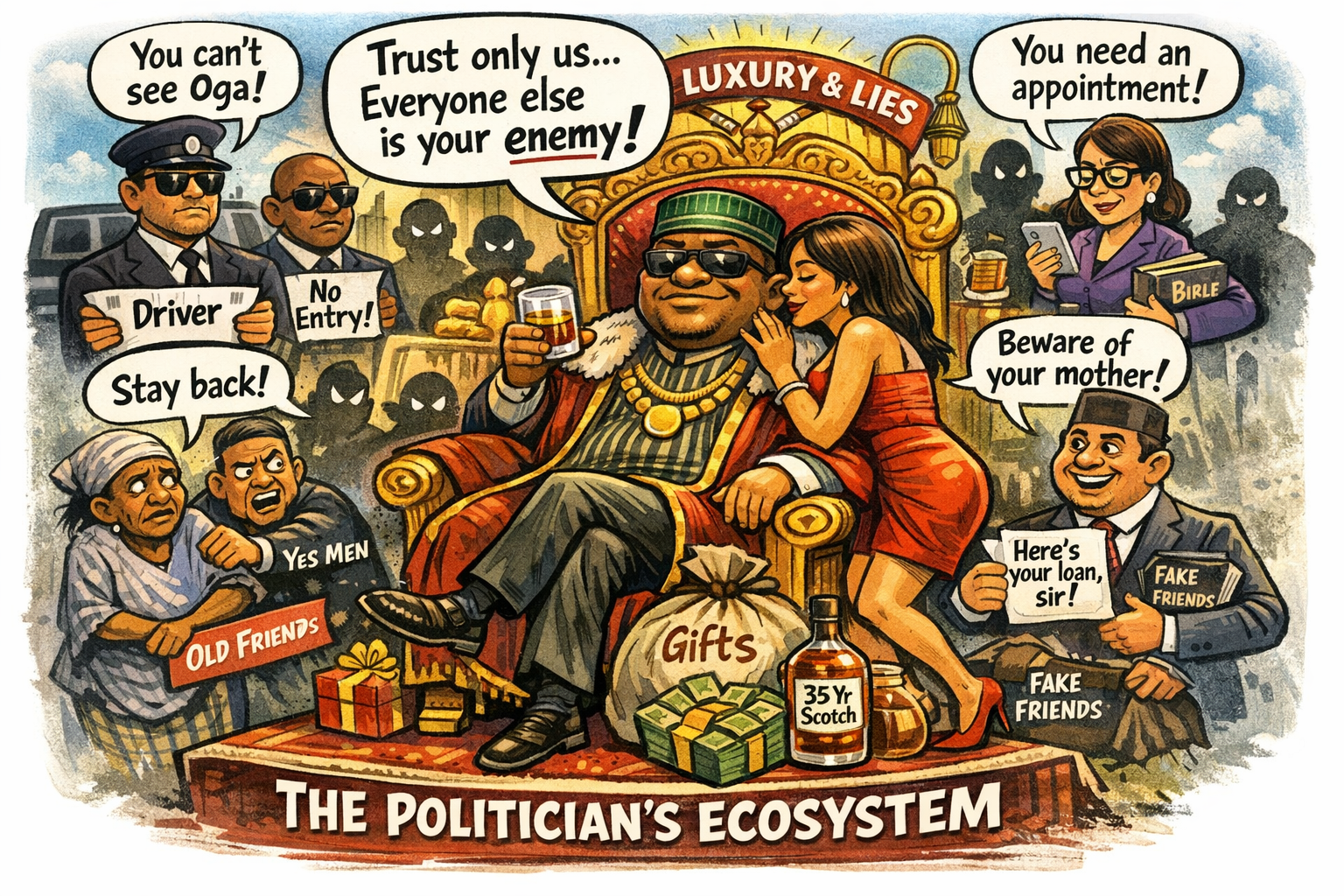

Power in Nigeria does not arrive alone. It comes with luggage—overweight, unclaimed, and suspiciously packed by other people.
Once you gain prominence, whether by election, appointment, or sudden economic elevation, an ecosystem forms around you. Not a natural one—this is not rainforest biodiversity—but a carefully cultivated human barricade. Family, friends, distant cousins, and acquaintances by two degrees of separation assemble like ants around sugar. Whether you like it or not, you are no longer accessible. Access becomes a commodity.
Your driver suddenly becomes a protocol officer. The gateman is promoted to chief of staff. The secretary is now the final court of appeal. Each one denies access on your behalf, allegedly to “protect” you. They hold the keys, literally and metaphorically. To see you, one must pay—cash, gifts, favours, or the promise of future patronage. Even you, on occasion, may need clearance to see yourself.
Slowly, you begin to live in rarefied air. Your reality is edited. Your weaknesses are airbrushed. Your importance is exaggerated. You are made to feel celestial—a tin god, yes, but a god nonetheless. Enemies begin to appear everywhere. Curiously, none of these enemies were created by you. They are manufactured by your hangers-on as part of the security architecture. Fear is useful. Suspicion is adhesive. It keeps you locked inside the bubble, dependent on the very people who built the walls.
You are told to trust no one but them. Old friends are suddenly “dangerous”. Your mother, you are warned, might be a passer-by with ulterior motives. Your religious leader acquires oversized importance in your life, offering divine endorsement for earthly excess. You receive gifts you never asked for and become indebted to people you barely recognise. Gratitude becomes a chain.
Your circle shrinks and expands at the same time. You see fewer people, but more faces. You suddenly discover best friends you never knew you had—men who always believed in you, especially now that you have a convoy.
Romance, too, is upgraded. Women who once failed to give you the time of day now profess undying love. You reassess your domestic situation. The wife of twenty years, you conclude, is somehow too dark, too short, too ordinary for your new altitude. Reinvention demands sacrifice—usually by others.
Your tastes change. You can no longer stomach food cooked more than two hours ago. Your palate becomes aristocratic overnight. Local gin must not be sighted anywhere near you—it is uncouth, ancestral, beneath you. You discover Scottish whisky, preferably 35 years old, and develop an emotional attachment to its price tag. You get pre-approved bank loans without collateral. The banks, like everyone else, have sensed destiny.
This, in a nutshell, is how we govern ourselves in Nigeria.
The ecosystem is not imposed from above; it is constructed from below upwards. It is sustained by ambition, fear, opportunism, and proximity. It insulates leaders from reality and replaces governance with theatre. When everyone around you benefits from your isolation, truth becomes a security risk.
In such an environment, good governance is not just difficult—it is structurally impossible. You cannot fix problems you are not allowed to see. You cannot hear the people when your ears are rented out. And you cannot lead a society when your ecosystem is designed to feed on power rather than restrain it.
Power corrupts, yes—but in Nigeria, it is first carefully curated.

