

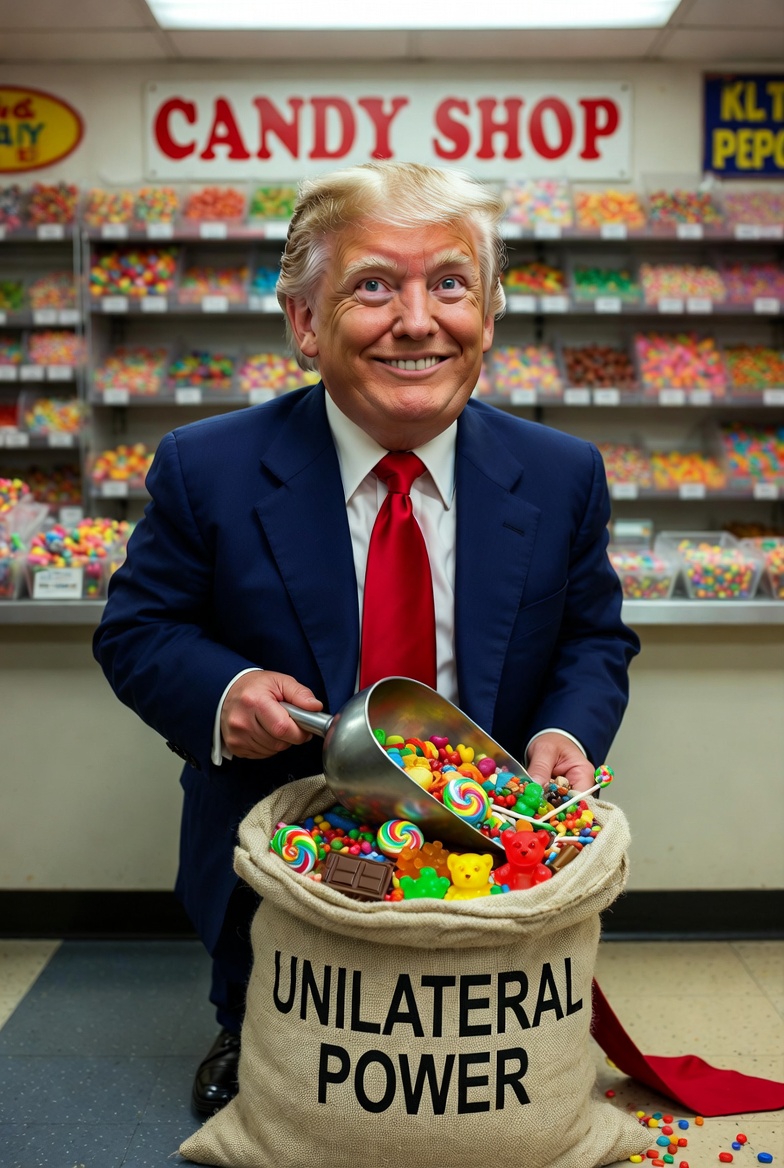

There is something uniquely theatrical about a president who has a compliant Congress and yet insists on governing as though Congress were an inconvenience best left on “mute.”
Enter Donald Trump BBC, a man who, when handed the levers of power, prefers to pull all of them at once.
With a friendly House and a Senate allergic to confrontation, one would assume tariffs, those blunt instruments of economic warfare, would pass through the constitutionally prescribed route. Draft bill. Committee markup. Debate. Vote. Signature. The boring but necessary choreography of republican government.
But no.
Instead, tariffs were imposed unilaterally, as though the Oval Office were a checkout counter and the President a child in a candy shop, loading up on executive orders because the sweets were within reach. Congress? Optional. Consultation? Overrated. Deliberation? For the weak.
The Constitutional Bypass
The U.S. Constitution is not ambiguous on this point. Article I vests the power to regulate commerce with foreign nations in Congress. Tariffs are taxes. Taxes are legislative. The Founders did not draft a document that said: “Unless the President feels particularly bold that morning.”
Yet through expansive interpretations of statutes such as the International Emergency Economic Powers Act and Section 232 of the Trade Expansion Act, the executive branch has slowly swallowed Congress’s lunch and then sent Congress the bill.
Trump did not invent executive overreach. But he refined it into a governing style. He did not merely stretch statutory language; he treated it like elastic.
“My Supreme Court”
For years, we heard about “my generals,” “my DOJ,” and of course, “my Supreme Court.” The possessive pronoun was not accidental. It revealed a worldview: institutions are extensions of the man, not constraints upon him.
But institutions, especially courts, have a way of occasionally remembering what they are for.
In a moment of judicial sobriety, the Supreme Court of the United States ruled against the careless imposition of tariffs that bypassed congressional authority. The Court reminded the executive branch that emergency powers are not decorative accessories to be worn at political rallies. They are meant for emergencies.
It was a constitutional speed bump placed squarely in the path of presidential ego.
The Irony
The irony is delicious.
A President with legislative backing chose the shortcut. A Congress that could have formalized his policies was treated as ornamental. And the very Court he believed ideologically aligned with him acted, gasp like a court.
The lesson here is not partisan. It is structural.
Democracies erode not only when opposition parties resist, but when governing parties surrender their institutional responsibilities out of loyalty or fear. Congress’s passivity invited executive adventurism. The Court’s intervention was less a rebellion than a reminder: separation of powers is not a suggestion.
Governing Like a Brand
Trump’s approach to tariffs was consistent with his broader political method: governance as spectacle. Announce big numbers. Shock markets. Declare victory. Repeat.
But trade policy is not a branding exercise. It reshapes supply chains, affects consumer prices, and can ignite retaliatory measures. When executed through unilateral impulse rather than legislative consensus, it also reshapes constitutional norms.
The real issue is not whether tariffs are good or bad economics. Economists will duel endlessly over that. The issue is who decides.
In a republic, power fragmented is liberty preserved.
In an ego-driven presidency, power consolidated is strength displayed.
Until it isn’t.
And when even “your” Supreme Court tells you no, it is a reminder that in America shining city or not institutions still occasionally remember that they serve the Constitution, not the occupant of 1600 Pennsylvania Avenue.
For now, at least.
 Centre for Nigeria Progress