

Every few months, when Budapest blocks an EU resolution, delays sanctions, or delivers another lecture on “illiberal democracy,” the same exasperated question echoes across Brussels dinner tables:
Why is Hungary still in the European Union?
Its current prime minister, Viktor Orbán, has proudly declared his model an “illiberal state.” He spars with EU institutions over judicial independence, media pluralism, LGBTQ rights, and academic freedom. He has cultivated a cordial relationship with Vladimir Putin while the rest of the bloc funds Kyiv against Moscow. He has positioned himself as an ideological ally of Donald Trump, styling Budapest as a laboratory for nationalist conservatism.
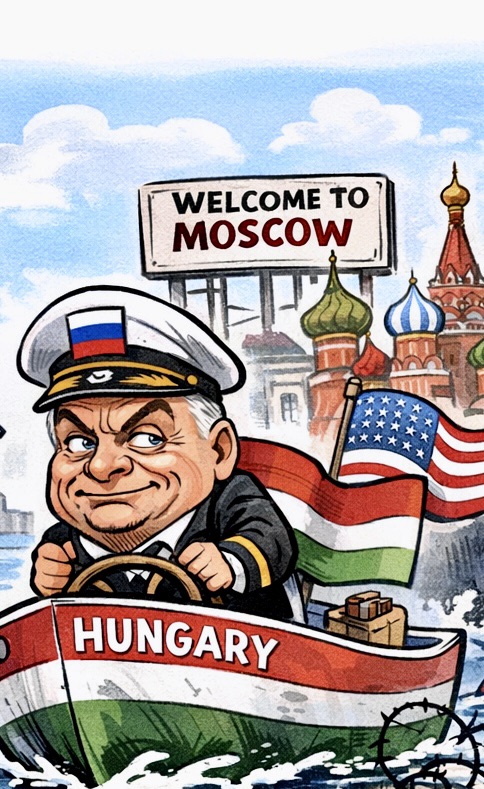
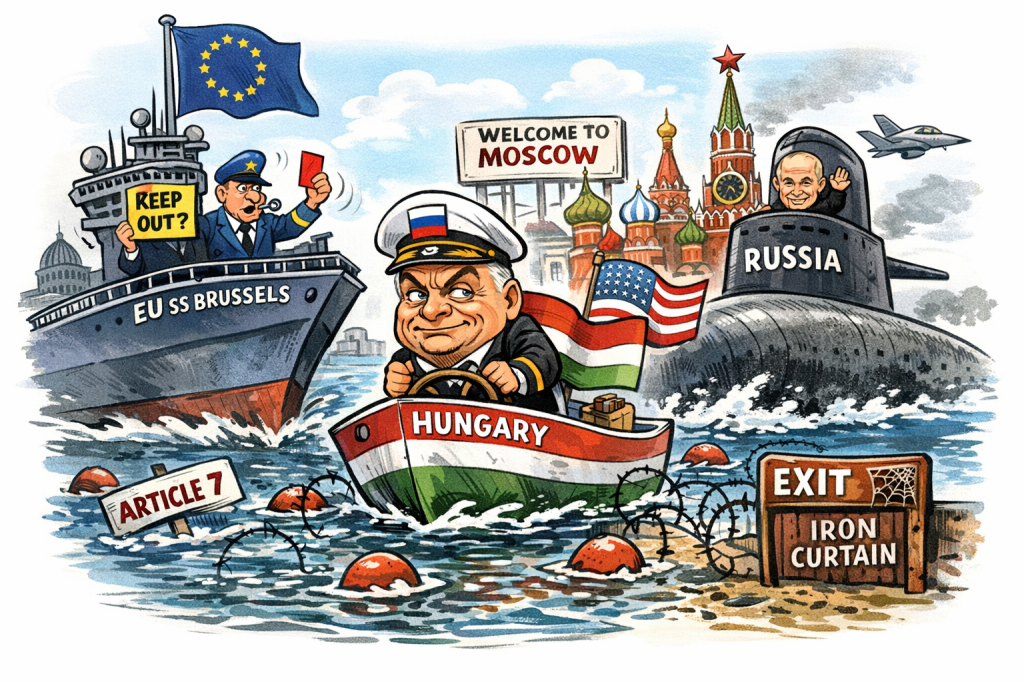
To critics, Hungary looks less like a member state and more like a diplomatic aircraft carrier drifting between Moscow and Mar-a-Lago.
So why not show it the red card? Why not “Hunxit”?
The answer is frustratingly technical, legally constrained, and politically revealing.
1. There Is No Mechanism to Expel a Member State
The EU treaties—those dense constitutional instruments lawyers adore and politicians pretend to read—contain Article 50, the clause that enabled United Kingdom to leave the Union after its referendum in 2016.
But there is no Article “You’re Fired.”
The treaties provide for voluntary withdrawal. They do not provide for expulsion.
The closest tool available is Article 7 of the Treaty on European Union, often called the “nuclear option.” It allows for suspension of certain rights—most notably voting rights in the Council—if a member state seriously breaches EU values such as democracy and rule of law.
However, activating its most severe stage requires unanimity among the other member states.
And here lies the legal chessboard: unanimity is a high bar in a club of 27 governments, many of whom are cautious about setting precedents that might one day be used against them.
In other words, you can reprimand Hungary. You can freeze funds. But you cannot simply eject it.
2. The EU Is a Legal Order, Not a Political Mood
The European Union is not a debating society. It is a rules-based legal order with binding treaties. Membership is not contingent on ideological conformity to the prevailing mood in Brussels.
Orbán was elected. Repeatedly.
His party commands parliamentary majorities. Opposition exists, though critics argue that the playing field is uneven. But from a strictly formal perspective, Hungary remains a constitutional democracy with regular elections.
The EU’s dilemma is philosophical: how do you defend liberal democracy without overriding the democratic choices of a member state’s electorate?
To expel Hungary for electing Orbán would require the EU to become something it claims not to be: a supranational arbiter of acceptable political ideology.
That paradox sits at the heart of the debate.
3. Follow the Money
Hungary is a net beneficiary of EU funds. Billions of euros flow into infrastructure, agriculture, and regional development.
Brussels has increasingly weaponised conditionality. Funds have been frozen over rule-of-law concerns. Financial leverage, rather than expulsion, is the preferred instrument.
Why? Because economic interdependence is a disciplining mechanism.
If Hungary were outside the EU, Brussels would lose that leverage entirely.
Sometimes keeping a troublesome member inside the tent is more strategically useful than pushing it into geopolitical exile.
4. The Russia Question
Orbán’s government has been more accommodating toward Moscow than most EU capitals, particularly regarding energy and sanctions. Critics describe him as a bridge to Russia. Supporters call it pragmatic nationalism.
But geography matters. Hungary sits in Central Europe, not on the Baltic coast or the Iberian peninsula. Energy dependence, historical memory, and economic calculation shape its posture.
Expelling Hungary would not necessarily weaken Russian influence in Europe. It might strengthen it.
A Hungary outside the EU, resentful and untethered, could drift further east—not back to the Iron Curtain, but into a grey zone where Brussels has no leverage.
5. “Hunxit” Would Not Be Clean
If Hungary chose to leave, the process would resemble Brexit: negotiations, market recalibration, trade disruption, capital flight, legal disentanglement.
But unlike the United Kingdom, Hungary’s economy is deeply integrated into EU manufacturing supply chains—especially Germany’s automotive sector.
A forced rupture would not be a neat ideological divorce. It would be an economic shockwave.
6. The Iron Curtain Rhetoric
The temptation to say “let them go back behind the Iron Curtain” is emotionally satisfying but historically careless.
Hungary fought its own revolution in 1956. It bled for sovereignty. The memory of Soviet tanks in Budapest is not theoretical.
The contemporary dispute is not about Soviet occupation; it is about the nature of liberal constitutionalism in the 21st century.
That is a different argument entirely.
7. The Political Reality
The EU is a pluralistic bloc. It includes social democrats, Christian democrats, liberals, nationalists, technocrats, and governments that oscillate between them.
The Union’s ethos is contested terrain, not a static doctrine.
Hungary tests the limits of that ethos. It frustrates federalists. It emboldens populists elsewhere. But it also forces the EU to clarify what its values actually mean—and how far it is prepared to go to defend them.
So Why Is Hungary Still in the EU?
Because:
There is no legal expulsion mechanism. Unanimity requirements make sanctions politically complex. Economic leverage works better from within. Strategic containment beats symbolic exile. The EU defines itself as a rule-of-law order—even when that order protects those who irritate it.
The question, then, is not “Why is Hungary still in the EU?”
The sharper question is this:
Can a union built on liberal democratic principles survive internal illiberalism without becoming illiberal in response?
If Brussels ever answers that decisively, the future of Hungary—and perhaps of the Union itself—will become much clearer.
Until then, there will be no Hunxit.
Only tension.
 Centre for Nigeria Progress