


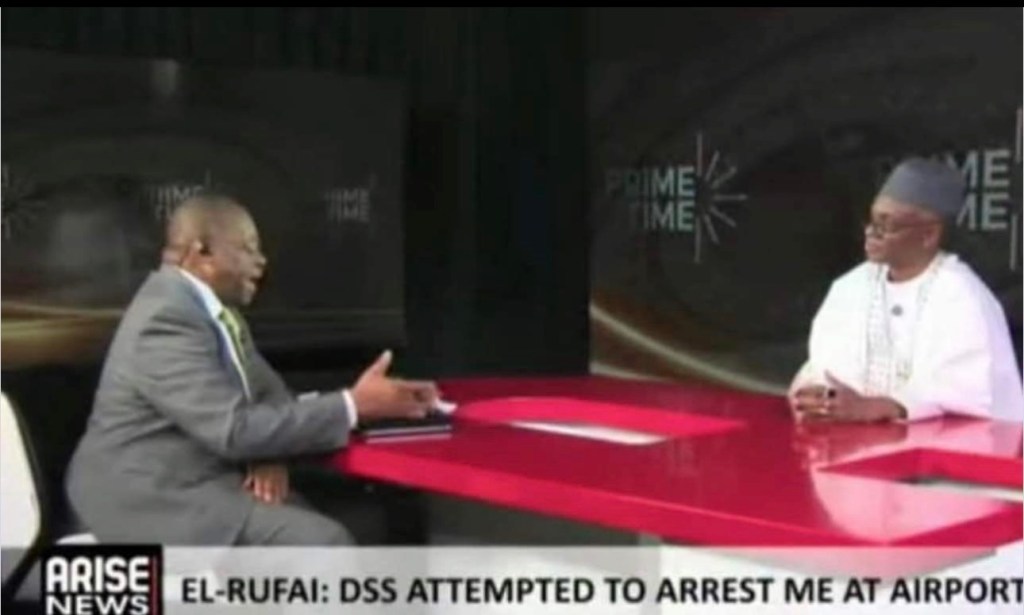
On a presumably ordinary broadcast of Arise TV, with Charles Anyagolu conducting a typically pointed interview, Nasir El-Rufai, former governor of Kaduna, former minister, serial political actor, spoke as politicians do: expansively, provocatively, and with the confidence of a man who knows microphones are not lie detectors.
Somewhere, one imagines, officials at the Independent Corrupt Practices Commission (ICPC) were watching.
And then, eureka. “We’ve got him.”
From Studio Confession to Swift Pursuit
The story, as it now circulates in the public domain, reads like a legal farce. The ICPC, allegedly triggered by what it interpreted as incriminating remarks on live television, moved to arrest El-Rufai. But before they could fully sink their institutional teeth into the moment, other alphabet agencies reportedly swooped in. The former governor was passed around the security ecosystem like a classified memo in a leaky bureaucracy, until he eventually landed in the ICPC’s custody.
Efficiency? Perhaps.
Due process? That is the more delicate question.
The Holding Charge Problem
Upon securing him, the ICPC proceeded to arraign him on what is colloquially known as a “holding charge” a procedural device widely criticised within Nigerian criminal jurisprudence and inconsistent with the spirit of the Administration of Criminal Justice framework, which discourages charging suspects without completing investigations.
The orthodox sequence in criminal law is straightforward:
Complaint Investigation Establishment of prima facie case Charge
In this case, the sequence appears inverted:
Television interview Arrest Charge Remand Investigation (still pending)
One does not require a doctorate in criminal procedure to observe the inversion.
The Great Listening Device Saga
Then came the dramatic flourish.
After arraignment and remand, the ICPC raided El-Rufai’s residence and announced with suitable institutional fanfare the discovery of “listening devices.”
This development briefly threatened to transform the matter from alleged financial impropriety into something resembling Cold War espionage.
The family promptly issued a categorical denial: no such devices were found.
Faced with public skepticism, the ICPC published a list of items seized. The inventory reportedly included worn-out computers and a collection of ageing mobile phones, among them the venerable Nokia N95.
At this point, the national mood shifted from alarm to bemusement.
Was this evidence of grand corruption? Or the remnants of a politician who never quite updated his gadgets after leaving office? One could be forgiven for wondering whether El-Rufai was curating a technological museum titled “The Evolution of Governance: 2007–2015.”
Forensics After the Fact
The most curious element, however, is the announcement that these antique devices are being sent for forensic analysis.
Forensic analysis.
Which raises the question: on what evidential foundation were charges formulated in the first place?
Criminal prosecution is not meant to operate on speculative retrofitting. Investigative agencies are constitutionally mandated to establish reasonable grounds before depriving a citizen, even a controversial one, of liberty. When investigation follows charge rather than precedes it, the optics are troubling and the jurisprudence even more so.
Charging first and investigating later is the procedural equivalent of writing a judgment and then looking for supporting authorities.
A Systemic Pattern
This episode, regardless of one’s views on El-Rufai’s politics or personality, reflects a deeper pathology in Nigeria’s law enforcement culture: action for spectacle, investigation as afterthought.
Watching television as an investigative trigger is not inherently improper; public admissions can and do ground investigations globally. But the crucial distinction lies in what follows: discreet evidence gathering, careful case-building, prosecutorial review, not an immediate sprint to court for remand while forensic teams are still dusting keyboards.
The rule of law does not demand that suspects be liked. It demands that procedures be respected.
The Broader Implication
Today it is El-Rufai, opposition organiser with the ADC, former governor, high-profile political antagonist. Tomorrow it could be someone less connected, less resourced, less able to mount a public defence.
Criminal justice institutions derive legitimacy not from dramatic raids or press statements, but from procedural discipline. When agencies appear to prioritise headlines over investigation, they weaken their own cases and erode public confidence.
If indeed computers are only now being examined to determine what, if anything, they contain, then the question remains unavoidable:
How were the charges conceived?
In criminal law, the horse is investigation. The cart is prosecution. Reverse the order, and you do not merely inconvenience one defendant, you destabilise the architecture of justice itself.
And that is not a partisan concern. It is a constitutional one.
A dark day? Perhaps not yet irreversible. But certainly a cautionary one for a system that too often mistakes movement for method.
 Centre for Nigeria Progress