


During the early years of World War II, Adolf Hitler’s Germany believed it had discovered the formula to break Britain’s will. The answer, they thought, lay in terror from the sky. Beginning in 1940, the German Luftwaffe launched the sustained bombing campaign known as the The Blitz, raining explosives on London and other British cities in the hope that civilian suffering would force the British government to sue for peace.
It was a brutal calculation: make life unbearable for the population and the government will bend.
The British government, led by Winston Churchill, did not bend. Instead, it responded in the only language war ultimately recognises — escalation. Allied bombers later turned German cities into targets of devastating aerial retaliation. Among the most infamous of these operations was the bombing of Dresden in 1945, a raid that caused massive destruction and heavy civilian casualties.
History still debates the morality and necessity of that act. What history does not debate, however, is the basic strategic reality: once you start a war, you no longer control how the other side chooses to fight it.
That is the gambler’s risk of aggression.
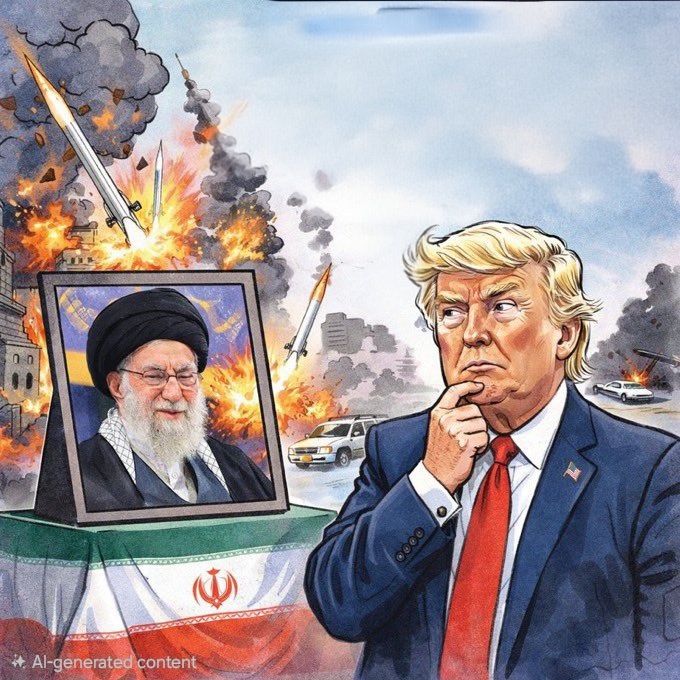
There is an old rule in conflict, as old as warfare itself: when you fight a snake, you strike the underbelly. You do not politely tap its scales and ask where it prefers to be hit. War is not governed by the comfort of the attacker; it is governed by the desperation of the attacked.
An aggressor therefore has a duty — if not moral, then at least strategic — to think several moves ahead. If you strike first, you must consider the retaliation. Where are your vulnerabilities? What will your opponent target? What happens if the response is harsher than the original blow?
These are not philosophical questions. They are the basic arithmetic of war.
Yet modern geopolitics sometimes carries an odd assumption: that certain states possess the exclusive right to determine how conflicts unfold, while their adversaries are expected to react within neatly defined boundaries.
This assumption is visible in the posture often taken by Israel, the United States, and their allies. Military action is justified as necessary, defensive, or pre-emptive — but the retaliation of the other side is immediately condemned as illegitimate, disproportionate, or irrational.
In other words, one side reserves the freedom to strike wherever it chooses, while insisting that the other side must respond politely, predictably, and preferably not at all.
History offers little support for such expectations.
Wars rarely proceed according to the script written by the side that fires the first shot. The attacked adapt. They exploit weaknesses. They target vulnerabilities. And they rarely do so according to the preferences of those who initiated the confrontation.
To complain about retaliation after launching an attack is rather like complaining about gravity after jumping off a cliff.
Statesmen who contemplate war should remember this before they act. Once the snake is struck, it does not politely negotiate the angle of its bite.
As the line from Hamlet reminds us, when events begin to defy logic and hypocrisy becomes the order of the day, one may fairly conclude that “something is rotten in the state of Denmark.”
 Centre for Nigeria Progress