

Nigeria prides itself on producing remarkable individuals who have climbed the ladder of commerce and influence. Among them stands Aliko Dangote, a businessman whose empire now stretches across Africa in cement, sugar, flour, and oil refining. His story is often narrated as a triumph of entrepreneurial brilliance. Yet, a closer examination suggests a more complex tale—one where state power, policy choices, and private ambition converged to create a modern industrial baron.
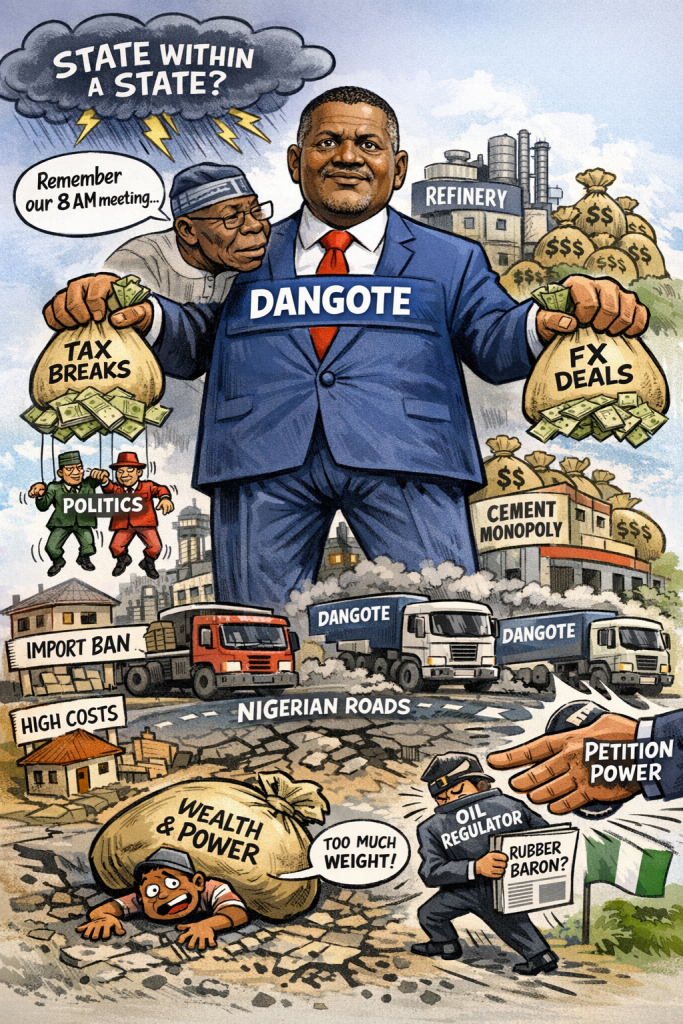
Like many great fortunes, the Dangote empire did not emerge in a vacuum. It developed within the intimate corridors of political power. Dangote himself once narrated an encounter with Nigeria’s former president, Olusegun Obasanjo. According to the story, he received an invitation to meet the president at 8 a.m. Dangote reportedly wondered why the meeting could not be scheduled at a more civilized hour, but the president insisted.
When Dangote arrived, the outcome of that early morning meeting proved consequential. The government sold existing state-owned cement plants to him and granted him what was effectively a near-monopoly in cement production and sales. To further sweeten the arrangement, the government banned the importation of cement into Nigeria.
The result was predictable. Cement prices rose dramatically—some would say by close to a thousand percent. In a country already struggling with housing deficits, the ripple effect was immediate. The cost of building materials surged, and with it the cost of housing. The policy that enriched one industrial champion simultaneously imposed higher costs on millions of Nigerians aspiring to build homes.
The pattern repeated itself when Dangote turned his attention to the petroleum sector. When constructing his vast refinery project, the Nigerian government reportedly bought shares in advance, effectively providing early financial backing that helped the businessman secure the massive funding required for the venture. It was not merely private enterprise at work; it was private enterprise riding on the shoulders of the state.
Across Nigeria today, Dangote’s trucks crisscross highways and rural roads, transporting cement and other products. Their constant movement is a testament to the scale of the enterprise—but also a reminder of the strain placed on public infrastructure. Nigerian roads, already fragile, have borne the weight of this industrial expansion.
Beyond logistics and infrastructure, Dangote’s businesses have benefited from special tax regimes and favourable foreign exchange arrangements—advantages that smaller competitors can scarcely dream of accessing. Such preferential treatment reinforces a system where economic concentration becomes inevitable.
Yet perhaps the most telling episode occurred when a regulator in Nigeria’s oil sector attempted to limit Dangote’s influence. In response, Dangote submitted a damning petition alleging corruption within the regulatory establishment. The details contained in that petition suggested that he had long been in possession of sensitive information—information deployed strategically when he needed to push back against perceived threats.
This reveals the sophisticated survival instincts of a businessman who understands that power in Nigeria is not merely economic; it is deeply political. Over the years, Dangote has carefully maintained relationships across the political spectrum, cultivating alliances with competing parties and political figures alike. In doing so, he has ensured that regardless of who occupies the seat of power, his empire remains protected.
The result is a phenomenon that increasingly resembles a “state within a state.” Dangote’s companies shape markets, influence policy debates, and command logistical networks that rival government capacity in some sectors.
History offers parallels. In the United States during the late 19th and early 20th centuries, industrial magnates such as Henry Ford rose to enormous prominence in an era often described as the age of the “robber barons.” These figures accumulated vast fortunes in industries like railroads, steel, and automobiles at a time when regulatory oversight was weak or non-existent.
Eventually, American institutions responded. Antitrust laws, regulatory agencies, and political reforms were introduced to curb excessive concentration of power in private hands.
Nigeria today may be approaching a similar moment of reckoning.
Dangote’s rise is undeniably impressive. Building a multinational industrial conglomerate in a challenging business environment requires vision, persistence, and formidable managerial skill. But the broader question remains: when a single industrial titan grows so powerful—benefiting from state policies, regulatory advantages, and political alliances—can the system sustain that concentration of influence?
Nigeria may soon discover whether it has created not merely a successful businessman, but an economic force whose weight the nation itself must learn to balance.

