


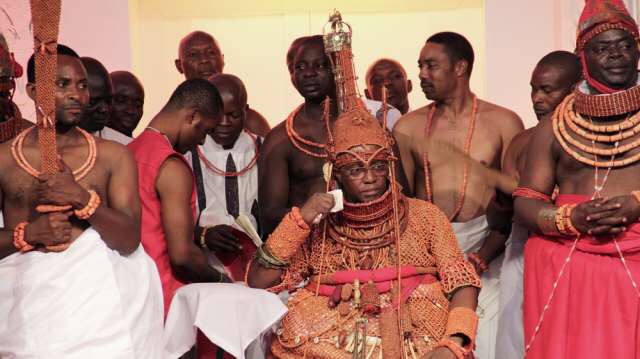
There was a time when the authority of the Benin monarchy did not need explanation, defence, or public relations management. It simply was. The throne of the Oba commanded reverence, not because of press statements or reactive letters, but because its institutional discipline, cultural clarity, and political neutrality were beyond reproach.
Today, however, the Edo Traditional Council appears to be engaged in a troubling experiment: testing just how much reputational damage a revered institution can absorb before its mystique collapses under the weight of administrative incompetence.
This is not a sudden decline. It is a pattern—consistent, layered, and now unavoidably public.
A Collision Course: Tradition Meets Political Power
The confrontation in Benin City involving Folashade Tinubu-Ojo, daughter of Bola Tinubu, remains a defining flashpoint.
Her attempt to impose a centralised market leadership model—culminating in the installation of a state-wide Iyaloja—was rejected by both the palace and market women. The Oba of Benin, Oba Ewuare II, made it clear: Benin’s market system is decentralised, culturally embedded, and not subject to external redesign.
This was not administrative friction. It was a constitutional clash dressed in market language.
Governance Breakdown: A Council That Cannot Control Events
Even where the palace holds the stronger legal and cultural argument, the Edo Traditional Council continues to fail in the basics:
Timely responses Clear communication Strategic anticipation
In each crisis, the council arrives late, speaks ambiguously, and leaves room for competing narratives to flourish.
The Obaseki Years: When Politics Invaded Tradition
The institutional fragility became most visible during the tenure of Godwin Obaseki.
Cash vs. Authority
By diverting payments to Enigies through local governments, the state triggered a fundamental dispute over control of the traditional hierarchy. The palace saw this not as reform, but as erosion.
The succeeding administration under Monday Okpebholo would later describe elements of this approach as an attempted “balkanisation” of the Benin Kingdom—reversing policies and reaffirming the Oba’s authority.
From Political Dispute to Personal Crisis
The alleged abduction and assault of Dr. Don Pedro Obaseki—denied by the council but now subject to litigation—dragged the institution further into controversy.
A monarchy that should be insulated from scandal now finds itself repeatedly adjacent to it.
Internal Fractures: The Enigies Revolt
The suspension of dozens of Enigies exposed cracks within the system:
Legal challenges to the Oba’s authority Public pleas for forgiveness Government intervention to validate traditional sanctions
This is no longer quiet dissent. It is institutional stress, visible in broad daylight.
Culture vs. Capital: The MOWAA Crisis
The dispute involving the Museum of West African Arts (MOWAA) and the ownership of the Benin Bronzes escalated from policy disagreement to physical disruption.
With federal law backing the Oba’s custodianship and the museum recalibrating its mission, tensions boiled over into protests, licence revocations, and eventual intervention by Bola Tinubu.
When cultural stewardship requires presidential mediation, something fundamental has already broken down.
The Peller Affair: When the Palace Becomes a Public Stage
If previous crises suggested administrative weakness, the Peller episode exposed something worse: institutional contradiction.
The visit of social media influencer Habeeb Adelaja (Peller) to the palace triggered outrage, disciplinary action, and—crucially—a public split within the palace itself.
The Edo Traditional Council declared the visit unauthorised, describing it as a breach of sacred protocol and moving swiftly to:
Summon Peller to appear before a committee Demand a written apology Initiate disciplinary proceedings against palace insiders
Among those sanctioned was Queen Ewuare herself.
A Queen in Open Rebellion
In an extraordinary twist, Queen Ewuare publicly contradicted the council.
Through social media, she produced documentary evidence—a stamped acknowledgment letter received by the council weeks before the visit—arguing that:
The visit had been formally communicated The council’s narrative was misleading The controversy masked deeper internal issues
This is not merely disagreement. It is institutional fragmentation played out in real time.
Procedure vs. Approval: A Bureaucratic Farce
At the heart of the dispute lies a technical but revealing question: does acknowledgment equal approval?
Critics say no. The council insists protocol was breached. The queen insists due process was followed.
What is undeniable, however, is this:
A functional institution does not leave such a fundamental question unresolved.
If a stamped letter can lead to:
A royal visit A public scandal A queen’s suspension Police involvement
…then the problem is not the visitor. It is the system.
From Sacred Space to Content Set
The council’s insistence that the palace is not a venue for “frivolous content creation” is, in principle, correct.
But principles require enforcement before events—not condemnation after embarrassment.
According to Peller’s team, the visit was:
Formally requested Acknowledged by the council Facilitated by palace representatives
If true, this suggests not an external breach—but internal incoherence.
A Pattern Now Impossible to Ignore
Across all crises—market leadership disputes, political battles, internal revolts, cultural ownership fights, and now open royal dissent—a single conclusion emerges:
The Edo Traditional Council is no longer governing events. It is chasing them.
And often, contradicting itself in the process.
The Real Risk: Collapse by Confusion
Institutions rarely collapse from opposition. They collapse from inconsistency.
When:
Authority is unclear Processes are opaque Communications are contradictory
…respect erodes, not by attack, but by doubt.
The danger is no longer external encroachment. It is internal confusion.
Conclusion: A Throne Exposed by Its Gatekeepers
The cumulative effect of these failures is stark: the throne is being exposed, not protected.
The Edo Traditional Council must urgently decide whether it intends to function as:
A ceremonial appendage reacting to crises Or a disciplined institution capable of preventing them
Because what is unfolding is not merely a series of controversies. It is a slow-motion devaluation of one of Africa’s most historic institutions.
The Benin monarchy has survived empire, invasion, and colonial disruption. It should not be reduced to managing influencer visits, internal rebuttals, and administrative contradictions.
History will not be kind if the institution is not weakened by outsiders—but undone by its own custodians.

