

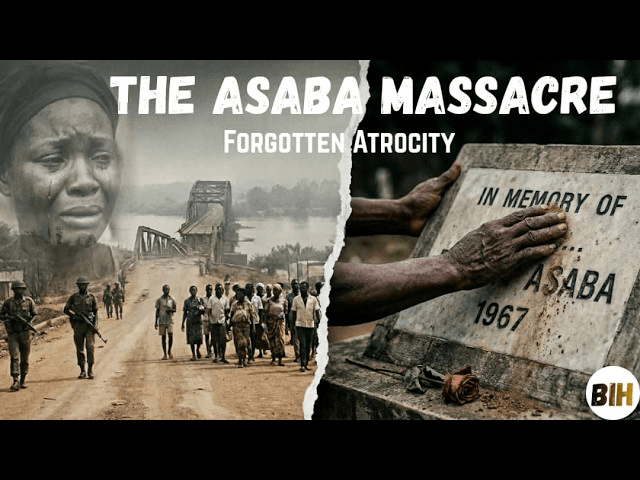
The Asaba Massacre ranks among the most harrowing atrocities of the Nigerian Civil War (1967–1970, also known as the Biafran War). It occurred on October 5–7, 1967, in Asaba, a predominantly Igbo town on the western bank of the River Niger in present-day Delta State. Troops of the Nigerian Army’s 2nd Infantry Division carried out the killings while pursuing retreating Biafran forces.
Background and Context
In August 1967, Biafran troops launched Operation Torch, invading the Mid-Western Region, capturing Benin City, and advancing toward Ore (threatening Lagos). Federal forces, under Col. Murtala Muhammed (commander of the newly formed 2nd Division), launched a rapid counter-offensive. They recaptured the Mid-West and pushed Biafran soldiers back across the Niger River. Biafrans destroyed parts of the Onitsha bridge during retreat, complicating pursuit.
Asaba, directly opposite Onitsha on the west bank, became a focal point. Federal troops entered the town around October 5 amid suspicion that locals (many with Igbo ties) harbored Biafran sympathies or had aided the invaders. The atmosphere was charged by earlier pogroms against Igbos in northern Nigeria and the broader ethnic tensions fueling the war.
Timeline of Events (October 5–7, 1967)
- October 5–6: Federal soldiers entered Asaba and began terrorizing civilians. They ransacked homes, looted, and killed men and boys accused of being Biafran soldiers or collaborators. Killings happened individually and in small groups at various sites, including near the police station and a football field. Hundreds died in this initial phase of violence.
- October 7 (Main Massacre): Asaba community leaders, hoping to end the killings and demonstrate loyalty, organized a peaceful demonstration. Town criers summoned residents from Asaba’s five quarters. Hundreds of men, women, and children—many dressed in ceremonial white attire (akwa ocha) as a symbol of peace and purity—paraded along Nnebisi Road. They sang, danced, and chanted “One Nigeria” in support of national unity. At a junction near Ogbe-Osowa (or Ogbeosowa) village, troops separated the men and older boys from the women and younger children. The women and children were taken to a nearby maternity hospital or other areas. The men and teenage boys were gathered in an open square at Ogbe-Osowa. Machine guns were revealed, and orders were given to open fire. The shooting was systematic and lasted until most victims were dead.
Survivors later described scenes of chaos: families pleading for mercy, young boys shot while claiming to be students, and bodies left in heaps. One eyewitness account noted soldiers running over a fallen boy with a lorry. Another recalled entire families losing multiple male members in a single day.
Death Toll and Scale
Estimates vary due to the lack of official records, mass graves, and incomplete survivor lists:
- 373 named victims (Asaba Development Council, 1981 — acknowledged as incomplete).
- 500–800 (scholars S. Elizabeth Bird and Fraser M. Ottanelli, based on extensive interviews).
- Up to 700 at the Ogbe-Osowa square alone, with additional hundreds killed elsewhere, bringing the total to well over 1,000 according to some eyewitness and community accounts.
- Other contemporary reports cited figures around 700–1,000.
Many victims were prominent community members, professionals, and students. The massacre disproportionately targeted males, devastating family structures and leaving women and children to cope with the aftermath. Bodies were mostly buried in mass graves at the site or nearby; few families could retrieve or perform proper rites for their dead.
Command Responsibility
The 2nd Infantry Division operated under Col. Murtala Muhammed. His second-in-command, Maj. Ibrahim Taiwo, is frequently cited in accounts as giving the direct order to open fire at Ogbe-Osowa. Some soldiers and officers reportedly refused to participate or even protected civilians, but the operation proceeded.
Murtala, as overall commander, bore ultimate responsibility for the division’s actions. Later allegations (including from Lt. Ishola Williams, who served under him) linked him to broader patterns of summary executions of prisoners during the war. In the 2001 Oputa Panel (Nigeria’s Human Rights Violations Investigation Commission), a successor officer, Maj. Gen. Ibrahim Haruna (who took command in 1968), controversially claimed involvement and showed little remorse.
The killings occurred in a context of retaliation and fear but targeted unarmed civilians in a deliberate gathering, qualifying as a war crime in many historical assessments.
Immediate Aftermath and Occupation
The massacre did not end the suffering. Federal troops occupied Asaba for months, with continued looting, destruction of homes, rape, and forced “marriages” of women and girls. A “second operation” in April 1968 followed a brief Biafran incursion, leading to more roundups, killings, and displacement. Elite institutions like St. Patrick’s College became refugee camps amid ruined buildings. Many residents fled and only returned after the war ended in 1970 with Biafra’s surrender.
Journalist Bill Norris described the town weeks later as devastated by bombardment, burning, and abandonment.
Long-Term Consequences and Legacy
The massacre decimated families—some lost 8 or more men—and left deep psychological scars. It contributed to Biafran resolve, prolonging the war (which ultimately claimed 1–3 million lives, mostly from starvation and disease). Asaba’s demographic and social fabric changed permanently, with lasting trauma passed across generations.
For decades, the event remained largely unspoken in official Nigerian narratives, overshadowed by post-war “no victor, no vanquished” rhetoric. Survivors testified before the Oputa Panel in 2001, prompting a public apology from former Head of State Yakubu Gowon.
Memory, Reconciliation, and Memorialization
Scholars S. Elizabeth Bird and Fraser M. Ottanelli conducted extensive research (over 100 interviews with survivors, military figures, and officials, plus archives) resulting in the seminal 2017 book The Asaba Massacre: Trauma, Memory, and the Nigerian Civil War (Cambridge University Press). It details causes, events, and legacy while advocating for confronting community trauma.
The Asaba Memorial Project (a collaboration involving the University of South Florida and Asaba community) aims to reclaim this hidden history in a spirit of reconciliation. Efforts include:
- Documenting stories.
- Academic publications.
- Commemorations (e.g., 50th anniversary in 2017 with book launch).
- Calls for a permanent memorial.
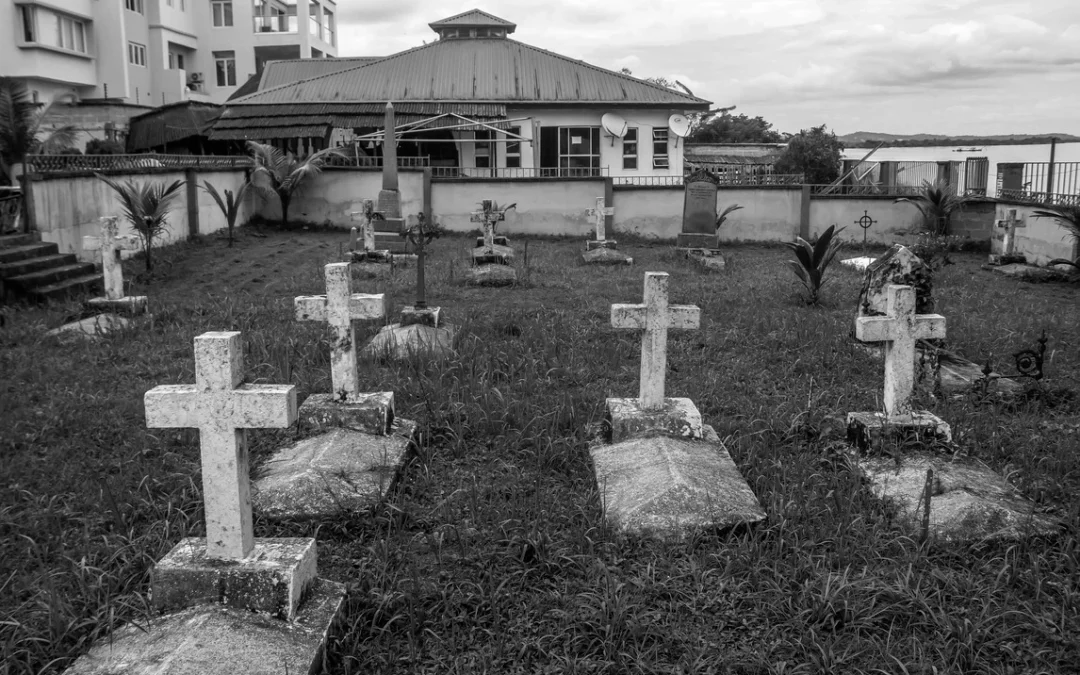
A monument and initiatives like planting trees in honor of victims exist or have been proposed, though plans sometimes stir passions amid ongoing national debates over war memory and Biafran legacy.
The Asaba Massacre underscores the human cost of civil conflict, ethnic suspicion, and unchecked military power. It remains a painful symbol for many Igbo communities and a reminder of the importance of truth-telling and healing in Nigeria’s complex history. While Murtala Muhammed is celebrated by some for his later reforms, his role here contributes to a more nuanced, controversial legacy.
Command Responsibility in the Asaba Massacre (October 5–7, 1967) centers on the military hierarchy of the Nigerian Army’s 2nd Infantry Division and the degree to which senior officers knew, ordered, condoned, or failed to prevent the killings of hundreds of unarmed civilians.
Chain of Command in October 1967
- Overall Commander: Colonel Murtala Ramat Muhammed (GOC, 2nd Infantry Division). He led the division from its rapid formation in August 1967 through the recapture of the Mid-West and the advance to Asaba.
- Second-in-Command: Major Ibrahim Taiwo (sometimes described as Brigade Commander or key field officer under Murtala).
- Division Level: The 2nd Division operated with significant autonomy during the fast-moving counter-offensive. Murtala was known for his aggressive, sometimes insubordinate style.
Murtala held ultimate operational responsibility as the commanding officer of the formation whose troops carried out the atrocities.
Direct Orders at the Massacre Site
On October 7, 1967, after community leaders organized a peaceful demonstration of loyalty (“One Nigeria”), federal troops separated men and older boys at Ogbe-Osowa. Eyewitness accounts and historical research indicate that machine guns were then revealed and orders were given to open fire.
- Most sources, including Wikipedia summaries drawing from scholarly work and survivor testimonies, attribute the direct order to shoot to Major Ibrahim Taiwo.
- Taiwo was present on the ground and reportedly issued the command in that moment.
- Some accounts describe soldiers speaking in Hausa during the operation, and broader patterns of house-to-house killings and looting preceded the main square execution.
The massacre was not portrayed as rogue actions by low-ranking troops but as a coordinated operation involving separation of victims and systematic gunfire.
Murtala Muhammed’s Responsibility
As GOC, Murtala bore command responsibility under both military doctrine and modern international humanitarian law principles (superior responsibility):
- He commanded the division at the time.
- The killings occurred in the immediate aftermath of his forces’ successful push against Biafran troops, amid suspicion of local sympathies.
- Broader violence (looting, individual killings, rape) by troops of the 2nd Division in Asaba and surrounding areas happened under his watch.
- Scholarly accounts (notably S. Elizabeth Bird and Fraser M. Ottanelli in The Asaba Massacre: Trauma, Memory, and the Nigerian Civil War, 2017) document the events as actions by troops under General Muhammed’s command. They do not claim Murtala personally gave the order at Ogbe-Osowa but hold the division leadership accountable.
Murtala was not relieved immediately after Asaba; he continued commanding until around mid-1968, when he was recalled to Lagos (partly linked to high casualties and reported indiscipline in other operations, such as river crossings toward Onitsha).
No formal military tribunal or court-martial ever held Murtala or Taiwo accountable for Asaba during or after the war.
The Ibrahim Haruna Controversy (Oputa Panel, 2001)
A major source of confusion arose from the testimony of Maj-Gen. Ibrahim B.M. Haruna before Nigeria’s Human Rights Violations Investigation Commission (Oputa Panel):
- Haruna reportedly stated he had “no apology” or “no regret” for the Asaba massacre, describing his actions as maintaining “the peace and unity of Nigeria.”
- Media reports at the time (e.g., 2001) quoted him claiming responsibility as commanding officer.
- Clarification: Haruna did not command the 2nd Division in October 1967. He replaced Murtala as GOC only in spring 1968. His testimony appears to have conflated or generalized his later command experiences (including operations in other areas like Owerri or Ameke-Item) with Asaba.
This misattribution persists in some public discourse, but historians and Wikipedia entries correct it: Haruna was not present at Asaba in 1967.
Broader Patterns and Context
- The 2nd Division was linked to civilian killings not only in Asaba but in nearby locations during the same campaign.
- Some soldiers reportedly refused orders or protected civilians, but the operation proceeded.
- Context included retaliation for Biafran invasion of the Midwest, fear of collaborators, and ethnic tensions (many victims were Igbo or of Igbo extraction, though Asaba people often identify as Anioma).
- Allegations of “hit lists” targeting prominent individuals have circulated in survivor accounts, though these remain debated.
Legal and Historical Assessment
- In modern terms (e.g., under the doctrine applied at tribunals like ICTY or ICC), a commander can be held responsible for crimes by subordinates if they knew or should have known about them and failed to prevent or punish.
- No such accountability occurred in Nigeria. The post-war “no victor, no vanquished” policy and Gowon’s reconciliation approach largely sidelined prosecutions for war crimes on either side.
- The Oputa Panel heard testimonies but had no prosecutorial power; it produced a report that was never fully implemented by the government.
- Bird and Ottanelli’s research, based on extensive interviews (survivors, military personnel, officials), provides the most detailed non-partisan examination. It frames Asaba within the chaos of rapid military advance, ethnic suspicion, and command culture that tolerated or encouraged harsh measures.
Legacy of Command Accountability
- Murtala’s defenders argue the massacre was an excess in the fog of war, not a deliberate policy, and point to his later role as a decisive anti-corruption reformer.
- Critics (especially in Igbo and Asaba communities) view him as bearing primary responsibility for the division’s actions, sometimes calling him the “Butcher of Asaba.”
- Ibrahim Taiwo is frequently named as the officer who gave the fatal order on the ground. He later rose in rank and was involved in the 1975 coup that brought Murtala to power; he was assassinated in 1976 during the Dimka coup attempt.
- The event remains a symbol of unresolved civil war trauma, with calls for official acknowledgment, memorials, and truth-telling rather than formal trials (most perpetrators are long deceased).
Command responsibility at Asaba illustrates the tension between military necessity, discipline, and atrocities in civil conflict. While Major Taiwo is most directly tied to the shooting order, Colonel Murtala Muhammed—as the senior commander—carried overarching accountability for the conduct of his troops. The lack of investigation or punishment at the time deepened communal wounds that persist decades later.

