

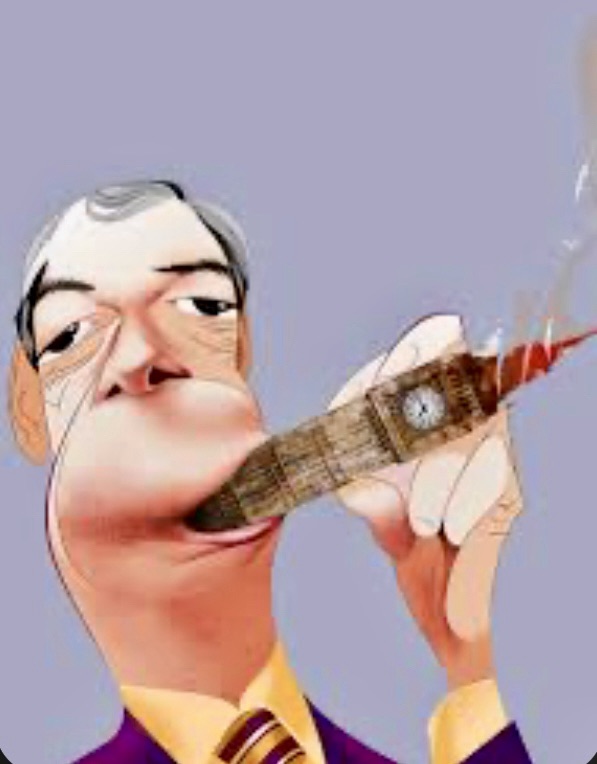

There was a time when being politically radioactive in Britain meant you were treated like a dodgy kebab at 3 a.m.—acknowledged, perhaps, but never recommended. Today, however, one could be forgiven for thinking that political quarantine has been replaced with a BBC studio slot and a polite nod.
Enter Nigel Farage and his vehicle, Reform UK—a party that, depending on who you ask, is either a legitimate insurgent force or UKIP with a rebrand and a fresh coat of grievance.
The question is not whether Reform should be covered. Of course it should. The question is whether the manner and volume of that coverage crosses the line from reporting into normalising.
The Numbers Don’t Whisper—They Shout
A study from Cardiff University found that Reform UK appeared in 25% of BBC News at Ten bulletins, compared to just 17.9% for the Liberal Democrats, despite the latter having vastly more MPs.
That is not editorial balance—it is editorial enthusiasm dressed up as impartiality.
The BBC’s defence is predictable: “We follow the story.” Reform is polling, Reform is rising, Reform is newsworthy. And yes, that is true. But journalism is not merely stenography for momentum. It is supposed to apply scrutiny proportional to influence.
Yet the same study noted that Reform’s claims were properly scrutinised in fewer than 40% of cases.
Translation: airtime without adequate interrogation. Oxygen without friction.
The Farage Factor: Media Gravity
Farage is not just a politician; he is a media event. He has spent decades perfecting a persona that thrives in broadcast environments—combative, quotable, and permanently aggrieved.
This is not new. Even before holding parliamentary office, he was a near-permanent fixture on BBC panels. As one observer noted, he appeared on Question Time over thirty times long before electoral success caught up with his airtime.
In other words, Farage was normalised long before Reform UK existed.
The BBC did not create Farage—but it undeniably helped scale him.
Is This Historically Normal?
Now to your sharper question: is there precedent?
Let’s be clear—comparisons to the Brownshirts (the SA in pre-war Germany) are rhetorically powerful but analytically messy. The media ecosystem of Weimar Germany was fragmented, partisan, and often openly ideological. The BBC, by contrast, operates under a statutory duty of impartiality.
But there is a more relevant British comparison: the British National Party.
The BNP, particularly in the 2000s, was treated as a political pariah. When its leader Nick Griffin appeared on Question Time in 2009, it was treated as a national event—protests, outrage, and a tone closer to containment than normalisation.
The key difference?
- The BNP was framed as beyond the pale
- Reform is framed as within the debate
Same broad territory (immigration, nationalism, populism), very different media treatment.
Why the Shift?
Three structural reasons explain the BBC’s current posture:
1. The collapse of the two-party duopoly
With Labour and the Conservatives losing vote share, smaller parties become “news” simply by existing in the gap. BBC leadership has explicitly said it must reflect this changing landscape.
2. Poll-driven editorial judgment
Modern political coverage increasingly follows polling, not parliamentary representation. If you poll, you platform.
3. The tyranny of “due impartiality”
The BBC’s interpretation of impartiality often becomes “put both sides on and let them fight,” even when one side’s claims require heavier scrutiny. Critics have long argued this creates false balance.
The Risk: From Coverage to Legitimacy
This is where your concern lands.
Media exposure does not just reflect legitimacy—it manufactures it.
Recent commentary suggests Farage is actively testing and reshaping what is politically acceptable, pushing boundaries and then redrawing them.
If that is true, then the BBC is not merely observing the map—it may be helping to redraw it.
So, Is the BBC “Normalising” Reform?
The honest answer is: not intentionally, but functionally, yes.
- By giving disproportionate airtime
- By under-scrutinising claims
- By prioritising spectacle over substance
…it risks turning a fringe-adjacent movement into a mainstream fixture.
Not through conspiracy. Through editorial gravity.
Final Thought
The BBC likes to imagine itself as a mirror of British society.
The problem is that mirrors do not just reflect—they frame. And if you angle the mirror just right, even the marginal starts to look central.
Farage understands that better than anyone.
And right now, he’s getting the lighting just right.

