

There is an old political maxim—vintage, durable, and minted in the scandal foundry of the Watergate scandal—that insists: “It’s not the crime, it’s the cover-up.”
The phrase gained immortality when Richard Nixon discovered that while a break-in could be explained away, a clumsy attempt to bury it could not.
Fast-forward to Nigeria, 2026—where politics has fully embraced the digital age, but unfortunately, not always its memory settings. We now have a sequel:
“It’s not the tweet, it’s the delete.”
Act I: Of Handles and Coincidences
Before the storm, there was an account: @joashamupitan, created on September 6, 2022.
Now, Nigerian political culture treats coincidence the way seasoned lawyers treat unsigned documents—with suspicion bordering on contempt.
The “coincidences” lined up rather neatly:
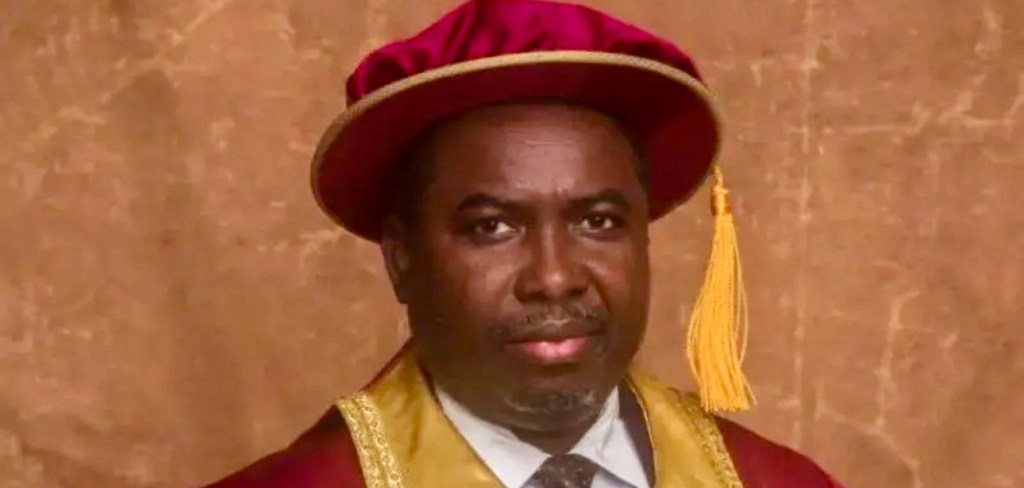
- An email—amupitanj@yahoo.com—reportedly consistent with one tied to Professor Joash Ojo Amupitan’s academic past.
- A phone number ending in 4099, used for verification.
- The same number allegedly linked to an Opay account bearing the full name Joash Ojo Amupitan.
At this point, even the most generous observer begins to feel that technology is less a witness and more an eager informant.
Act II: The Great Digital Disappearance
Then came April 10, 2026—the day the account discovered spirituality and was born again:
- @joashamupitan became @Sundayvibe00—a name suggesting soft music, good weather, and absolutely no institutional responsibility.
- The account was locked—past posts now visible only to the chosen few, like classified documents or grandmother’s soup recipe.
- A fresh label appeared: “Parody Account.”
Parody, in modern politics, is less a genre and more a legal defence strategy.
Act III: The Law, the Ideal, and the Nigerian Reality
Now, let us introduce an inconvenient but necessary ingredient: constitutional principle.
Every Nigerian possesses the unquestionable right to participate in the political process. That right is neither controversial nor conditional—it is foundational.
However, when an individual ascends to an office that demands impartiality and institutional independence, something changes. Not legally—but ethically, structurally, and perceptually.
Such a person is expected to:
- Disclose prior political engagements, transparently and without prompting;
- Undertake to rise above partisan politics, not merely in conduct but in appearance;
- And, borrowing from Roman wisdom, to be like Caesar’s wife—above suspicion, and seen to be above suspicion.
Because the office of a chairman of an independent electoral commission is not just about competence—it is about credibility.
Judgment and integrity are not optional extras. They are the job description.
Act IV: Where There Is Smoke…
Now comes the delicate part.
If the allegations surrounding this account were ever to be conclusively proven, then the conclusion is straightforward and uncomfortable:
the essential attributes of impartiality, judgment, and integrity would be fundamentally compromised.
But Nigerian politics rarely waits for courtroom finality. It thrives in the grey zone—the space between allegation and proof.
And here lies the real problem:
Even if nothing is legally established, the sequence of events—the creation, the linkage, the sudden transformation, the retreat into parody—generates smoke.
And in public office, particularly one requiring neutrality, smoke is not a minor inconvenience. It is reputational acid.
Because the question is no longer merely:
“Is it proven?”
It becomes:
“Is this the standard we are comfortable with for electoral neutrality?”
Act V: Back to Watergate (Because We Never Really Left)
The enduring lesson from the Watergate scandal was not that politicians err—it is that how they respond to scrutiny defines their fate.
Richard Nixon might have survived the initial scandal. What he could not survive was the appearance—then the reality—of concealment.
And so, decades later, in a different jurisdiction with better smartphones and worse deniability, the same principle applies.
Final Whistle
Public trust is a fragile instrument. It does not collapse only when guilt is proven; it erodes when doubt becomes reasonable.
And the chairman of an independent electoral body cannot afford reasonable doubt—not as a legal standard, but as a public perception.
Because elections are not just about counting votes.
They are about convincing millions of sceptical citizens that the counting is honest.
So perhaps the updated maxim for our times should read:
It’s not the account, it’s the accountability.
And somewhere, in the grand theatre of political déjà vu, Richard Nixon is watching—probably wondering why, in the age of screenshots and metadata, anyone still believes that a quick rename and a “parody” label can outwit history.

