


There is an old and reliable principle in physics: nature abhors a vacuum. Where there is nothing, something will rush in. The question has always been what. For a brief and almost convincing moment, the answer appeared to be progress — climate action, social justice, economic empowerment blinking into their earliest spring. Then the world took a long look at that tender growth and decided, collectively, that it preferred ordnance.
We are now in the age of the preemptive war, that most euphemistic of military enterprises. Israel and the United States have determined that Iran’s intentions constitute a clear and present danger; Russia has decided that Ukraine’s aspirations toward NATO and the EU are an existential provocation. Nobody waited for the act. The act, apparently, is beside the point. We have industrialised the logic of the pre-crime and dressed it in the language of national security. Philip K. Dick wrote a dystopia about this. We called it foreign policy.
The arms race, once an embarrassing Cold War relic we had agreed to be ashamed of, has been rehabilitated as strategic necessity. And there is a peculiar internal logic to it, one that deserves to be stated plainly: if you build the weapons, you will eventually need a theatre. An arms race with no war at the end of it is just very expensive theatre criticism. Nobody stockpiles for the aesthetic. The procurement justifies the deployment, and the deployment justifies the next procurement, and so the wheel turns, lubricated generously by the blood of people who had no vote on the matter.
Meanwhile, climate change — that other existential threat, the one without a military contractor — remains firmly categorised by the Right as a hoax, a globalist fever dream, a conspiracy by scientists who have apparently coordinated across a hundred nations and several decades purely to inconvenience the fossil fuel industry. There is no arms race to solve it. There are no preemptive strikes against rising sea levels. The threat, you see, cannot be bombed.
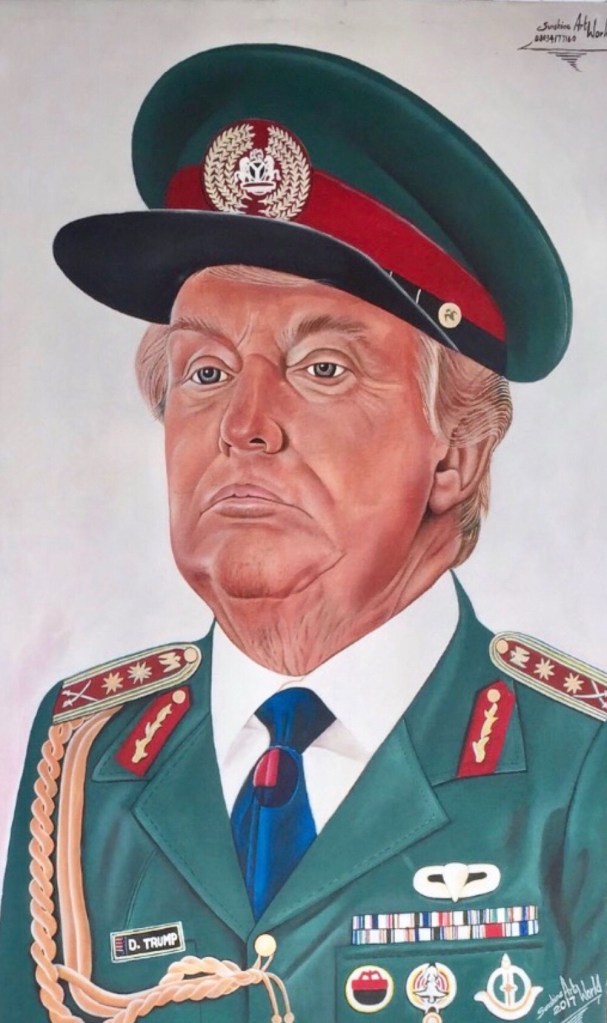
Consider the men at the helm of these enterprises. Benjamin Netanyahu, the Prime Minister of Israel, is reportedly managing cancer alongside his management of regional conflagration. Donald Trump is, to put it charitably and with clinical restraint, not well. These are the architects of fires they will not survive to see extinguished — men who have lit the kindling from their sickbeds and their delusions, and who will not be present for the reckoning their decisions have authored. History will note the irony. The victims will not find it especially amusing.
In Britain, the editors of the right-wing press have apparently divined the coming war in their waters — a spiritual gift unique to those who have never served and never will. The screaming headline — the UK is planning for welfare rather than warfare — was delivered as scandal, as dereliction, as proof of national softness. The suggestion, earnest and unselfconscious, is that the poor should tighten their belts so that the defence budget may expand; that the funding for rearmament should come not from progressive taxation of those who have accumulated grotesquely during every crisis of the past decade, but from the spending cuts applied to those who have accumulated nothing. It is, in its way, a coherent worldview. It simply requires you to believe that the primary threat to British security is the existence of the welfare state.
The United States has, as in all things, taken this disdain for its domestic poor and elevated it to an art form. In a single, largely fruitless strike on a target of debatable strategic significance, the cost of the Tomahawk missiles deployed would have resolved, without remainder, the outstanding medical bills of a substantial number of Iowa residents. Iowa, one notes, voted for the administration that launched the missiles. The residents of Iowa will presumably find comfort in their patriotism when the bills arrive.
And here we must return to the election that made much of this possible. The American voter — or enough of them, in enough of the right places — looked upon a world containing climate catastrophe, housing unaffordability, the collapse of social mobility, a healthcare system of baroque cruelty, and concluded that the decisive issue of our time was transgender participation in competitive sport. To be clear: there are no more and no fewer trans athletes competing in American sports before, during, or after the Trump administration. The threat was imaginary. The election result was not. It has been an extraordinarily expensive foray into a fiction, and the invoice is being settled by people who cannot afford it, in currencies — stability, institutional trust, global standing — that once spent do not easily return.
Nature, as we began, abhors a vacuum. The vacuum left by retreating ambition — by the slow deflation of the hope that we might, collectively, be better — has been filled. It has been filled by arms manufacturers and authoritarian instincts and the resentments of men who feel that equality, having gone on long enough, constitutes an affront. The poor, we are told in so many words, have had it nice for too long.
We are sleepwalking, eyes wide and entirely glazed, into a global crisis whose contours rhyme uncomfortably with 1939. The difference, perhaps, is that in 1939 there was at least the pretence of a cause worth fighting for. What is being assembled now is something older and less dignified: the simple logic of power seeking an outlet, of weapons demanding use, of leaders with nothing left to lose and populations left to bear the cost.
The void has been filled. We should have been more careful about what we left lying around.

