

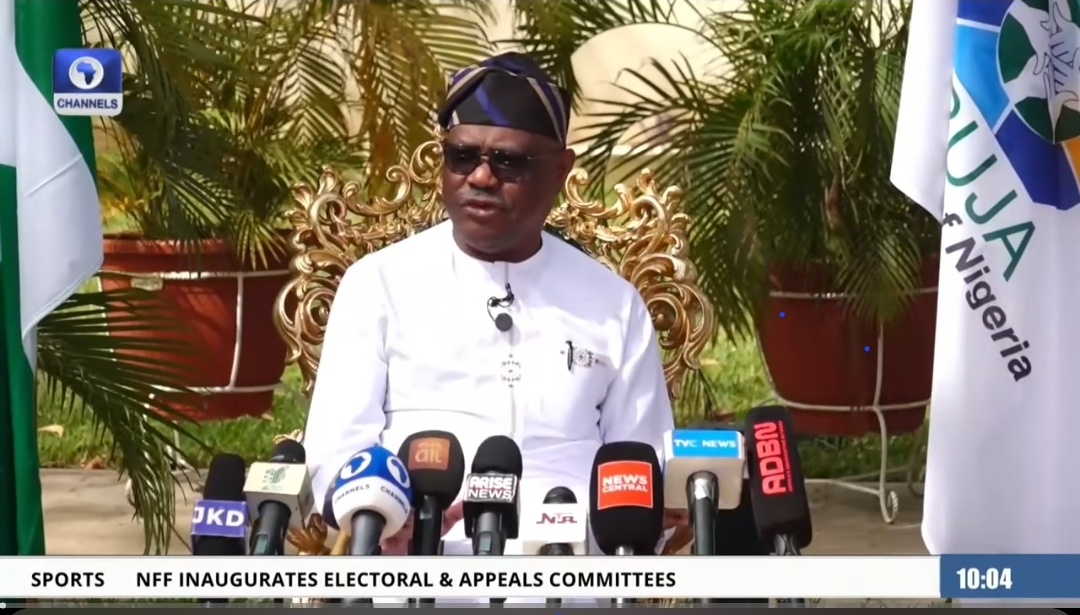

There are moments in politics when a man says too much in anger and accidentally tells the truth. The recent outburst by Nyesom Wike was one of those moments.
The Federal Capital Territory Minister, speaking with the swagger of a provincial emperor who believes Abuja is his personal estate, became visibly irritated when journalists dared to ask him a simple question: why were plots of prime Abuja land being handed out freely to ambassadors appointed by President Bola Ahmed Tinubu?
It was not the question itself that offended him. Power can tolerate criticism. What power cannot tolerate is ingratitude.
And so, in a fit of irritation, Wike pulled back the curtain. He reminded the journalists that many of them were beneficiaries of his “generosity” too. He openly referenced the land occupied by Channels Television as evidence of his largesse. He further confirmed what many Nigerians have long suspected: journalists covering him are paid for the privilege of doing so.
Just like that, the theatre mask slipped.
For years, Nigerians have watched an increasingly compromised media environment where political propaganda is disguised as journalism and orchestrated chaos is packaged as breaking news. Wike’s comments merely confirmed the mechanics behind the performance.
Observe the recurring ritual in opposition politics. An unknown character suddenly emerges from nowhere claiming to be a “factional chairman” or “authentic leader” of an opposition party. Within minutes, cameras appear. Microphones are thrust forward. Endless interviews follow. Television panels dissect the manufactured conflict for days. Newspaper headlines scream of crisis, implosion and collapse.
The oxygen of publicity is generously supplied.
Yet remarkably, similar theatrics inside the ruling party rarely receive equal treatment. Internal fractures are massaged into “strategic consultations.” Public embarrassments become “family matters.” Defections into the ruling party are treated like divine conversions, while defections away from it are framed as betrayals or political irrelevance.
This asymmetry is not accidental. It is transactional.
The Nigerian media ecosystem increasingly resembles a marketplace where editorial independence is auctioned to the highest bidder. Financial desperation has made many institutions vulnerable to political capture. In a country where economic hardship has pulverised the middle class and reduced salaries to comedy sketches, principles become luxuries few organisations believe they can afford.
The tragedy is not merely corruption itself. Corruption has become normalised to the point where its public confession no longer generates national outrage. A minister can openly boast about funding journalists and dispensing public assets like royal gifts, and the political system barely pauses.
In functioning democracies, such statements would trigger investigations, parliamentary hearings and professional sanctions. In Nigeria, they become another item in the endless carnival of scandal fatigue.
That fatigue is perhaps the greatest victory of the political class.
A citizenry permanently overwhelmed by inflation, insecurity, unemployment and institutional decay eventually loses the energy required for outrage. Survival becomes the full-time occupation of the people. Accountability becomes optional.
Meanwhile, the political elite continue operating like feudal landlords presiding over conquered territory rather than public servants managing a republic.
Abuja itself increasingly reflects this mentality. Land allocations are treated less as instruments of urban planning and more as political patronage tokens. Loyalty is rewarded with plots. Access becomes currency. Influence becomes real estate. The capital city risks becoming less of a federal territory and more of an imperial court where favours flow downward from powerful men dispensing benevolence to loyal retainers.
The press, ideally meant to act as a watchdog against abuse, too often behaves like palace scribes documenting the greatness of the emperor.
Of course, not every journalist is compromised. Nigeria still possesses courageous reporters and independent voices working under difficult and often dangerous conditions. But the institutional rot is impossible to ignore. When political access determines financial survival, journalism slowly mutates into public relations wearing a press badge.
The deeper danger is what this does to democracy itself.
A compromised press cannot effectively scrutinise power. Citizens deprived of trustworthy information cannot make informed political choices. Opposition parties subjected to selective media warfare struggle to organise effectively. Public debate becomes distorted by narratives crafted not around truth but around political sponsorship.
And so corruption reproduces itself endlessly.
The ruling class enriches itself. The media sanitises the ruling class. The public grows poorer and more cynical. Then the same elite return during elections to preach sacrifice, patriotism and national unity to citizens who can barely afford food.
Wike’s angry confession was therefore valuable, not because Nigerians learned something entirely new, but because the system briefly admitted what it usually tries to conceal.
The emperor spoke plainly.
And for once, honesty escaped from the palace.
 Centre for Nigeria Progress