


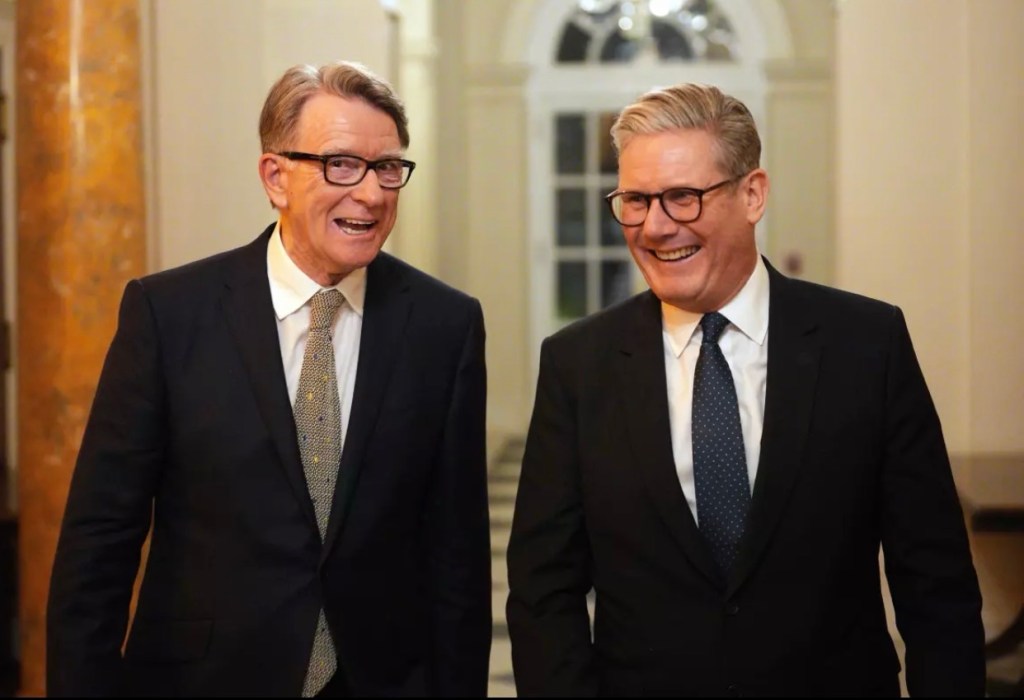
There is now a growing pattern in British politics that ought to terrify every Labour prime minister. It is not strikes in Liverpool, miners in Yorkshire, or intellectual rebellions from Oxford common rooms that have brought Labour governments to the edge of ruin. No. The political graveyard of Labour leaders increasingly appears to lie somewhere between Baghdad and Gaza, with the ghost of Peter Mandelson hovering nearby like an expensive political cologne that refuses to evaporate.
Two Labour prime ministers. Two overwhelming electoral victories. Two men convinced history had chosen them for greatness. And two leaders now politically wounded by the Middle East.
Tony Blair was not merely successful; he was the most electorally dominant Labour politician in modern British history. Three consecutive general election victories transformed Labour from a party of permanent opposition into a machine of power. Blair rebranded Labour, detoxified it for middle England, and sold “New Labour” as the political equivalent of a premium supermarket meal deal, polished, modern, and suspiciously close to conservative economics with softer background music.
But then came Iraq.
Blair decided Britain had to march loyally behind George W. Bush into Iraq like an eager deputy manager desperate for approval from head office in Washington. The invasion lacked a clear authorising UN mandate and rested upon the now infamous claims of weapons of mass destruction that turned out to possess the remarkable ability of invisibility. Britain was dragged into a catastrophic war on a tide of certainty that dissolved almost immediately after arrival in Baghdad.
The Labour base never forgave him.
What enraged many voters was not merely the war itself but the contemptuous certainty with which Blair dismissed dissent. This was a prime minister who once told Labour members they had to “learn to love” Peter Mandelson, the dark prince of spin, patron saint of triangulation, and perhaps the only man capable of making a tax accountant appear emotionally spontaneous.
The Iraq War shattered trust between Labour and many of its natural supporters. Millions who had marched against the war concluded that the government neither heard nor respected them. The moral authority Labour traditionally claimed as the party of international justice evaporated in the deserts of Iraq. Blair won elections, yes, but he left behind a party morally fractured and politically exhausted. Eventually Labour lost power to the Conservatives, and much of the social democratic settlement Labour had painstakingly built was slowly dismantled.
History, however, has a wicked sense of humour.
After years wandering the opposition wilderness like political nomads surviving on conference speeches and internal inquiries, Labour returned to power in a landslide under Keir Starmer. The party promised competence, stability, and a restoration of seriousness after the Conservative circus years in which Britain seemed governed alternately by hedge fund interns and men trapped inside their own haircuts.
Then came Gaza.
The Israel war on Gaza has become not merely another foreign conflict but a live-streamed humanitarian and genocidal catastrophe broadcast directly into British homes. Entire neighbourhoods reduced to rubble. Dead children pulled from debris. Hospitals destroyed. Civilians facing Israeli overwhelming military retaliation. To many Britons, especially younger voters and ethnic minority communities, the scale of destruction and deaths is indefensible.
Yet Labour’s leadership responded with the caution of a law firm terrified of offending a wealthy client.
Rather than becoming a moral voice demanding restraint, humanitarian protection, or even clear condemnation of civilian slaughter, Labour appeared paralysed by political calculation. The party leadership often seemed more frightened of newspaper editorials than dead civilians. While public anger mounted, Labour’s front bench adopted the tone of men attempting to comment on genocide while simultaneously renewing their home insurance. And on occasions acting like a defence lawyer for Israel claiming its right to defend itself against whom, Labour supporters asked.
The consequence has been devastating internally.
A chasm has opened between the Labour leadership and significant sections of its membership and voter coalition. Communities who traditionally supported Labour now openly question whether the party sees their humanity as negotiable. Young progressive voters feel betrayed. Local councillors resigned. MPs rebelled. Protest votes multiplied.
And now electoral warning signs are flashing.
Recent May 2027 local government elections have delivered painful setbacks to Labour while giving oxygen to Reform UK Ltd, a party increasingly behaving like insurgents smelling blood in the water. Like the Liberal Democrats during periods of Conservative collapse in the 1980s and 1990s, Reform senses opportunity. British politics has become volatile, fragmented, and deeply distrustful of establishment parties.
The obituary of Labour may indeed be premature. Governments survive terrible local election results all the time. But wounded governments often stagger before they fall, insisting everything is under control while voters quietly sharpen electoral knives.
And once again, Peter Mandelson lurks nearby.
His return to influence around Starmer has revived old anxieties within Labour that the party leadership remains excessively managerial, excessively corporate, and emotionally disconnected from the moral instincts of its own supporters. Mandelson represents a technocratic vision of politics where presentation frequently outranks conviction. To Labour traditionalists, his fingerprints on a government often signal that principles are about to be focus-grouped into extinction.
But the Middle East and Mandelson are not the only recurring problems.
Both Blair and Starmer suffer from another chronic Labour illness: the belief that elite approval matters more than grassroots trust.
Blair became intoxicated by international statesmanship and the approval of Washington. Starmer appears obsessed with reassuring financial markets, establishment commentators, and cautious swing voters that Labour is no longer frightening. In both cases, Labour leaders drifted away from the emotional core of their own movement.
Another recurring problem is excessive centralisation of power. Blair’s government became notorious for sofa government, spin operations, and over-managed messaging. Starmer’s Labour has similarly developed a reputation for rigid control, purges of dissenting voices, and intolerance toward internal disagreement. Parties that silence debate eventually discover voters are perfectly capable of expressing disagreement at the ballot box.
Then there is the recurring Labour temptation to mimic Conservative frameworks rather than challenge them. Blair accepted much of Thatcherite economics while softening the edges. Starmer often appears reluctant to articulate bold ideological alternatives, preferring managerial competence over transformative politics. Labour repeatedly wins power promising change only to govern cautiously, leaving supporters wondering whether they elected a government or merely changed the office stationery.
And hovering over everything is Britain’s unresolved identity crisis.
The Iraq War exposed Britain’s subordinate relationship to American foreign policy. Gaza exposes Britain’s discomfort with confronting allies over human rights. Labour governments inherit not only domestic expectations but also the burden of navigating Britain’s declining imperial identity, a nation still pretending to be a global power while often acting like Washington’s nervous assistant manager.
Perhaps that is the true recurring decimal.
Labour leaders rise promising moral renewal but become trapped between power and principle. The Middle East simply exposes the contradiction more brutally than most issues. It forces governments to answer uncomfortable questions: What do you truly believe? Whose suffering matters? And at what point does political caution become moral cowardice?
Blair answered those questions in Iraq and paid for it politically.
Starmer is answering them now in Gaza.
History may yet judge whether Labour has learned anything at all.
 Centre for Nigeria Progress