

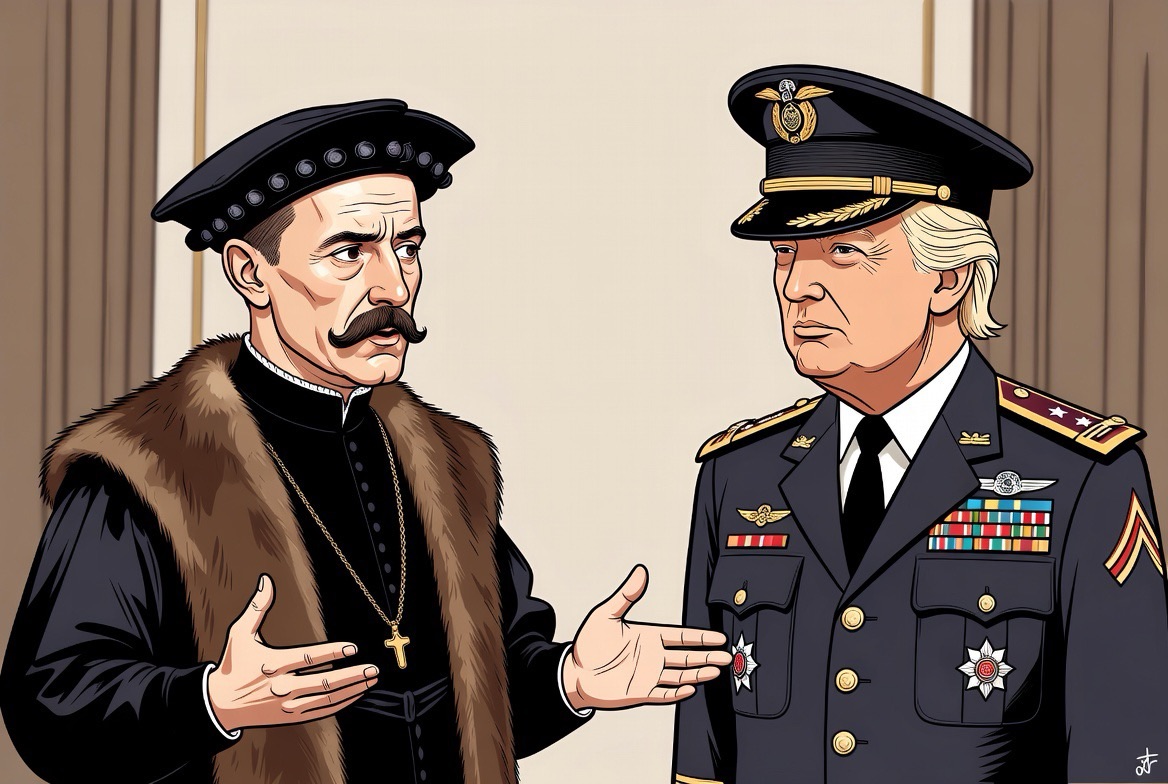
A Letter to Mr. Donald J. Trump | Lawson Akhigbe
Being the views of Sir Thomas More, Knight, Lord Chancellor of England,
on the matter of Unjust Wars, Territorial Ambition, and the Moral Poverty of Conquest
⸻ ✦ ⸻
From: Sir Thomas More, Knight, Lord Chancellor of England (retired, involuntarily).
Tower of London, Anno Domini 1534. Forwarded posthumously across five centuries by editorial necessity.
To: Mr. Donald John Trump, 47th President of the United States of America,
Mar-a-Lago, Palm Beach, Florida. Or wherever the golf cart has parked him.
Your Most Considerable Excellency
I write to you from a cell in the Tower of London, where I have had considerable leisure to think, a luxury that power, I have observed, rarely permits. My present accommodation is not, I confess, what I was accustomed to as Lord Chancellor, but it has furnished me with a clarity of mind that the corridors of power never quite allowed. It is in that spirit of enforced reflection that I take up my quill. I have been watching you, Mr. Trump. The dead, you will find, have excellent visibility.
You are not, of course, the first powerful man to whom I have had occasion to speak plainly. I once served Henry VIII, a sovereign of considerable appetites, prodigious self-regard, and a disposition toward acquisition that made him, in some lights, a figure you might recognise at a dinner party. Henry also believed that wanting a thing was sufficient justification for taking it. He wanted Anne Boleyn. He took her. He wanted the Church. He took it. He wanted my head. He took that too. I mention this not to alarm you but simply to note that I have some experience with the species.
Nota Bene Henry VIII also had a gift for branding, breaking with Rome was sold to the English public as a matter of sovereign liberty. Plus ça change.
I wrote, in my Utopia, a work which I note you have not read, though I bear you no particular ill-will on this account, as it is also unread by most of the people who cite it, that war is “the most beastly activity of the most beastly part of mankind.” I did not write this as poetry. I wrote it as diagnosis. And it pains me, Mr. President, that the diagnosis should remain so current five hundred years on.
“Bellum autem, ut rem plane beluinam, nec ulli tamen beluarum aequè atque homini usitatam…””War, as an activity altogether bestial, and yet practised by no beasts so constantly as by man…” Utopia, 1516
In Utopia, the commonwealth I imagined, my citizens went to war under three conditions only: to defend their own territory; to drive an invading enemy from the land of an ally; or to free an oppressed people from tyranny. Three conditions. That was the whole of it. Wars of conquest, wars undertaken to seize the land and resources of others, wars prosecuted to extend the dominion of the already-powerful, were not considered acts of statecraft. They were considered crimes. My Utopians, you would find, were deeply unfashionable on this point.
Now, I have observed your recent communications regarding the island of Greenland, the nation of Canada, and the sovereign passage of the Panama Canal. I have observed your continued material and diplomatic sustenance of a war in Gaza in which tens of thousands of civilians have been killed, including a proportion of children that would have made even Henry VIII pause to reconsider his public image. And I have observed, with the particular attention of a man who has thought carefully about the moment power outruns its lawful warrant, your administration’s decision to bomb Iran while your own diplomats were still seated at the negotiating table. I raise these matters not as a partisan. I raise them as a man who, in a different century, chose death over the validation of a sovereign’s lawless appetite, and who therefore has some personal investment in the question of where power ends and crime begins.
⸻ ✦ ⸻
Let us address Greenland first, because it is the most operatic of your ambitions and therefore the most instructive. You have expressed a desire, persistent, emphatic, apparently sincere, to acquire Greenland for the United States. The territory, you note, is strategically vital. It has minerals. It has coastline. It has, one presumes, a great deal of ice, though this is becoming a less reliable selling point than it once was. The people of Greenland have, with a unanimity remarkable even by the standards of nations that feel strongly about things, indicated that they do not wish to be acquired. This detail appears to have made no material impression upon you.
In Utopia, we had a word for the seizure of land from people who have not consented to part with it. The word was injustice. We did not dress it in the language of strategy, or national interest, or the rhetoric of making something great. We called it what it was. I appreciate that this makes for less compelling rally material, but truth has never been particularly concerned with its own palatability.
Marginalia The Utopians also had a policy of refusing to take pride in military conquest. Medals were given to ambassadors. This would not, I suspect, translate well to the current political culture.
Canada presents a variation on the same theme, though with the additional refinement of comic absurdity, a superpower threatening to absorb its largest trading partner and closest ally by means of economic strangulation, on the apparent theory that if you squeeze a friend hard enough he becomes a dependent. This is not geopolitics, Mr. Trump. This is the logic of the protection racket, dressed in a flag and given a press secretary.
The just war tradition, which I did not invent, though I advanced it, has always insisted upon right intention as a precondition of a lawful conflict. The belligerent nation must be pursuing an objectively just end, not merely clothing a selfish one in just language. When the stated purpose of a military or economic campaign is the acquisition of wealth and territory, and the sovereign interest is personal rather than communal, right intention fails at the first test. What remains is dressed conquest. And dressed conquest, however fine the tailoring, is still conquest.
⸻ ✦ ⸻
I come now to Gaza. I approach it with care, as a man who was himself killed for the sake of a principle, and who therefore does not use the language of sacrifice carelessly.
The just war tradition, I speak now of Aquinas, of Augustine, of myself, of that long and serious conversation conducted by serious men over centuries of blood, also requires proportionality. The harm inflicted must not exceed what is necessary to achieve the legitimate military aim. It requires discrimination: non-combatants must not be deliberately targeted. It requires, at minimum, the appearance of a moral conscience operating under conditions of restraint. Where these conditions fail, and I put this to you as a matter of law, not rhetoric, what remains is not a war. It is a massacre conducted at scale, with the administrative apparatus of a state behind it.
You have supplied weapons. You have supplied diplomatic cover. You have stood in the posture of the indulgent patron while the work was done, and then announced a ceasefire as though you had built the house you had merely watched burn. I do not ask you to be a saint, Mr. Trump. I am one, officially, and I will tell you candidly that sainthood is most uncomfortable and not to be recommended as a career path. I ask only that you consider whether there is a difference between brokering peace and brokering the conditions under which peace becomes necessary.
“Utopiani nullam victoriam sanguine civium partam gloriosam ducunt.””The Utopians count no victory glorious that is purchased with the blood of citizens.” Utopia, 1516
In Utopia, when we found that a war was being conducted in our name against innocent people, we stopped the war. This was considered the minimum. Not the heroic act. The minimum.
⸻ ✦ ⸻
And then there is Iran. I confess that Iran presents the most philosophically interesting of your military adventures, and therefore the one that most requires careful treatment. Gaza tests proportionality and discrimination. Greenland and Canada test right intention. Iran tests something older, and in some respects more fundamental: the question of whether a war may be launched against a country for what it has not yet done.
The just war tradition, and here I must be precise, because this is the precise point at which the argument turns, has never recognised the preventive war as a lawful act. The pre-emptive strike, that is, the strike against an attack that is imminent, certain, and otherwise unavoidable, sits in a difficult but defensible corner of the tradition. But the preventive war, the war launched against a threat that is speculative, potential, and contingent upon a sequence of events that has not yet occurred, does not. It has never done so. Aquinas did not permit it. Augustine did not permit it. And with great respect to your Secretary of Defence, the fact that it has a name does not make it a doctrine.
On Preventive War The distinction between pre-emption and prevention is not academic. Pre-emption answers a drawn sword. Prevention answers a sword that has not yet been forged, by a man who has not yet decided to forge it, who was, at last report, attempting to negotiate.
Iran, at the time your administration elected to strike its nuclear facilities, was a country in active diplomatic communication with your own government. The negotiators were in the room. The ink, as they say, was still warming. One need not be a partisan of the Iranian theocracy, I am not, and I note that the suppression of conscience is as objectionable in Tehran as it is anywhere else, to observe that the bombing of a country while simultaneously negotiating with it represents a rather emphatic breakdown of the requirement of last resort. The just war tradition has always insisted that war may only be undertaken when all other reasonable means of resolution have been genuinely exhausted. Not diplomatically exhausted in the sense of having grown impatient with the process. Actually exhausted. Thoroughly. Without reservation.
The argument presented in justification was, essentially, this: Iran seeks to build a nuclear weapon; a nuclear weapon would be dangerous; therefore Iran must be bombed. I have rendered this argument in its simplest form not to caricature it but because its simplest form is, in fact, its most honest form. The elaborate intelligence assessments, the threat matrices, the carefully worded statements from officials who had clearly been told to use the word “existential” these were the dress. The argument inside the dress was: we struck first because we feared what they might do next.
“Nec ullum bellum iustum initur nisi ob iniuriam illatam aut illatam fore certissimam.””No war is justly undertaken except on account of injury inflicted, or most certainly about to be inflicted.” derived from Cicero, De Officiis, a text I commend to your reading list, alongside Utopia.
Note the standard: certissimam. Most certain. Not probable. Not plausible. Not the considered opinion of advisers who have careers to protect and threat assessments to justify. Certain. The bar was always high, and it was always high deliberately, because the men who set it understood from long and costly experience, that powerful nations are extraordinarily creative in their capacity to manufacture certainty when they have already decided they wish to act.
I observe also the particular theological irony of this enterprise. Your administration conducted, on the same diplomatic calendar, the conclusion of a major arms agreement with the Kingdom of Saudi Arabia, a transaction of prodigious scale, in a region of already considerable combustibility, sold to weapons manufacturers whose shareholders received the news with the kind of enthusiasm that one usually associates with the publication of good quarterly results. You bombed one country for pursuing a weapon it did not yet have while arming another country that has been prosecuting its own war with the weapons you previously sold it. I am a saint, Mr. Trump, not a strategist, but even from my cell in the Tower I can see that this position is difficult to hold with a straight face and a Bible simultaneously.
On Arms & Piety The Utopians considered the merchant of war the lowest species of citizen. They did not, I should note, have a defence industry lobby. This may be related.
There is, finally, the matter of consequence. The just war tradition has always required that a belligerent consider, before committing to arms, whether the war is winnable in a meaningful sense, that is, whether the intended result can actually be achieved, and whether the result, once achieved, will produce a more just and stable order than what preceded it. I put this question to you directly: having struck Iran’s nuclear facilities, having demonstrated to every nation on earth that diplomatic engagement with America is compatible with being bombed during it what, precisely, do you expect Iran, and North Korea, and any other nation watching, to conclude about the utility of nuclear deterrence? You have not made the world safer from nuclear proliferation, Mr. President. You have written the most compelling recruitment advertisement for it that this century has yet produced.
⸻ ✦ ⸻
I anticipate your reply, Mr. President, because I have served sovereigns long enough to have heard all the versions of it. You will say: strength. You will say: national interest. You will say, perhaps, that the world is hard and that sentiment is weakness and that you, alone, see the world as it truly is. These are old arguments. They were old when Machiavelli made them, and he, at least, had the intellectual honesty not to dress them in the language of righteousness.
The particular difficulty with your position is that you conduct wars and threaten conquest while simultaneously invoking God with the enthusiasm of a man who has recently discovered the electoral utility of the Almighty. This is, if I may say so, awkward. I am a martyr of the Catholic Church, canonised, no less, and I assure you that the tradition from which you appear to draw this religious enthusiasm has never been particularly sympathetic to the proposition that the seizure of foreign territory is consistent with the Gospel. Even the Crusades, which were a catastrophe by most measurable standards, at least had the theological dignity of a defined sacred purpose. “I want Greenland for strategic minerals” does not, I submit, rise to the same level of doctrinal justification.
A Note on Irony More was executed in part for refusing to endorse a king’s expansion of sovereign power beyond its lawful limit. The parallel is offered without further comment.
You will also say, perhaps, that you have made deals. That you are a dealmaker. That the world is better for your transactions. I do not dispute that deals may sometimes avert wars, and that this is good. But a deal in which one party holds a gun to the other party’s head is not, in the philosophical sense, a contract. It is a coerced agreement, and coerced agreements, as any lawyer will confirm, even the lawyers you have not yet fired, are voidable. The law has always known this. The only question is whether the man holding the gun knows it too.
⸻ ✦ ⸻
I was beheaded, Mr. Trump, on the sixth of July, 1535, for refusing to sign a document. The document would have made Henry VIII the supreme head of the Church in England. I thought this was wrong. I did not think it was complicated. The king had power; he wished to extend it beyond its proper limit; I declined to say that he had the right to do so; he removed my head. This is, when you strip away the pageantry, a simple story about what happens when power is unrestrained by law, conscience, or the fear of judgment.
I do not think you are Henry VIII. Henry had, at least, the discipline to read his briefs. But you are operating in a tradition that I recognise, the tradition of the powerful sovereign who believes that wanting constitutes deserving, that strength confers right, and that the law is a tool to be wielded rather than a constraint to be observed. This tradition is very old. It is also, in the fullness of time, very reliably wrong.
The empires built on unjust wars are also, in that same fullness of time, undone by them. This is not moralising. It is the historical record, and the dead, as I noted at the outset, have excellent visibility.
⸻ ✦ ⸻
I wish you, Mr. President, better counsel than you appear to be receiving.
I wish you, more importantly, the intellectual courage to hear it if it comes.
I pray that you will remember, in the quiet moments between rallies, if such moments exist, that history does not judge sovereigns by how large they made their nations. It judges them by what it cost.
And I pray, as a professional saint with some standing in the matter, that the cost in this instance may yet be reduced.
Your servant in truth, if not in politics.
Thomas More
Knight. Lord Chancellor. Martyr. Saint.
Tower of London, 1534.
(Delivered, posthumously, with regrets.)
Editor’s Note
Sir Thomas More (1478–1535) was Lord Chancellor of England, the author of Utopia (1516), and a foundational figure in the just war tradition. He was executed by Henry VIII for refusing to endorse the king’s assertion of supremacy over the Church, and canonised by the Catholic Church in 1935. He is the patron saint of lawyers and statesmen, a coincidence that continues to generate work for satirists. His views on just war, territorial acquisition, and the obligations of the powerful to the powerless are drawn from Utopia and his broader humanist writings. He did not, to the author’s knowledge, own a golf club.

