

When a sitting governor is politically expelled from his own reelection contest by a former governor who belongs to a different party, we are no longer describing a democracy. We are describing its funeral.
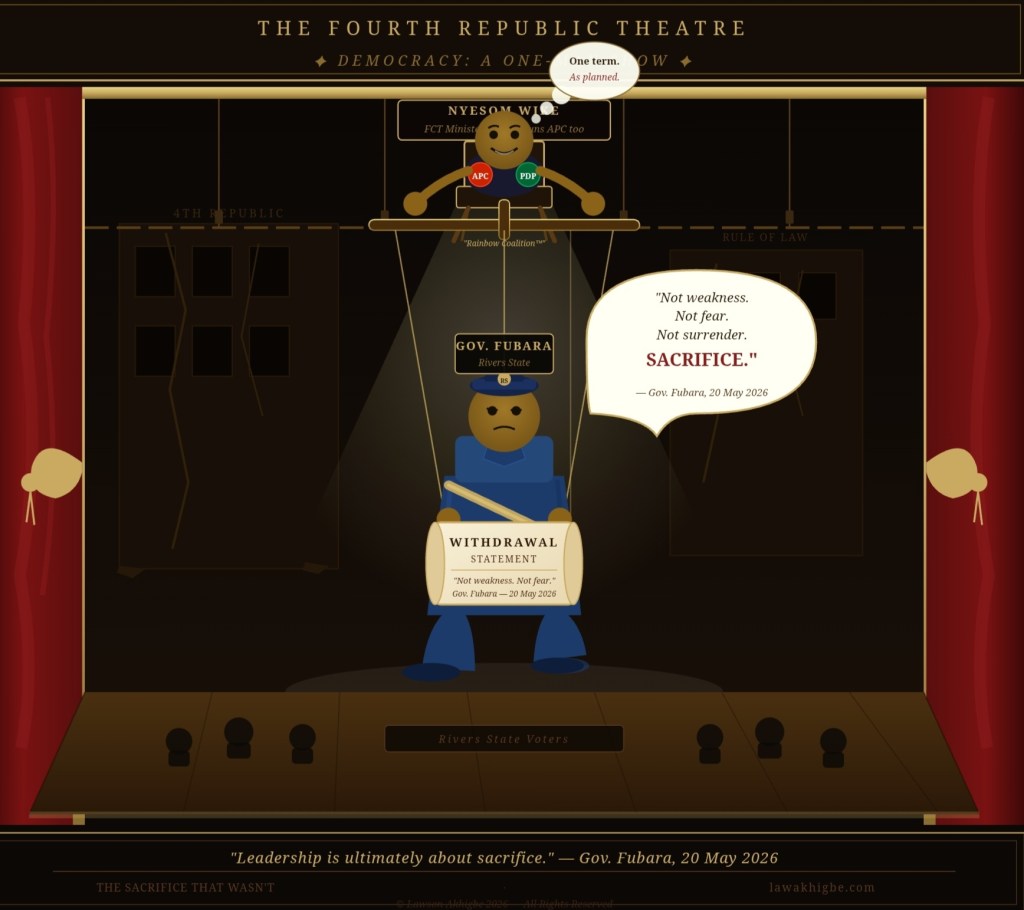
On the night of Wednesday, 20 May 2026, Governor Siminalayi Fubara of Rivers State issued a statement that was, in the tradition of Nigerian political communication, a small masterpiece of diplomatic dishonesty. He had withdrawn, he explained, “not out of weakness, fear or surrender, but out of conviction and sacrifice so that Rivers State may move forward in peace and unity.” Leadership, he instructed us solemnly, “is ultimately about sacrifice.” It was, he concluded, simply his turn to give way to the greater good.
One can only admire the stamina required to issue such a statement with a straight face. The governor had not made a noble choice between personal ambition and public duty. He had been squeezed out of his own party’s governorship primary through a sustained, coordinated and, at critical junctures, constitutionally indefensible campaign of political annihilation, mounted, with considerable creativity, by a man who is not even a member of the same party. The sacrifice was real enough. The voluntariness of it was not.
“The minister is not the owner of Rivers State. He doesn’t own Rivers State, and he doesn’t own the people of Rivers State.” Rivers State activist Kio-Briggs, responding to Wike’s vow that Fubara would be a one-term governor
Act I
The Godfather Speaks, the Godson Listens Until He Doesn’t
To understand why Nyesom Wike has spent the better part of three years trying to destroy a governor he personally installed, one must understand the peculiar theology of Nigerian godfatherism. The arrangement is not, as outsiders sometimes suppose, merely corrupt. It is corrupt in a very specific, hierarchical and deeply felt way. The godfather does not give power. He lends it, on terms. He expects interest payments in the currency of political loyalty, patronage distribution, and the quiet acknowledgement, never spoken aloud in polite company, that the governor’s office is, at bottom, a tenancy.
Fubara’s crime was elementary: he moved in, changed the locks, and stopped forwarding the rent. What followed was not a policy disagreement. It was not an ideological rupture. It was the fury of a landlord whose tenant has claimed adverse possession. Wike, a member of the Peoples Democratic Party, and the Federal Capital Territory Minister in an APC administration, a man whose cross-party omnipresence is itself a commentary on the vacuity of Nigerian party ideology, had engineered Fubara’s emergence as governor in 2023 apparently to have a successor he could remotely control. Power, once transferred, proved unwilling to remain remotely controlled. Institutions buckled. Governance stalled. And a war was declared.
The war had a stated objective. Wike vowed, repeatedly and publicly, that Fubara would be a one-term governor. This was not an idle expression of electoral preference. It was a political directive, issued by a man who has since demonstrated that he controls both APC and PDP party structures in Rivers State through what he has called a “Rainbow Coalition” an arrangement that would be charming if it were not the institutional architecture of one-man political dominance. Wike additionally declared his group would produce Fubara’s successor. The democratic will of the people of Rivers State was not consulted in the drafting of these plans.
Act II
The State of Emergency as Political Instrument
The normal instruments of political pressure, legislative revolt, media assault, funding strangulation, were deployed with enthusiasm. When these proved insufficient to remove the governor, the crisis was escalated to a level that required federal intervention. In March 2025, President Bola Tinubu declared a state of emergency in Rivers State, suspending Governor Fubara, his deputy Ngozi Odu, and members of the Rivers State House of Assembly, and appointing retired Vice Admiral Ibok-Ete Ibas as sole administrator of the state.
This was constitutionally extraordinary. Section 305 of the 1999 Constitution permits the President to proclaim a state of emergency where there is a breakdown of public order and public safety, a clear and present danger to the nation, an actual breakdown of government machinery, or imminent danger or actual outbreak of war. The prolonged quarrel between a governor and his predecessor-turned-minister however venomous, however productive of legislative paralysis, is none of these things. A political feud, even a spectacular one, is not a natural disaster. The Constitution does not permit the President to resolve internal party power struggles by suspending elected officials and appointing military administrators.
A political feud, however venomous, is not a natural disaster. The Constitution does not permit the President to resolve internal party power struggles by suspending elected officials and appointing military administrators.
What the state of emergency demonstrated, and what the Fourth Republic’s defenders must honestly reckon with, is that the Nigerian Constitution’s emergency provisions are sufficiently elastic, and the judiciary sufficiently cautious, that they can be stretched to accommodate political imperatives dressed in constitutional clothing. After six months, the emergency rule was lifted and Fubara was allowed to return to office. This, presumably, was presented as evidence of the system’s resilience. In reality, a sitting governor had been suspended from his constitutionally elected position to cool a political dispute, and the restoration of his office was treated as a presidential favour rather than a legal necessity. That is not constitutional government. That is constitutional theatre.
The impeachment attempts that preceded and accompanied the state of emergency deserve equal candour. Multiple attempts were made to impeach Fubara through a legislature widely regarded as under the control of Wike’s political machinery. The spectacle of a state legislature deploying the solemn instrument of impeachment as a factional weapon is not unique to Rivers State, it has become, across the Fourth Republic’s geography, a recurring feature of the political landscape. What makes the Rivers State version distinctive is the sheer brazenness of the enterprise: the political sponsor of the impeachment effort was a federal minister of a different party who had nonetheless managed to retain operational command of the state’s legislative chamber.
Act III
The Primary as Pantomime
By May 2026, the killing blow was delivered through the very process that democracy provides for the legitimate resolution of political competition: the party primary. After Fubara had defected to the APC in the preceding months, a defection that was itself a measure of the political asylum-seeking to which he had been reduced, he submitted himself to the APC’s governorship primary process. The result was instructive.
At the screening conducted by the APC’s national committee, Fubara received what sources described as a “cold shoulder.” He walked out of the screening room visibly moody and declined to speak to journalists, the body language of a man who already knows the verdict before the jury retires. The APC’s screening committee had separately disqualified dozens of Fubara’s associates from House of Assembly primaries. The message was being delivered in instalments.
Note on the “Rainbow Coalition”: Wike has described his cross-party arrangement in Rivers State as a “Rainbow Coalition” a term that in Nigerian politics denotes the control of both ruling and opposition party structures by a single political operative. The arrangement means that, in practice, there is no party in Rivers State capable of mounting credible opposition to Wike’s preferred candidates. This is, in the strictest sense, the negation of multiparty democracy. Calling it a coalition is, under the circumstances, admirably bold.
The APC’s conduct in this episode exposes the deep democratic deficit that has calcified inside Nigeria’s ruling party. A party primary is not, in theory, a mechanism by which powerful political patrons reallocate state governorships among themselves. It is supposed to be a process by which party members choose their preferred candidate for electoral contest. What happened in Rivers State was something quite different: a pre-determined factional outcome, administered through a formal process whose trappings of legitimacy were presumably intended to persuade someone. It is unclear who.
When Fubara eventually withdrew on Wednesday night, citing the need for “peace, unity and stability,” he thanked President Tinubu for his “support and encouragement” a sentence that, in context, is so richly ironic as to function almost as satire. The President whose administration declared an unconstitutional emergency rule over his state, suspended him from office, and whose party machinery had apparently just cold-shouldered him out of the primary had, apparently, been supportive and encouraging throughout. Nigerian political courtesy is a remarkable linguistic achievement.
Act IV
The Death Spiral: A Diagnostic
Nigeria’s Fourth Republic entered office in 1999 on the back of a military transition that handed power to a former military head of state, which is itself a commentary on the institutional maturity of the enterprise. Twenty-seven years later, the republic is exhibiting the symptoms of a system that has never resolved the foundational question of whether elected office is a public trust or private property.
The Rivers State crisis is not an aberration. It is a concentrated, high-visibility expression of a political pathology that runs through the republic’s tissues. The godfather system, by which political office is manufactured, distributed, and reclaimed by men who operate outside electoral accountability, has proved extraordinarily durable because it has never faced a structural challenge. Courts have occasionally intervened at the margins. The electorate, when permitted to vote freely, has occasionally delivered verdicts that inconvenience the operators. But the operators have consistently proved more creative than the constraints.
The specific features of the Rivers State episode mark an escalation. We have seen godfathers attempt to recall their proteges before. We have seen impeachment weaponised for factional purposes. What is relatively new, and what ought to alarm anyone who retains concern for constitutional government in Nigeria, is the direct deployment of federal emergency powers to resolve a state-level intraparty dispute. When the President of the Federal Republic suspends an elected state governor and installs a military administrator because the governor will not submit to his predecessor’s political dominion, the boundary between federalism and feudalism has been crossed.
The Fourth Republic is in a death spiral not because any single actor within it is uniquely villainous, Nigeria has not been short of political villains in previous republics, but because the institutional guardrails that are supposed to make individual villainy costly have been progressively dismantled, neutralised, or simply ignored. The judiciary that might have struck down the Rivers State emergency rule as unconstitutional did not do so in a timely fashion. The National Assembly that should have scrutinised the proclamation with rigour was otherwise occupied. The electorate that might, in 2027, have delivered a verdict on these events will now be denied that option, because the man who was supposed to represent their choice has been removed from the ballot before the ballot exists.
The people of Rivers State rub their eyes. They did not ask for any of this. They did not elect Nyesom Wike to determine their next governor from his ministerial office in Abuja. They did not vote for the APC’s national chairman to give their sitting governor a cold shoulder. They did not request a sole administrator. They are, in the most literal sense, spectators in a political contest from which their own preferences have been procedurally excluded, and the actors responsible for this exclusion are, without exception, invoking democratic language to describe what they are doing.
Conclusion
A Prognosis, Reluctantly Offered
The consolation that commentators typically reach for at this point, that Nigeria has survived worse; that the republic endures; that Nigerians are resilient, is not entirely false. It is, however, insufficient. Survival is not the same as health. Endurance is not the same as progress. The fact that previous republics were also dysfunctional is not a constitutional argument for the dysfunctions of this one.
The death spiral of the Fourth Republic does not necessarily end in a coup. It may end, instead, in something more insidious: the slow, unannounced, perfectly legal-looking evacuation of democratic content from democratic form. Elections will continue to be held. Primaries will continue to be conducted. Governors will continue to be sworn in. The apparatus will function. Only the substance, the meaningful choice of a people about who governs them, and on what terms, will have been removed. What remains will be the husk of a republic: noisy, expensive, and entirely hollow.
Governor Fubara told his supporters on Wednesday night that he understood “the disappointment, the anger, and the pain many of you may feel.” He was right to understand it. That anger belongs not only to the people of Rivers State. It belongs to every Nigerian who has watched, over nearly three decades, as self-important actors have treated the Fourth Republic as a vending machine for personal political outcomes, inserting money and connections and federal emergency powers until the desired snack falls out, and who have grown increasingly furious that the machine always delivers.
The question is not whether that anger is legitimate. It plainly is. The question is whether it can yet be converted into the kind of sustained institutional pressure that makes the next abuse more difficult than the last. If it cannot, then the sacrifice Governor Fubara claims to have made on Wednesday night will not be the last that the republic extracts from those who are foolish enough to believe that electoral office, in Nigeria, belongs to the person who wins it.
 Centre for Nigeria Progress