


There is a growing fashion among Nigerian political intellectuals to speak about insecurity as though the country merely suffers from “poor coordination” or “weak intelligence architecture.” The language sounds modern. References to drones, cyber intelligence, intelligence fusion centres and homeland security structures create the image of a state preparing for 21st-century warfare.
The above is intellectually ambitious, emotionally persuasive and politically seductive. It correctly identifies insecurity as an economic ecosystem involving illegal mining, oil theft, ransom networks, arms trafficking and politically connected criminality. It also rightly points out that corruption within security institutions undermines Nigeria’s ability to confront organised violence.
But beneath the polished language lies a familiar Nigerian temptation: the belief that insecurity can be solved primarily through stronger political will, institutional restructuring and technological sophistication, while ignoring the deeper historical and regional realities that created the crisis in the first place.
Nigeria’s insecurity problem did not emerge in isolation, and it certainly did not begin with the current administration.
One of the greatest weaknesses in Nigeria’s modern security debate is the near-total absence of institutional memory. Every government behaves as though insecurity started yesterday and can be solved by renaming agencies, creating task forces, launching military operations with catchy code names or introducing another security doctrine with an impressive acronym.
But Nigeria has travelled this road before.
Before the Nigerian Civil War, violent armed robbery on a national scale was relatively uncommon. Crime existed, but most criminality involved petty thefts, local disputes and opportunistic crimes. In many communities, people left homes and properties relatively unsecured. Villagers feared thieves stealing chickens, goats or bicycles, not heavily armed gangs carrying military-grade weapons.
The civil war changed Nigeria permanently.
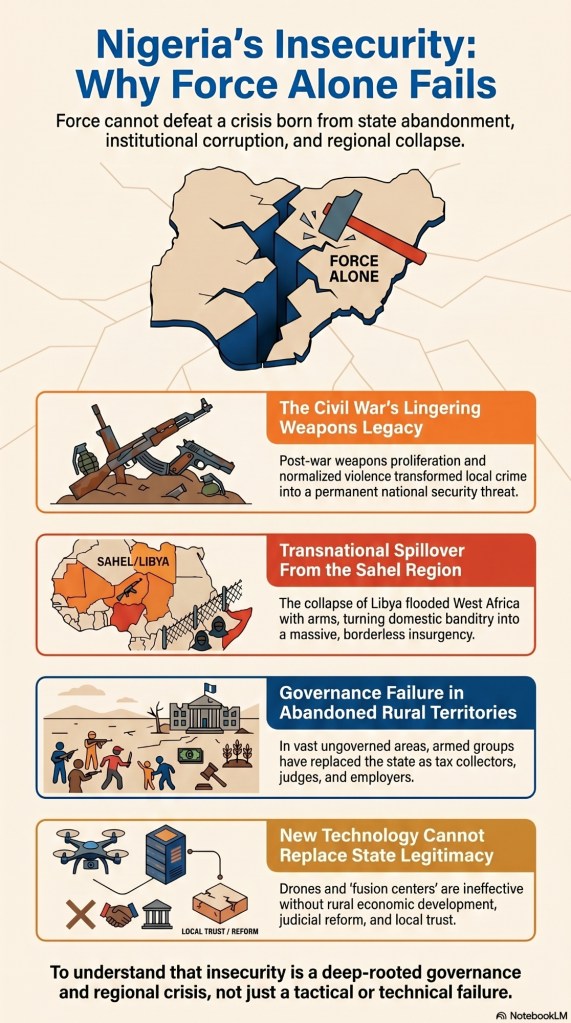
The conflict flooded the country with weapons, traumatised combatants, weakened institutions and normalised violence as an economic and political instrument. When the war ended, the guns did not disappear. Weapons circulated into civilian society. Former fighters, opportunists and criminal syndicates adapted wartime methods into peacetime criminal enterprise.
Armed robbery exploded across Nigeria in the years that followed.
The military government responded with overwhelming force. Anti-robbery squads and Armed Robbery and Firearms Tribunals became central to state policy. Extraordinary criminal procedures entered Nigerian jurisprudence. Due process protections were weakened in the name of national security. Convictions increased. Executions became public spectacles intended to frighten criminals into submission.
The state believed fear alone could restore order.
Yet despite executions, military crackdowns and aggressive policing, armed robbery survived for decades because the underlying conditions driving criminality were never fully addressed.
Weapons proliferation remained.
Economic hardship deepened.
Institutional corruption spread.
Public trust in law enforcement deteriorated.
The state focused heavily on punishing symptoms while struggling to address causes.
That historical experience should serve as a warning to contemporary Nigeria.
Today’s insecurity crisis follows a disturbingly familiar pattern:
- widespread weapons proliferation,
- weak border enforcement,
- regional instability,
- criminal adaptation,
- corruption within institutions,
- and state overreliance on force-based responses.
The difference is that today’s crisis is even more dangerous because it is transnational.
Modern Nigeria is no longer dealing only with domestic criminality. It is confronting the spillover effects of one of the most unstable geopolitical regions on earth.
The collapse of Libya after the NATO-backed overthrow of Muammar Gaddafi in 2011 unleashed massive quantities of weapons across North and West Africa. Arms from Libyan stockpiles flooded the Sahel. Tuareg fighters returned heavily armed into Mali. Jihadist organisations expanded rapidly. Smuggling routes evolved into insurgency corridors.
The consequences are now visible from Mali to Burkina Faso, Niger and northern Nigeria.
Banditry in Nigeria did not emerge in a vacuum. Many armed groups terrorising Zamfara, Katsina, Sokoto and Kaduna are connected directly or indirectly to broader Sahelian instability. Fighters move across porous borders with ease. Arms flow through Niger Republic. Foreign mercenaries, extremist networks, cattle rustlers and organised criminal syndicates overlap in ways the Nigerian state barely comprehends.
This is where it becomes politically convenient rather than historically rigorous.
Every Nigerian administration since 1999 has underestimated the scale and complexity of the problem.
Olusegun Obasanjo confronted Niger Delta militancy and communal violence.
Umaru Yar’Adua faced Boko Haram in its infancy.
Goodluck Jonathan watched Boko Haram evolve into a territorial insurgency.
Muhammadu Buhari presided over the explosion of industrial-scale banditry despite his military background.
Now Bola Tinubu inherits overlapping security crises involving:
- jihadist insurgency,
- rural banditry,
- separatist militancy,
- piracy,
- oil theft,
- illegal mining,
- farmer-herder conflict,
- and transnational organised crime.
No administration has solved the problem because the crisis itself keeps evolving faster than the state’s institutional capacity.
There are arguments speaking confidently about intelligence fusion centres, territorial domination and advanced surveillance systems. Such language sounds impressive until one remembers Nigeria’s realities.
Nigeria is not a compact surveillance state. It is a vast country with forests, deserts, mountains, riverine swamps and thousands of poorly governed rural communities where the state barely exists outside election seasons.
Technology helps, but drones cannot govern abandoned territory.
What happens after military operations end?
Who governs the villages reclaimed from bandits?
Who resolves grazing disputes?
Who rebuilds destroyed local economies?
Who restores trust between communities and security agencies accused of extortion and abuse?
Who creates alternatives for unemployed young men already absorbed into criminal networks?
There is endless talk about intelligence superiority but remarkably little about governance failure at the grassroots level.
That omission matters.
Banditry survives not merely because criminals possess weapons, but because millions of Nigerians feel abandoned by the state itself. In many rural communities, armed groups now function as tax collectors, employers, judges and protectors.
That is not simply a security failure.
It is state failure.
Another weakness is the almost theatrical confidence that “the sponsors are known.” Nigerians love this phrase. It appears in television interviews, political speeches and newspaper columns almost weekly.
“The sponsors are known.”
If they are truly known, why are prosecutions so rare?
Because evidence sufficient for public outrage is not always evidence sufficient for criminal conviction. Criminal networks operate through layers of intermediaries, ethnic loyalties, informal financial systems and cross-border protection structures. Nigeria’s weak judicial process further complicates matters.
There is the illusion that a determined Homeland Security Adviser could simply “clean the system” if granted enough authority. History suggests otherwise.
Even sophisticated states struggle against decentralised insurgencies and criminal economies. The United States spent two decades in Afghanistan only for the Taliban to return to power. France deployed heavily across the Sahel under Operation Barkhane and still watched Mali, Burkina Faso and Niger descend further into instability.
Nigeria cannot merely arrest its way out of this crisis.
Nor can it drone-strike its way into peace.
The deeper challenge is rebuilding state legitimacy in regions where government authority has collapsed psychologically, economically and physically.
This is why security reform must go beyond militarisation and political sloganeering.
Yes, Nigeria needs:
- stronger intelligence systems,
- better border protection,
- financial surveillance,
- anti-corruption enforcement,
- modern policing,
- and improved coordination among agencies.
But it also needs:
- functioning local government,
- rural economic development,
- judicial reform,
- land and grazing reforms,
- education systems,
- regional diplomacy,
- and genuine cooperation with neighbouring states.
Without stabilising the wider Sahel region, Nigeria will continue fighting an endless hydra of insecurity.
One cannot discuss Nigeria’s security crisis honestly without discussing:
- ECOWAS paralysis,
- the coups across the Sahel,
- anti-Western political sentiment in Francophone Africa,
- transnational smuggling economies,
- and the geopolitical vacuum increasingly occupied by Russia, Gulf actors and private mercenary networks.
Nigeria’s borders were designed for another century. Criminals understand this better than politicians do.
The final irony is that while we condemn the politicisation of security, the response itself is heavily politicised. National insecurity becomes framed less as a collective emergency.
Nigeria deserves a more honest conversation.
The country must acknowledge three uncomfortable truths simultaneously.
First, corruption within Nigeria absolutely fuels insecurity.
Second, regional instability across Libya and the Sahel massively amplifies it.
Third, no Nigerian president, whether Tinubu, Obi, Atiku or Kwankwaso possesses a magical institutional formula capable of reversing decades of state decay overnight.
History already warns us about the dangers of reactive security policy without institutional memory.
After the civil war, Nigeria responded to rising armed robbery primarily with force, tribunals and executions while failing to address deeper structural causes.
Today, Nigeria is repeating the same mistake with more sophisticated language and newer technology.
The country is once again attempting to reinvent the wheel while calling the wheel something else.
The lesson from Nigeria’s history is not that force is unnecessary. States must maintain coercive authority or they collapse. But force alone cannot defeat criminal economies born from weapons proliferation, political instability, economic despair, institutional corruption and regional collapse.
Nigeria’s insecurity crisis is not a single fire.
It is an entire climate of instability stretching from the collapse of Libya to the forests of Zamfara and the creeks of the Niger Delta.
And climates are not solved with political speeches, media appearances or new security acronyms alone.

