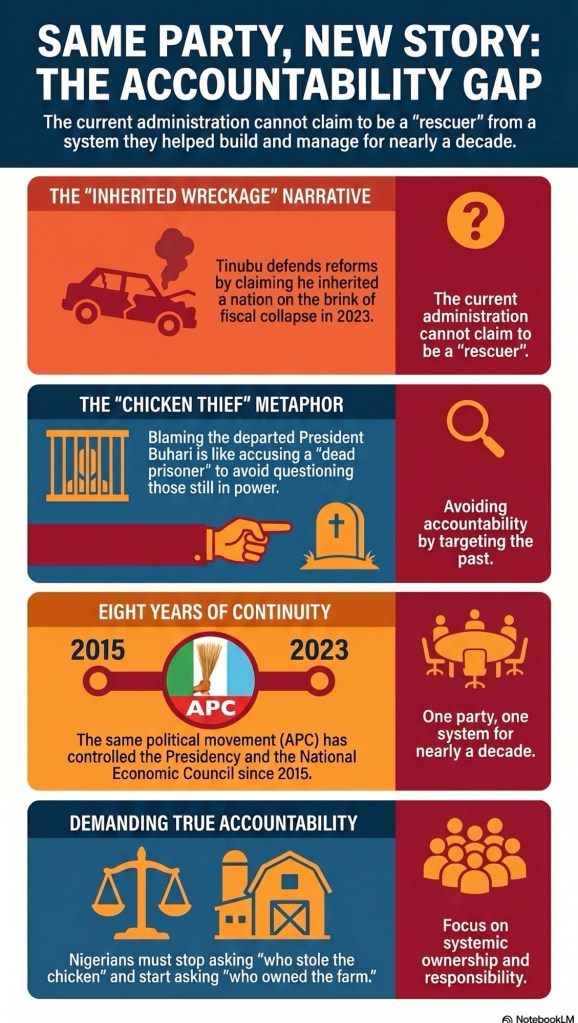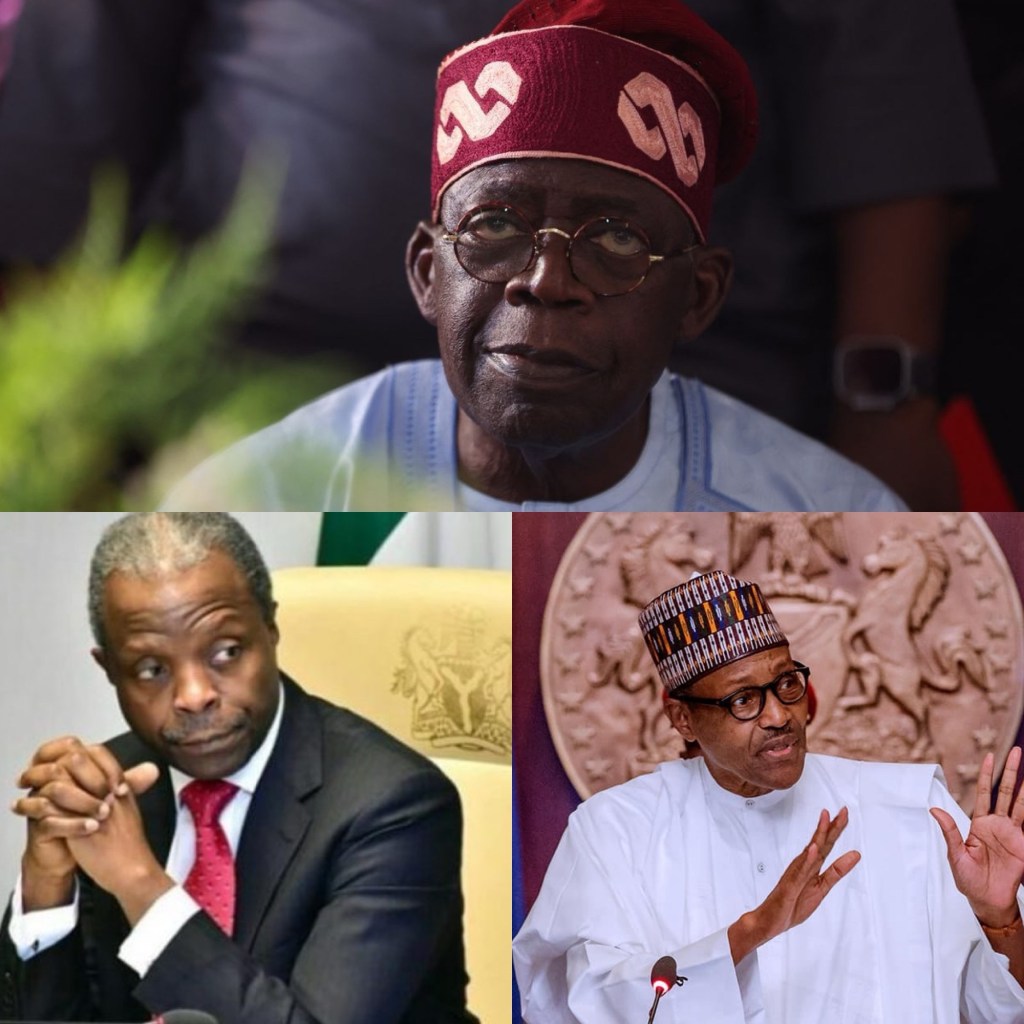
President Bola Tinubu has repeatedly defended his economic reforms by arguing that Nigeria stood on the precipice of fiscal collapse when he assumed office in May 2023. According to the President, the removal of fuel subsidies, the floating of the naira, and other painful economic measures were unavoidable decisions designed to save the nation from bankruptcy.
The argument is familiar.
Nigeria, we are told, inherited a near-empty treasury. Public debt had spiralled out of control. Fuel subsidies had become an unsustainable burden. Foreign exchange policies had distorted the economy beyond recognition. The previous administration, according to the narrative, left behind an illusion of prosperity built on borrowed money and unsustainable spending.
Perhaps.
But there is a question that stubbornly refuses to disappear.
Who exactly was in charge during the accounting period?
In law, finance and governance, responsibility does not simply materialise on inauguration day. Every auditor knows that before assigning blame, one must identify who controlled the books, who approved the expenditures, who supervised the policies and who occupied the offices responsible for oversight.
The Buhari administration did not govern in a vacuum.
The National Economic Council (NEC), one of the highest economic policy-making bodies in the country, was chaired by then Vice President Yemi Osinbajo. Osinbajo was not a political opponent of the current President. He was a leading member of the same political family.
The political lineage is impossible to ignore.
The Action Congress of Nigeria (ACN), founded and led by Bola Ahmed Tinubu, eventually became the dominant component of the All Progressives Congress (APC). The APC itself emerged in 2013 through the merger of the ACN, CPC, ANPP and other political groups.
The same political movement controlled the Federal Government from 2015 until 2023.
The same movement controlled the National Economic Council.
The same movement controlled the presidency.
The same movement controlled the majority of the policy apparatus that now stands accused of steering Nigeria toward disaster.
Yet, listening to some government officials today, one might conclude that the APC discovered the economic wreckage only after winning an election against itself.
This is where the explanation begins to resemble one of the most chilling scenes from Schindler’s List.
In the notorious Plaszów labour camp, SS Commandant Amon Göth demands to know who stole one of his chickens. When nobody confesses, he randomly shoots and kills a prisoner. Afterwards, a terrified boy points to the dead man and identifies him as the chicken thief. Göth accepts the explanation and moves on.
The absurdity is obvious.
The accused is conveniently unable to defend himself because he is already dead.
The matter is closed.
The authority figure remains unquestioned.
The narrative is preserved.
Nigeria’s current political discourse occasionally feels uncomfortably similar.
The late President Muhammadu Buhari has increasingly become the designated chicken thief. Every economic difficulty is traced back to his administration. Every painful reform is justified as a consequence of his decisions. Every hardship becomes evidence of a mess inherited from the past.
But unlike the unfortunate prisoner in the film, the accounting records are still available.
Many of the principal actors are still alive.
The former Vice President who chaired the National Economic Council remains alive.
Former ministers remain alive.
Former governors who sat on the NEC remain alive.
Senior APC leaders who defended those policies at the time remain politically active.
Most importantly, the National Leader of the APC throughout much of that period was Bola Ahmed Tinubu himself.
This is not an argument against reform.
It is entirely possible that subsidy removal was necessary.
It is entirely possible that exchange-rate unification was unavoidable.
It is entirely possible that difficult economic decisions had to be made.
The issue is accountability.
If the previous economic model was truly an unsustainable illusion, then the public deserves a more complete explanation than simply blaming a departed president.
Who designed the policies?
Who defended them?
Who supervised them?
Who approved the budgets?
Who chaired the economic councils?
Who exercised influence over the governing party?
These are not opposition figures. These are members of the same political establishment.
A government cannot spend years praising its stewardship while in office and then, upon inheriting power from itself, suddenly discover that everything was a catastrophe.
At some point, the distinction between “they” and “we” becomes impossible to maintain.
The challenge facing the Tinubu administration is therefore not merely economic. It is political and historical.
The government must explain how a party that has effectively controlled the federal government since 2015 can simultaneously. present itself as both the architect of the previous system and the courageous reformer sent to rescue the country from that same system.
That contradiction is becoming increasingly difficult to sustain.
Because eventually Nigerians will stop asking who stole the chicken.
They will start asking who owned the farm.