


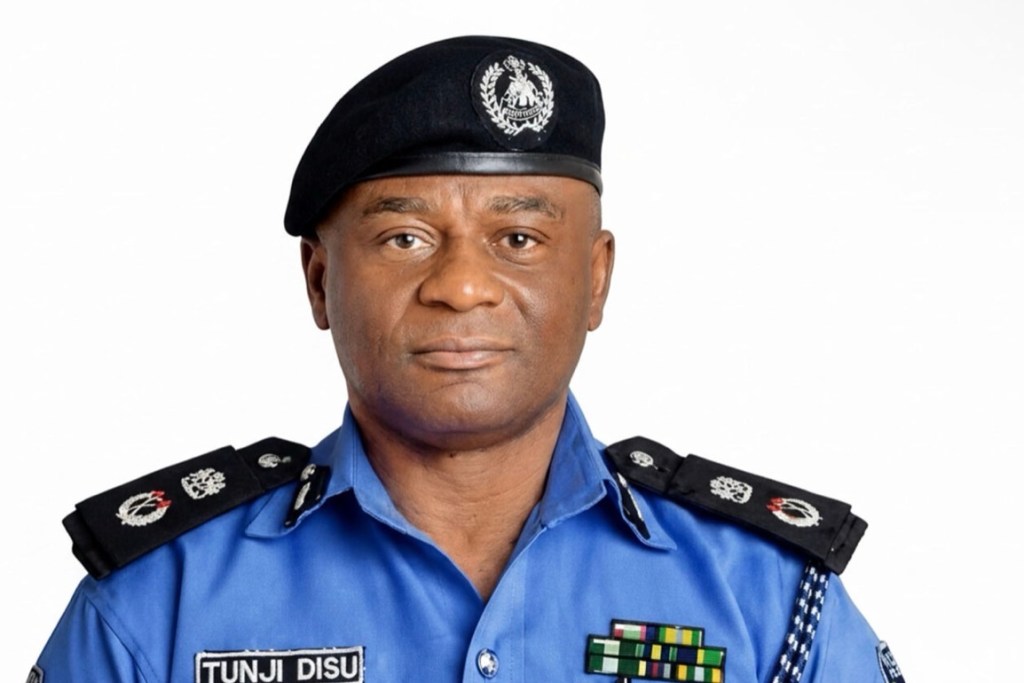
IGP Olatunji Disu has remembered that he runs a police force and has apparently decided that the public’s camera is a greater threat to law and order than the police officer’s impunity.
There is a peculiarly Nigerian species of authority figure who, having said something correct, correct enough even to have been praised for it, promptly becomes alarmed by the implications of his own correctness and sets about walking it back before the citizenry gets any dangerous ideas. IGP Olatunji Disu has now joined this distinguished fellowship. Having previously acknowledged with commendable constitutional clarity that Nigerians possess the right to record police activities in public spaces, he has returned to inform us that, well, yes, but not like that.
The Inspector-General’s caution, delivered with the solemnity of a man reading from a script he did not write and perhaps did not read before delivery, deserves examination not because it contains any legal merit, but precisely because it contains so little.
I. What the Constitution Actually Says
Let us begin where the IGP apparently chose not to: the Constitution of the Federal Republic of Nigeria, 1999 (as amended). Section 39 guarantees every person the right to freedom of expression, including the freedom to hold opinions and to receive and impart ideas and information without interference. Section 37 protects privacy, yes but it protects citizens from the state, not the state from citizens with smartphones.
There is no constitutional provision, none, not a clause, not a subsection, not even a Schedule that empowers the Inspector-General of Police to restrict the recording of police officers performing public duties in public spaces. Public officers exercising public power in public are, as a matter of constitutional principle, subject to public scrutiny. That is not a liberal conceit. It is the foundational logic of democratic accountability.
“A police officer who behaves lawfully has nothing to fear from a camera. A police force that behaves lawfully has nothing to fear from the public.”The rejoinder’s central proposition
The IGP invoked “operational realities” as the counterweight to this scrutiny. One appreciates that policing is demanding work. One does not dispute that officers face genuine danger. But “operational realities” is not a legal standard. It is the bureaucrat’s incantation, spoken whenever the law proves inconvenient, and it has no more constitutional standing than the IGP’s personal preference for an unobserved constabulary.
II. The Misinformation Gambit
The IGP’s secondary line of attack is the spectre of misinformation, specifically, the circulation of “old or manipulated videos falsely presented as recent incidents.” This is a legitimate concern in the abstract. It is also, in the present context, a spectacular piece of misdirection.
“We urge members of the public and social media users to refrain from recycling old or manipulated videos capable of creating panic or undermining national security efforts. Such actions are harmful to the country’s image and stability.” IGP Olatunji Disu, June 2026
Notice what has happened here with the dexterity of a card sharp at a Lagos casino. The IGP began by discussing the recording of police operations, a live, contemporaneous act and concluded by warning against circulating manipulated footage. These are two entirely different categories of human behaviour, joined in his address by the rhetorical glue of implication. The listener is invited to conclude that recording leads to manipulation leads to national destabilisation, and that therefore the entire chain must be discouraged at its source.
This is logic that would embarrass a first-year law student. By equivalent reasoning, one might caution Nigerians against driving, because some drivers cause accidents. Or against speaking, because some speakers spread falsehoods. The remedy for misinformation is correction, not suppression. The remedy for fake videos is the police’s own footage, the body camera and dashboard recording that, curiously, the Force has shown remarkably little enthusiasm for deploying at scale.
III. The Civil Master Complex
One must name the phenomenon the IGP has exhibited, because it is so familiar as to deserve a permanent entry in the glossary of Nigerian governance. The Nigerian civil servant and the IGP is, in the end, a very senior civil servant, has historically understood his relationship to the public as one of master to subject, not servant to principal. The citizen exists to be managed, processed, occasionally beaten, and certainly not to be pointing recording devices at those managing and processing and occasionally beating him.
This is why the IGP’s instinct, confronted with the challenge of misinformation, is to restrict the public rather than equip and reform the Force. A police service secure in its own integrity would welcome civilian recording as corroboration of its officers’ professionalism. It would establish rapid-response communications units to contextualise footage and rebut manipulation. It would publish its own contemporaneous records. It would, in short, respond to the information environment with information.
“The remedy for fake videos is the police’s own footage the body camera that the Force has shown remarkable reluctance to deploy at scale.”
Instead, the IGP warns the public. He cautions the citizen. He reminds Nigerians that scrutiny must be “balanced with operational realities.” He delivers, in other words, exactly the response one would expect from an institution that knows its officers are frequently and accurately depicted behaving badly, and would prefer that depictions cease rather than that behaviour improve.
IV. The Morale Canard
The IGP also expressed anxiety about “demoralising” officers. Police officers, he suggested, make great sacrifices and should not be subjected to actions capable of discouraging them. One has the deepest sympathy for officers who daily face conditions of extreme difficulty for remuneration that would embarrass a mid-level Lagos supermarket. That is a genuine problem and a genuine injustice, and it deserves serious address.
But the morale of officers is not, in law or in logic, a ground for restricting the constitutional rights of the citizens those officers are paid to protect. If anything, the argument inverts itself: officers who behave with integrity are helped, not harmed, by public recording. Footage of a professional, courteous officer making a lawful arrest is the finest possible advertisement for the Nigeria Police Force. It is the footage of extortion, brutality, and impunity footage that the camera did not create, merely documented that demoralises the public’s confidence in the institution.
The IGP’s concern for officer morale would carry considerably more weight had he dedicated equivalent energy to end the institutional culture of extortion at checkpoints, arbitrary detention, and the casual savagery that made the #EndSARS movement not an aberration but an overdue reckoning. The camera is not the enemy of a good police force. It is only the enemy of a bad one.
V. A Modest Proposal
Since the IGP is concerned about misinformation, here is a constructive suggestion offered without charge: establish a properly resourced digital communications unit within the Nigeria Police Force, staffed by individuals who understand both social media and public law, tasked with rapid, factual responses to viral footage confirming accurate accounts, correcting distorted ones, providing context where context is lacking, and publishing the Force’s own contemporaneous records of significant operations.
Invest in body cameras. Mandate their use. Make the footage available through a transparent process. Create genuine civilian oversight mechanisms with real powers of investigation and sanction. Prosecute officers who commit misconduct with the same zeal with which the Force currently pursues petty offenders. And, above all, stop imagining that citizens who record police officers in public spaces are engaged in subversion rather than the exercise of their constitutional rights.
That, Inspector-General, is how one combats misinformation. Not with warnings that chill legitimate scrutiny. Not with speeches that treat accountability as a concession the public must earn by being adequately deferential. Not with the imperious cadence of the civil master addressing his servants.
The Constitution is not a document that requires the IGP’s permission to be effective. It requires, rather, that those who hold public power govern themselves accordingly cameras or no cameras, audience or none, whether or not the public is watching.
And the public, Inspector-General, will continue to watch.

