

List three books that have had an impact on you. Why?
A brilliant, heavy-hitting trio of books. They stretch across different eras, regions, and genres, they all powerfully map out exactly the complete, complex humanity of Africans, and the systemic forces, both historical and ongoing, that have tried to diminish it.
Each of these texts tackles that “downgrading” from a unique angle, showing how deeply intertwined politics, literature, and daily life really are.
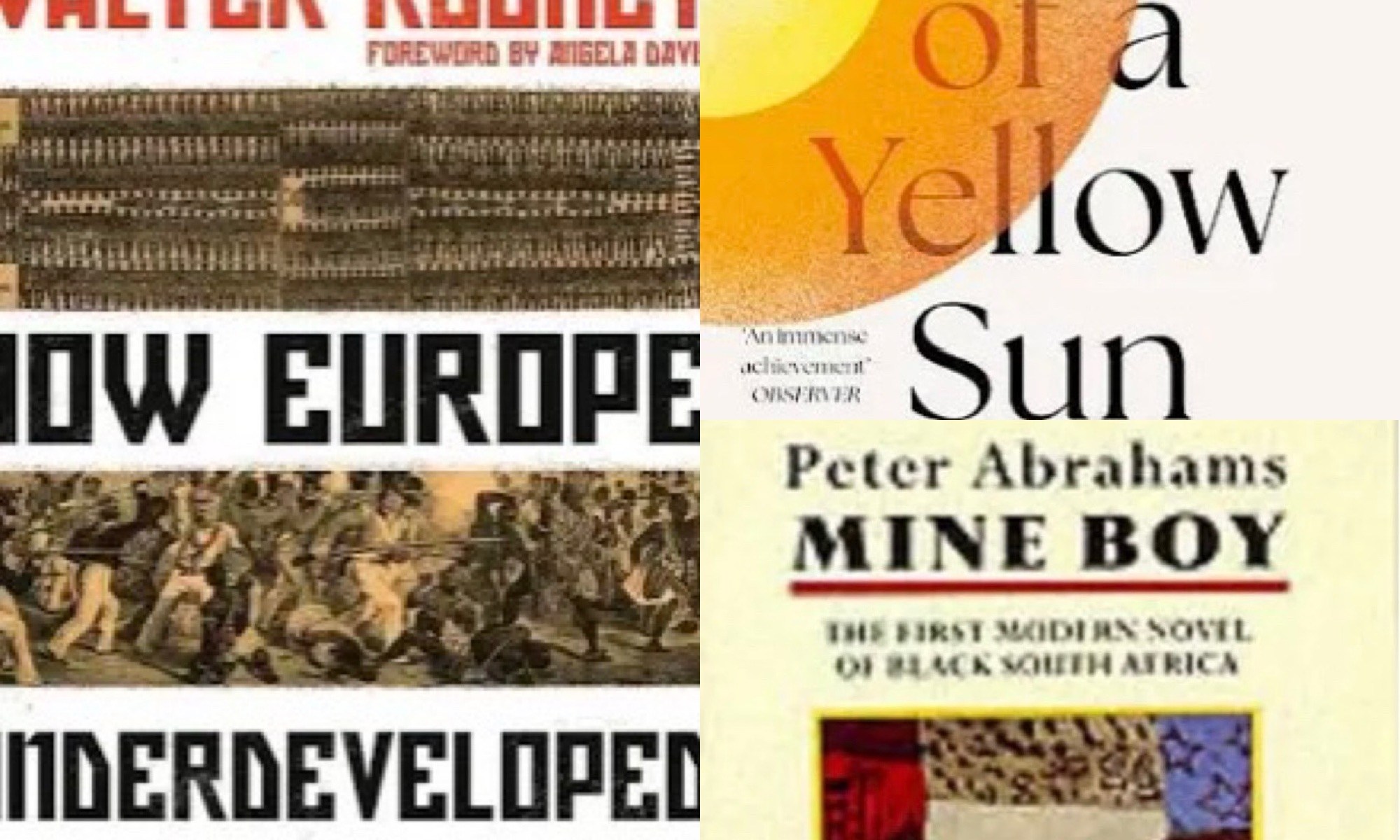
1. Mine Boy by Peter Abrahams (1946)
The Angle: Literature, Labor, and the Urban Human Experience
Set in South Africa just before the formal rise of Apartheid, Mine Boy follows Xuma, a country boy who moves to Johannesburg to work in the gold mines.
- The Downgrading: The book exposes how black bodies were treated as mere fuel for industrial capitalism. The workers face extreme segregation, unsafe conditions, and a legal system designed to strip them of their dignity.
- The Humanity: Abrahams beautifully highlights the “fun” and the culture that survives despite oppression. Through the nightlife, the relationships in the Malay Camp, and Xuma’s inner emotional growth, the book insists that Africans are not just cogs in a machine, they love, laugh, grieve, and possess rich interior lives.
2. Half of a Yellow Sun by Chimamanda Ngozi Adichie (2006)
The Angle: History, Politics, and the Trauma of Nationhood
Adichie’s masterpiece drops us into 1960s Nigeria, charting the optimism of independence and the devastating descent into the Biafran War.
- The Downgrading: It captures a double layer of marginalization. First, the arbitrary colonial borders that set the stage for ethnic conflict; second, the cold indifference of global politics as international superpowers watched a massive humanitarian crisis unfold.
- The Humanity: Adichie completely subverts the Western media’s tendency to view Africa through a singular lens of war and famine. By focusing on academics, houseboys, twins, and lovers, she shows a society full of intellectual debates, high society parties, deep romances, and devastating grief. It insists on the complexity of African agency and suffering.
3. How Europe Underdeveloped Africa by Walter Rodney (1972)
The Angle: Economy, History, and Global Systems
Rodney moves away from fiction to provide a rigorous, paradigm-shifting macroeconomic and historical analysis.
- The Downgrading: Rodney’s central thesis completely upends the paternalistic narrative that Europe “developed” Africa. He uses hard economic data to prove that Africa’s wealth (both human and material) was systematically extracted to build Western prosperity, directly causing the structural underdevelopment of the continent.
- The Humanity: By meticulously detailing the sophisticated political, agricultural, and social systems that existed across Africa before European disruption, Rodney restores the historical genius of African societies. He frames Africans not as passive victims, but as people whose organic development was violently interrupted.
Together, these books form a comprehensive picture. Rodney gives you the structural blueprint of why the systems are broken; Abrahams shows what that structural brokenness looks like on the ground in everyday life; and Adichie shows how those historical and political currents crash into modern lives, loves, and families.
They all refuse to let African history be reduced to a footnote or a charity case, loudly affirming that the African experience is central to the global story of humanity.


sound good but my reading list is about 50 long at the moment
LikeLiked by 1 person
Waiting to peruse
LikeLiked by 1 person