


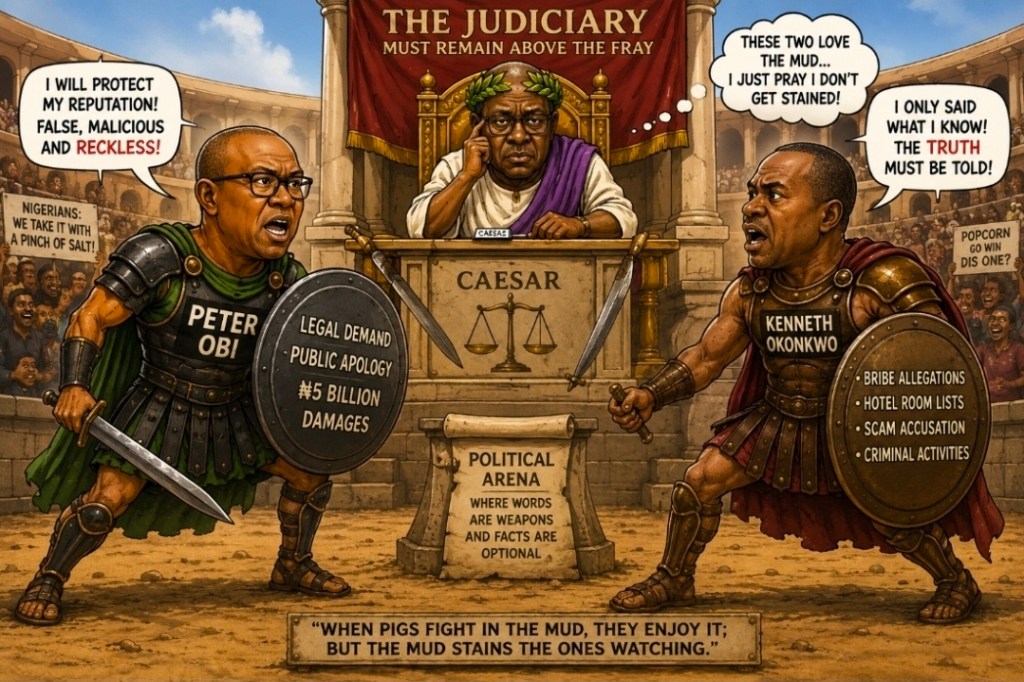
Nigerian politics has always had a theatrical quality to it. Our politicians rarely speak with restraint. Nuance is considered weakness, exaggeration is mistaken for conviction, and opinion is frequently presented as established fact. Press conferences often resemble auditions for Nollywood productions rather than serious political engagement.
One of the enduring weaknesses of Nigerian political parties is the absence of robust research and policy departments. Many politicians appear deeply enamoured with the sound of their own voices. Statements are made without verification, accusations are thrown about without evidence, and wild claims become campaign talking points overnight.
The public, having been subjected to decades of this behaviour, has developed a certain immunity. Nigerians generally consume political pronouncements with a healthy dose of scepticism. Every allegation is treated as an allegation. Every counter-allegation is viewed with equal suspicion. Citizens have learned to separate political drama from political reality.
This scepticism, while unfortunate, serves a useful purpose. It protects the public from becoming captive audiences to political propaganda. It also ensures that political disagreements remain where they belong: in the political arena.
The danger arises when politicians seek to judicialise political disputes.
There is an old saying that when pigs fight in the mud, they enjoy it. The mud is their natural environment. The judiciary, however, is not a pig. It is an institution whose authority depends on public confidence, dignity and impartiality. When political actors drag every disagreement before the courts, they risk staining an institution that must remain above the fray.
This concern is particularly relevant in light of the latest dispute involving former allies, Peter Obi and Kenneth Okonkwo.
Obi has reportedly issued a formal legal demand seeking a public apology and damages of ₦5 billion following statements made by Okonkwo during an appearance on Channels Television’s Sunrise Daily programme on 8 June 2026.
According to reports, Okonkwo alleged that Obi and leaders of the Nigerian Democratic Congress (NDC) in the South-East extorted aspirants by demanding bribes after official nomination fees had already been paid. He further claimed that candidate lists were allegedly compiled from a hotel room and suggested that aspirants risked being deceived or exploited.
Obi’s legal team, led by Chief Alex Sean, has responded forcefully. The allegations have been described as false, malicious and reckless. A seven-day ultimatum has reportedly been issued demanding a retraction and an unreserved apology through the same media channels that carried the original statements. Failing compliance, further legal proceedings may follow.
From a legal perspective, every citizen possesses the right to protect his reputation. Defamation law exists for precisely this purpose. A person’s standing in society is valuable and deserves protection against false and damaging allegations.
Yet politics occupies a special category.
Political leaders routinely make accusations against one another. They question each other’s integrity, competence, motives and records. Often these exchanges generate more heat than light. The electorate is usually capable of evaluating such claims without judicial intervention.
The courts are at their strongest when deciding questions of law, not when serving as referees in political quarrels. Every time politicians rush to court over statements made in the course of political combat, there is a risk that the judiciary becomes perceived as an extension of the political battlefield.
This is not an argument against legitimate defamation claims. If serious allegations of criminal conduct have been made without evidence, the injured party is entitled to seek legal redress. Equally, if the allegations can be substantiated, then truth remains a complete defence.
The larger question is whether Nigerian politics has become so devoid of internal discipline that every disagreement must now be resolved by judges rather than facts.
In mature democracies, political parties investigate allegations against their own members. Journalists scrutinise claims. Research departments verify facts. Party disciplinary mechanisms resolve disputes. The courts remain a last resort.
In Nigeria, however, politics increasingly resembles a reality television programme in which sensational claims are made first and evidence is sought later, if at all.
The dispute between Peter Obi and Kenneth Okonkwo is therefore about more than two former political allies. It reflects a broader problem within Nigerian political culture: the substitution of evidence with rhetoric and the growing temptation to transform political disagreements into legal battles.
The public will ultimately judge the credibility of both men. The courts, if called upon, will determine whether the law of defamation has been breached. But the political class should remember that while they may enjoy fighting in the mud, institutions such as the judiciary cannot emerge from such contests entirely unstained.
Nigeria’s democracy needs fewer actors performing for the cameras and more statesmen committed to facts. Until then, the spectacle will continue, the accusations will grow louder, and the courts will increasingly find themselves dragged onto a stage where they were never meant to perform.

