Nigeria has many thriving industries. We produce oil. We produce music. We produce footballers. We produce politicians faster than China produces electronics.
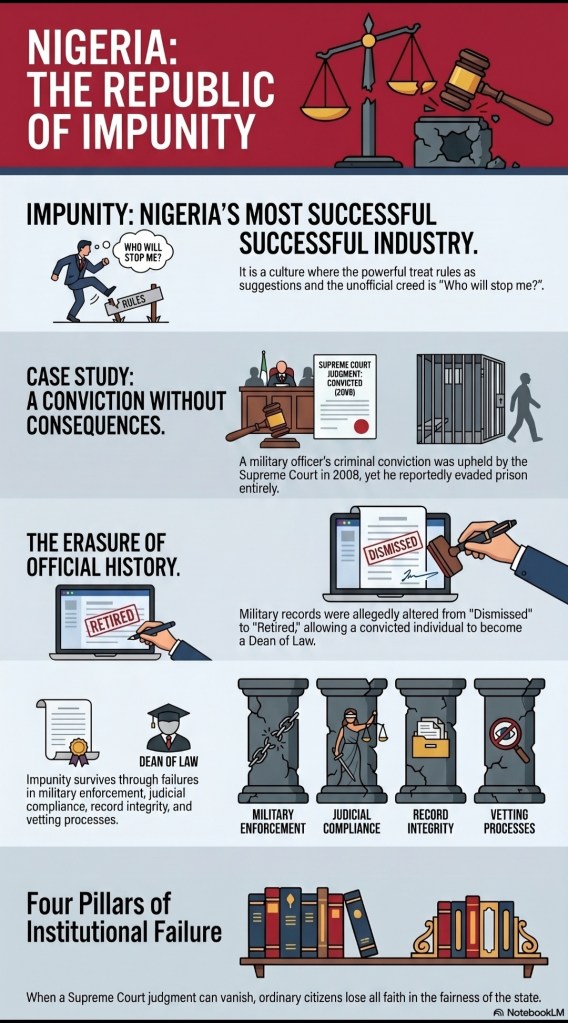
But perhaps our most successful industry is impunity.
Impunity is the one Nigerian product that never suffers from foreign exchange shortages, power outages, or infrastructure deficits. It is available in abundance from Sokoto to Calabar. Rich and poor alike participate in it. Politicians practise it. Civil servants perfect it. Businessmen embrace it. Even ordinary citizens occasionally treat rules as mere suggestions.
The national motto may officially be “Unity and Faith, Peace and Progress,” but our unofficial creed often appears to be: “Who will stop me?”
This culture of impunity is perhaps the single greatest obstacle to Nigeria’s development. No nation can progress where laws are treated as optional, institutions are routinely manipulated, and accountability is viewed as a nuisance rather than a necessity.
The recent investigation by Premium Times provides a remarkable case study.
The facts are so extraordinary that if they appeared in a Nollywood script, viewers would complain that the writer had exaggerated.
In 1997, military police officer Bello Magaji was convicted by a General Court Martial for a serious criminal offence. He challenged the conviction through the legal system for years. Eventually, in 2008, the matter reached its final destination: the Supreme Court.
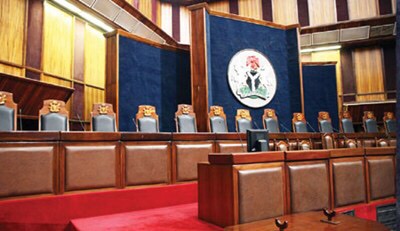
The highest court in the land unanimously dismissed his appeal.
That should have been the end of the story.
In every functioning legal system, a conviction upheld by the Supreme Court is not a polite recommendation. It is not an advisory opinion. It is not an invitation for further negotiations.
It is final.
A prison sentence should follow.
Yet somehow, in Nigeria, the sentence never materialised.
The convicted officer reportedly evaded imprisonment entirely.
Then the story became even more astonishing.
Instead of fading into obscurity after a criminal conviction affirmed by the Supreme Court, he received a presidential pardon during the administration of President Goodluck Jonathan.
One may debate the wisdom of presidential pardons, but what followed raises even deeper questions.
According to the investigation, military records that had reflected a dismissal from service were allegedly altered to show a voluntary retirement.
That distinction is not merely semantic.
Being dismissed from service following conviction carries obvious consequences. Voluntary retirement suggests a respectable departure from public service.
One describes disgrace.
The other suggests honour.
In a country where official records form the basis for appointments, promotions, and public trust, such a transformation is not a trivial matter.
Armed with a sanitised history, Bello Magaji reportedly built an academic career spanning institutions in Nigeria and Uganda.
The journey eventually culminated in his appointment as Dean of the Faculty of Law at the American University of Nigeria, Yola.
Pause for a moment and appreciate the symbolism.
A man whose criminal conviction survived scrutiny all the way to the Supreme Court somehow rose to become the head of a faculty responsible for teaching future lawyers about the rule of law.
One almost expects a dean of a medical school to be discovered practising medicine without qualifications or a fire chief to be secretly running an arson syndicate.
The irony is breathtaking.
Yet the real issue is larger than one individual.
This story is not fundamentally about Bello Magaji.
It is about institutions.
At every stage, institutional safeguards appear to have failed.
The military failed to ensure enforcement of a court-martial sentence.
The criminal justice system failed to ensure compliance with a Supreme Court judgment.
Record-keeping systems failed to preserve the integrity of official history.
Vetting processes failed to uncover information that should have been readily available.
The result is that a conviction that should have carried permanent consequences appears to have become little more than a historical inconvenience.
This is how impunity operates.
It does not arrive dramatically.
It advances through a series of small compromises.
One official looks away.
Another signs a document.
A third decides not to ask difficult questions.
A fourth concludes that someone important should not be inconvenienced.
Before long, accountability disappears entirely.
Meanwhile, ordinary citizens receive a very clear message.
If a Supreme Court judgment can effectively vanish, why should anyone respect parking regulations?
If official records can be rewritten, why should anyone trust public institutions?
If serious misconduct carries no meaningful consequences, why should anyone believe that integrity matters?
Countries are not destroyed merely by corruption.
They are destroyed when citizens lose faith that rules will be applied fairly and consistently.
The strength of a nation is not measured by the eloquence of its constitution or the number of agencies it creates.
It is measured by whether consequences follow misconduct.
Without consequences, laws become decoration.
Courts become theatres.
Institutions become costumes.
And governance becomes performance art.
Nigeria’s challenge is therefore not a shortage of laws. We have enough statutes to fill libraries.
Our challenge is the willingness to enforce them.
A society where everybody can break the rules and escape accountability eventually reaches a point where nobody believes in the rules at all.
That is not democracy.
That is not development.
That is organised disorder.
And unless the culture of impunity is confronted, Nigeria will continue to discover that its greatest obstacle is not a lack of resources, talent, or opportunity.
It is the persistent belief that some people are simply too connected, too powerful, or too fortunate to face the consequences of their actions.
No society can build lasting progress on such a foundation.
Eventually, the bill always arrives.This piece keeps the focus on the broader problem of impunity while using the Bello Magaji case as a vivid illustration of institutional failure and the erosion of accountability.