

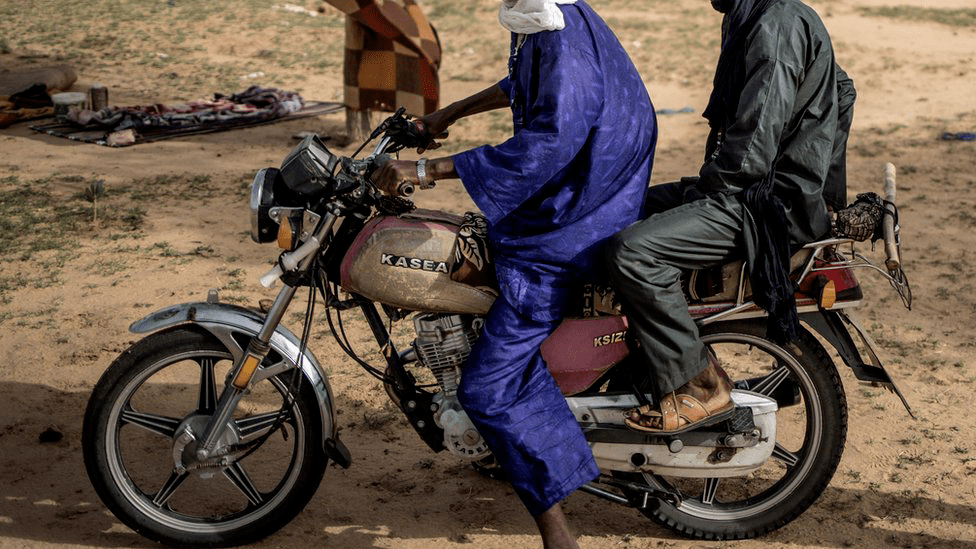

Nigeria is a country where reality regularly out-fictions Hollywood. But a recent viral video from Katsina State might have just clinched the Oscar for Best Surreal Suspense Thriller.
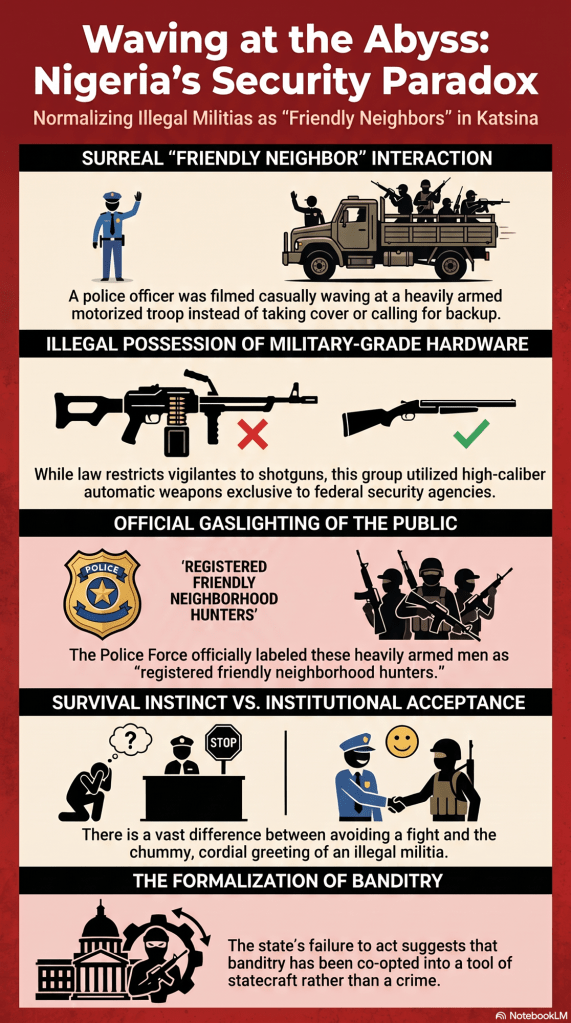
In the footage, a heavily armed, highly mobile troop of men cruises down the road. They aren’t exactly rocking bows, arrows, and Dane guns. No, this crew looks like they just ransacked an action movie set. Enter our protagonist: a lone Nigerian police officer who, instead of diving into the nearest bush or calling for backup, casually waves at them like he’s greeting his favorite neighbor returning from a grocery run.
Naturally, the internet went into a tailspin. But don’t worry, the Nigerian Police Force quickly stepped in with a masterclass in gaslighting. According to the official statement, these were not bandits. They were wait for it “friendly neighborhood hunters and vigilantes” registered by the government. Move over, Spider-Man; Katsina has a new friendly neighborhood hero, and they come with belt-fed machine guns.
This explanation leaves us with two distinct, equally terrifying scenarios. Let’s break them down.
Scenario A: The “Legal” Loophole (Where the Law Goes to Die)
Let’s play devil’s advocate and accept the police narrative. These men are registered local vigilantes. Great! Splendid! Wonderful!
Just one tiny, nagging question: Who bought the heavy artillery?
The Law of the Land: Under current Nigerian law, the monopoly on high-caliber automatic weapons belongs strictly to the state’s military and federal security agencies. Local hunters and vigilantes are legally restricted to single-barrel shotguns and local rifles.
If these “hunters” are rolling around with military-grade hardware, we have a major systemic glitch:
- Is the Katsina State Government running a rogue arms procurement program?
- Are local vigilantes now outgunning the regional police?
- Why is the police force turning a blind eye to a blatant breach of federal firearms laws?
If the state is funding and arming militia groups under the guise of “vigilantism” to bypass federal control, the rule of law hasn’t just left the building—it has fled the country.Scenario B: “Houston, We Have a Bandit Problem”
Now, let’s pivot to what the cynical public actually believes: these men were bandits, and they own the road.
If this is true, the friendly wave from our traffic-controlling officer takes on a chilling new meaning. Look, nobody expects a lone policeman armed with a prayer and a rusty AK-47 to engage a motorized troop of bandits. Survival instinct is real, and self-preservation is a valid human reaction.
But there is a vast gulf between not committing suicide and giving a chummy, cordial wave.
[Terrorist Militia Passes By] Standard Procedure: Take cover, observe, report. The Katsina Remix: "Hey guys! Safe travels! Smash that like and subscribe button!"
The wave speaks to a state of mind. It implies familiarity, acceptance, and a mutual understanding that the road belongs to the guys with the biggest guns.
Even worse is the police command’s frantic rush to deflect, sanitize, and rewrite the narrative. When the institutional response to a heavily armed militia is to put on a PR cape and defend them, it forces us to ask a dark question: Has banditry transitioned from a security crisis into a state-sanctioned industry?
The Nigerian Way: Time to Pull Up to the Negotiating Table?
If we are being honest with ourselves, if banditry has indeed become a tool of statecraft, maybe we are looking at this all wrong. Maybe we should stop fighting and do what Nigeria does best: settle.
Historically, we are masters of the compromise.
- We “settled” the aftermath of the Civil War.
- We “settled” the Niger Delta militancy with lucrative amnesty checks and pipeline surveillance contracts.
- We “settle” political beefs with handshakes and shared oil blocks.
If the state has decided that controlling bandits is impossible, and has instead chosen to co-exist with (or co-opt) them, then let’s formalize it. Let’s create the Federal Ministry of Banditry and Strategic Wealth Redistribution. Let’s put them on the payroll, give them official hazard allowances, and allocate them a budget line in the National Assembly.
At least then, when a policeman waves at them on a Katsina highway, we can comfort ourselves with the knowledge that he’s just greeting a fellow civil servant on his way to the office.


A thought-provoking and well-written piece. It raises important questions about security, accountability, and public trust. Every society deserves transparency, the rule of law, and institutions that protect its people. I sincerely hope for a future where peace, justice, and safety become the reality for every community.
LikeLiked by 1 person
You are too kind with your kind comments, I am grateful 🙏🏿
LikeLiked by 1 person
It’s my pleasure 😊
LikeLiked by 1 person