



One resisted to comment on the recent ruling of the Honorable Mr. Justice Adama Hamma Isa Dashen of the Federal High Court sitting in Lokoja regarding the National Democratic Congress (NDC) matter until a certified true copy of the judgement became available. Now that it has, one’s belief system is suspended.
One is left wondering why the learned trial judge agreed to an appeal against his own judgement and set aside his judgment of December 2025.
In that originating case, the Independent National Electoral Commission (INEC) was the sole defendant and ordered to register the NDC as a political party. That order was obeyed, and the NDC was duly registered.
Enter the Peace Movement Party (PMP), an association that was not a party to that original judgment. On May 5, 2026, the PMP filed an application with two very distinct prayers:
- Prayer One: An extension of time to apply to set aside the judgment.
- Prayer Two: An order setting aside the said judgment.
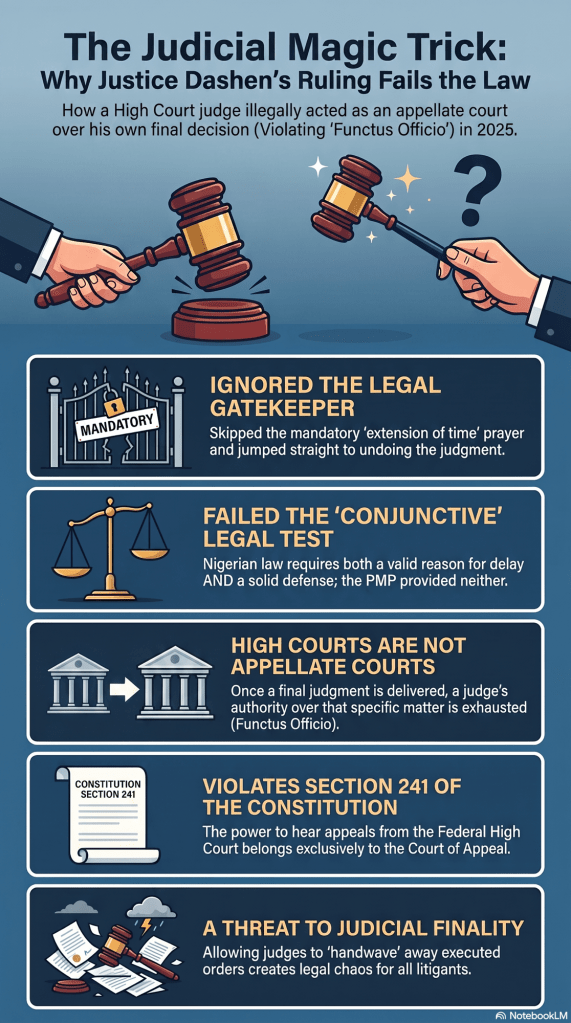
- Justice Dashen carefully listed both prayers in his ruling. Yet, when it came to doing the actual judicial math, his Lordship completely ignored Prayer One. He skipped right past the legal gatekeeper of “extension of time” and went straight to killing the judgment. Why? Nobody can hazard a guess. But was his Lordship legally right? Not by a long shot.Justice Dashen carefully listed both prayers in his ruling. Yet, when it came to doing the actual judicial math, his Lordship completely ignored Prayer One. He skipped right past the legal gatekeeper of “extension of time” and went straight to killing the judgment. Why? Nobody can hazard a guess. But was his Lordship legally right? Not by a long shot.
The Legal Conjunctive: You Can’t Have One Without the Other
It is an foundational principle of Nigerian law that when a party shows up late to the party and wants a default or regular judgment set aside, they face a double-barrelled legal hurdle. They must satisfy two conditions:
- A good and substantial reason for the failure to appear or the delay in filing.
- A prima facie defence on the merits (usually by showing a proposed statement of defence disclosing triable issues).
These conditions are conjunctive, not disjunctive. You cannot pick and choose. You need both, and failing one is fatal. In fact, you have to clear the first hurdle (explaining the delay) before the court can even look at the second.
The Supreme Court has beaten this drum for decades: - Williams vs. Hope Rising Voluntary Funds Society: The apex court held that an applicant must show good reasons for the default and disclose a defence on the merits.
- Nalsa & Team Associates vs. NNPC: Reaffirmed that the reason for default and a triable defence must coexist.
- Skenconsult (Nig.) Ltd. vs. Ukey & A.C.B. Plc vs. Losada (Nig.) Ltd: Re-emphasized that the court’s discretion depends entirely upon satisfying these recognized, combined conditions.
- Macaulay vs. NAL Merchant Bank Ltd: Absolute prerequisites. No shortcuts allowed.
- Justice Dashen bypassed this entire body of jurisprudence. He did not interrogate why the PMP waited until May 2026 to attack a December 2025 judgment that had already been complied with. By leaving out this fundamental judicial function, we are left in the dark about what truly informed his decision. It leaves a distinct impression that there is more to this case than the public knows.
The Vexed Issue: A High Court is Not an Appellate Court Over Itself
This brings us to the deeper, structurally vexed issue embedded in this bizarre ruling. By setting aside his own substantive judgment without the applicant clearing the necessary statutory hurdles, the Federal High Court essentially acted as an appellate court over its own decision.
In Nigerian jurisprudence, a High Court is not vested with an appeal right against its own judgment. Once a judge delivers a final judgment on the merits, they become functus officio their authority over that specific matter is exhausted.
1. The Constitutional and Statutory Barrier
Under Section 241 of the 1999 Constitution of the Federal Republic of Nigeria (as amended), the jurisdiction to hear appeals from the Federal High Court lies exclusively with the Court of Appeal. A High Court judge possesses no constitutional mandate to sit in judgment over their own prior final decisions.
Statutorily, while the Federal High Court Rules allow a court to set aside its own judgments under very narrow, specific parameters (such as a judgment obtained by fraud, or a default judgment where a party was never served), it cannot do so by ignoring procedural rules.
2. The Caselaw Precedent
The courts have long guarded this boundary to prevent judicial chaos and guarantee the finality of litigation.
- In the locus classicus Yanaty Petrochemical Ltd v. EFCC (2017), the Supreme Court made it clear that a court cannot sit on appeal over its own judgment, nor can it review it except to correct clerical errors or slips (under the “slip rule”).
- In Minister of Agricultural Research & Water Resources v. Muuri (2014), the court reiterated that if a judge is unhappy with their own conclusion upon deeper reflection, they cannot change it; that correction belongs strictly to a higher court.
By jumping straight to setting aside the judgment without finding a legally sound, time-extended reason to do so, the lower court took a sledgehammer to the principle of finality. If a High Court can simply handwave away its own final orders months after they’ve been executed, then no litigant can ever sleep soundly. The NDC matter shouldn’t have been “undone” in Lokoja; if the PMP had a grievance, the proper route was a trip to the Court of Appeal. Instead, we got a judicial magic trick that defies the law.
 Centre for Nigeria Progress